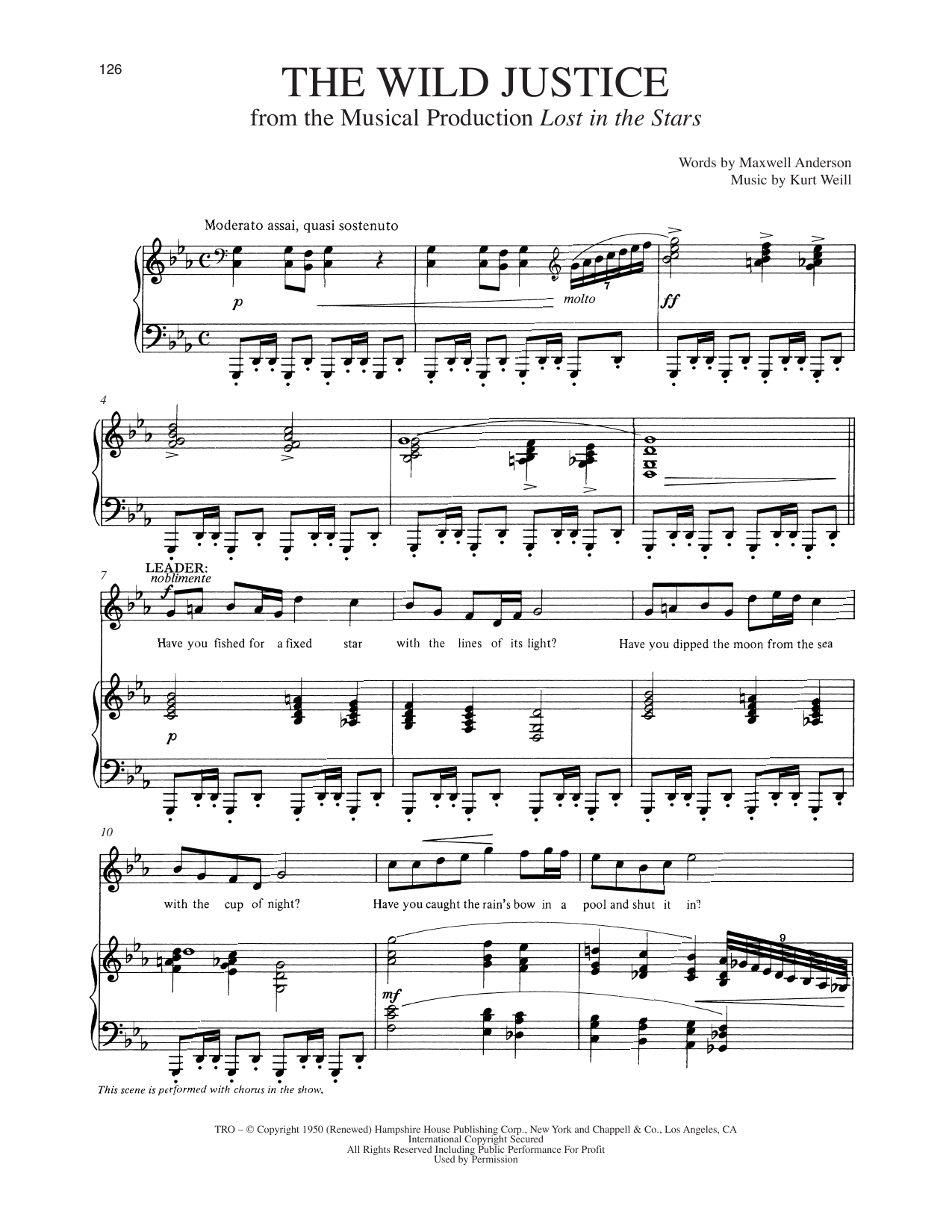
The Wild Justice (from Lost In The Stars) Sheet Music Preview

The Wild Justice (from Lost In The Stars): Piano Vocal

As performed by Maxwell Anderson / Edited by Richard Walters

Item: 35-DS01920965

Digital Download
$5.99
Description

The Wild Justice (from Lost In The Stars): Piano Vocal isn't in MakeMusic Cloud just yet...but it could be. Let us know you'd like to see it, and you'll help shape what comes next. In the meantime, start a free trial and dive into thousands of interactive titles your students can play along with today.

Sample Audio
No sample audio found.
Sample Video
Additional Details
Publisher: Hal Leonard
Page Count: 7
SKU: 35-DS01920965

More about this title

About the Artist: Maxwell Anderson

Maxwell Anderson was an American dramatist and lyricist whose theatrical works spanned decades of Broadway and opera composition. His collaboration with composer Kurt Weill on Lost in the Stars (1949) stands as a landmark achievement in American musical theater, bringing moral urgency and sophisticated musical language to the Broadway stage.

Anderson's approach to songwriting prioritized lyrical substance and emotional authenticity. His texts demand singers who can handle both dramatic weight and vocal nuance, making his work particularly valuable for students exploring the intersection of theater and art song.

Why we love this

This song sits at the intersection of Broadway sophistication and art song sensibility in ways that challenge advanced singers. The text carries real philosophical weight without sacrificing singability, and the piano writing supports rather than overwhelms the voice. Programming this signals to your audience that you're serious about repertoire depth.

What to expect

Introspective and searching, with an undercurrent of moral questioning. The music unfolds with the kind of restraint that paradoxically demands intense emotional focus from the singer. It's contemplative without being precious.

Who it's for

Advanced vocalists preparing art song repertoire or students exploring the art-song traditions within American musical theater. This works equally well for classical singers looking to expand into American song and for theater vocalists seeking material with genuine musical substance.

How to get the most out of it

  • Approach the text as poetry first. Anderson's lyrics reward careful attention to phrasing and word stress; let the natural speech rhythms emerge through the musical line.
  • Balance legit vocal production with theatrical storytelling. The song needs both technical security and emotional immediacy.
  • Collaborate closely with your pianist on tempo and rubato. This piece breathes better when conductor and accompanist share a unified interpretation.

How to use it

Pair this with other American art songs or early Weill works to frame a concert exploring the intersection of theater and concert music. It works particularly well as a solo recital piece that showcases interpretive maturity, or as part of a thematic program addressing justice, faith, or human resilience.

Skills your students will build

  • Legit vocal production balanced with dramatic expression
  • Lyrical interpretation grounded in textual meaning
  • Sustaining emotional through-line across longer phrases
  • Collaborative interpretation with piano accompaniment
  • Navigation of sophisticated harmonic language typical of mid-century American theater

You May Also Like