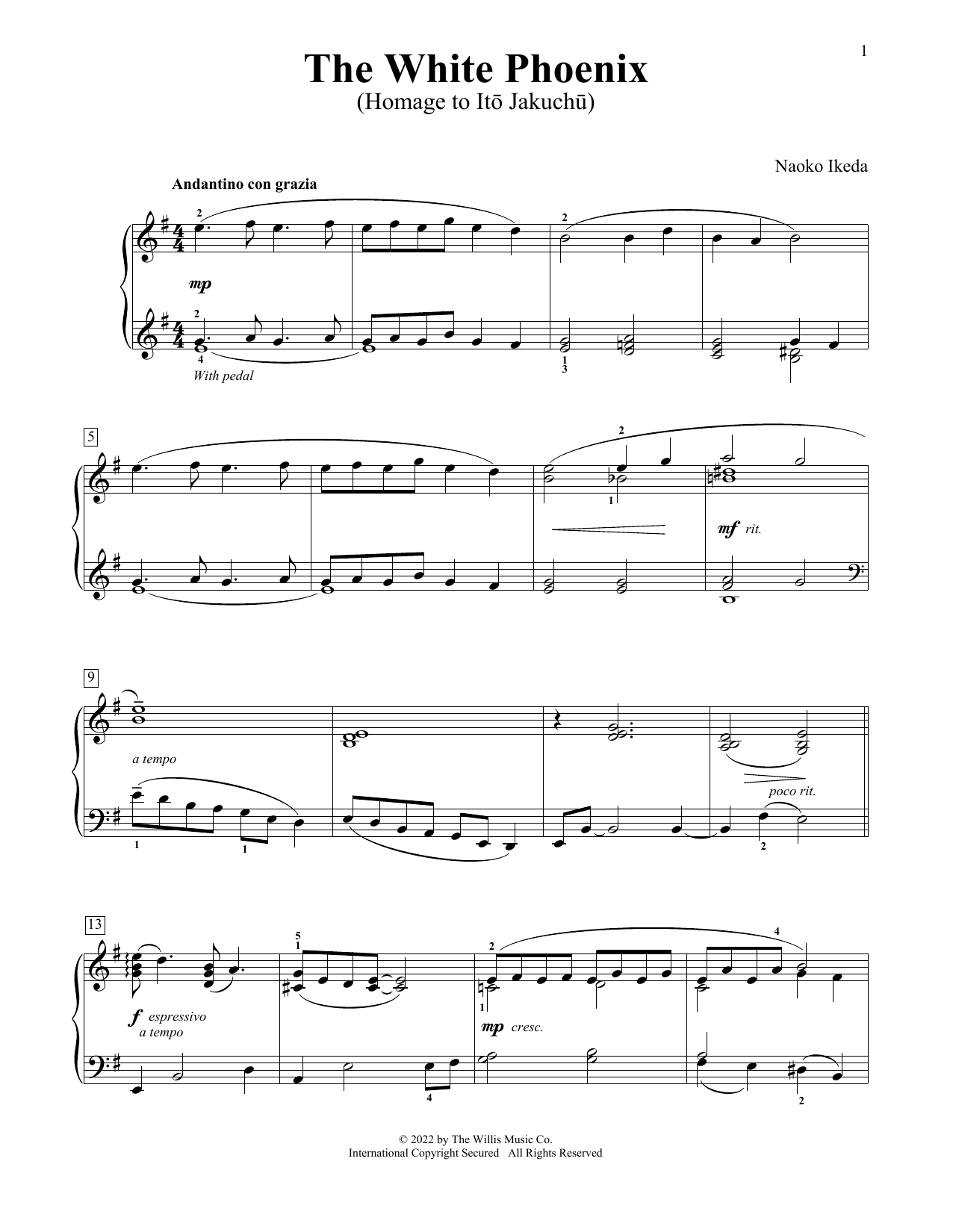
Naoko Ikeda is a Japanese composer whose work often draws inspiration from traditional art and nature, translating visual imagery into musical form. Her pedagogical compositions demonstrate sophisticated harmonic language while remaining accessible to advancing students, making her a valued voice in contemporary educational piano repertoire.
Why we love this
Ikeda's homage to the 18th-century Japanese painter Ito Jakuchu captures something rare in educational repertoire: genuine artistic depth without pretension. The piece respects both the student's developing abilities and the artistic integrity of its visual inspiration, making it rewarding to learn and genuinely interesting to hear.
What to expect
The piece unfolds with the contemplative quality of observing a carefully composed artwork, finding movement and vitality within restraint. Colors shift subtly across the keyboard, suggesting the layered precision and natural beauty found in Jakuchu's botanical paintings.
Who it's for
This three-page work suits intermediate pianists ready to explore contemporary classical writing with literary and visual dimensions. It works well for students developing artistic interpretation alongside technical skills, and fits naturally into recital programs or studio repertoire.
How to get the most out of it
Consider the architectural balance of the piece as you practice; each phrase should breathe with intentionality rather than rushing forward.
Pay close attention to dynamic markings as a guide to emotional shape. The quieter passages often carry as much weight as the more sonorous moments.
Experiment with pedal changes at phrase boundaries to clarify harmonic shifts without muddying the texture.
How to use it
Include this alongside traditional classical works to demonstrate how contemporary composers engage with historical inspiration. Its concise length makes it ideal for student recitals or as a transition piece between larger works in a mixed program.
Skills your students will build
Pedal control and tonal color differentiation
Interpretation of dynamic nuance in modern harmonic language
Phrase architecture and structural awareness
Understanding music's relationship to visual art and imagery
You May Also Like
Scan to Complete Your Purchase
Use your phone's camera to scan the code below
You'll log in on your phone and the order will be added to your account