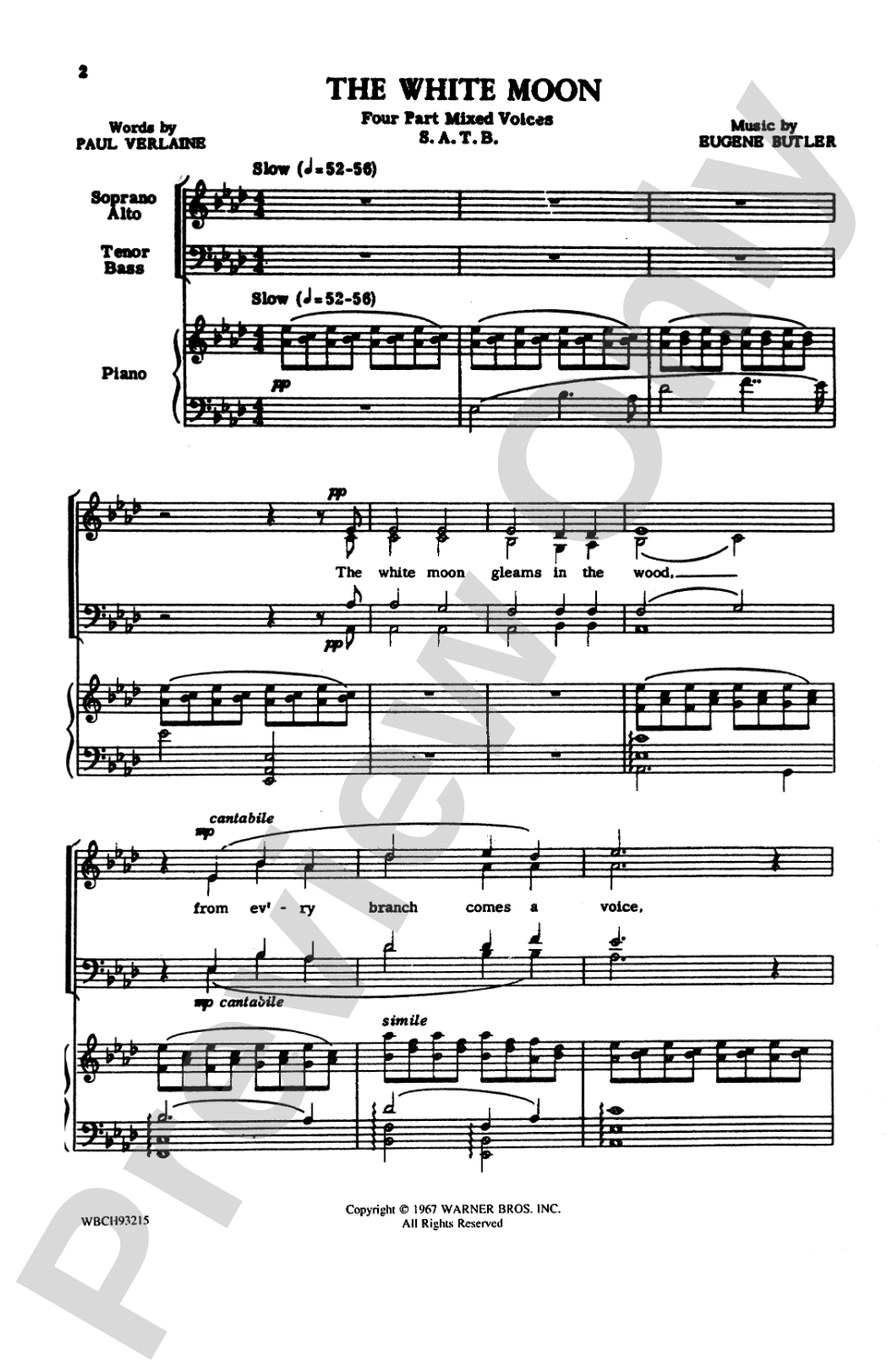
The White Moon Sheet Music Preview

The White Moon: SATB Choral Octavo

By Eugene Butler

Item: 00-PO-0003103

Digital Download
$2.25

Minimum order quantity: 20 copies

One moment…

Description

The White Moon: SATB Choral Octavo isn't in MakeMusic Cloud just yet...but it could be. Let us know you'd like to see it, and you'll help shape what comes next. In the meantime, start a free trial and dive into thousands of interactive titles your students can play along with today.

Sample Audio
No sample audio found.
Sample Video
Additional Details
Series: Alfred Archive Edition: Alfred Choral Designs
Publisher: Alfred Music
Page Count: 8
SKU: 00-PO-0003103

More about this title

About the Composer: Eugene Butler

Eugene Butler

Eugene Butler brings decades of experience as a composer, conductor, and educator to every work he writes. His credentials span prestigious institutions including Oklahoma University, Union Theological Seminary, and the University of Missouri-Kansas City, where he earned his doctorate in composition. Butler has been recognized consistently throughout his career with honors including Kansas Composer of the Year, the ASCAP Standard Music Panel Award annually since 1972, and a National Teaching Excellence Award. His prolific output exceeds 650 published compositions across 47 publishing houses, with his music performed thousands of times each week across English-speaking countries.

Beyond composition, Butler shaped American choral and church music through his work as Director of Choral Activities at Johnson County Community College and as a conductor of regional civic choirs. He has served as an adjudicator and clinician in 39 states, three Canadian provinces, and England, leading workshops on composition, choral technique, and new music repertory. His influence extends from the concert hall to the church, from the classroom to the festival stage.

Why we love this

Butler's command of SATB writing is evident in the clean, singable lines that make this piece accessible without sacrificing musical substance. The contest and festival designation signals that this octavo rewards thoughtful preparation while remaining within reach of capable high school and community choirs. Its secular text and moderate demands make it a natural fit for mixed programs where you need something with genuine musical weight.

What to expect

The White Moon carries a poetic sensibility that invites singers to explore lyrical phrasing and expressive nuance. The piece balances accessibility with musical sophistication, offering moments of harmonic interest that reward careful listening without demanding virtuosic technique. There's an understated elegance here that lets the text and melody breathe.

Who it's for

This octavo works well for intermediate to advanced high school choirs and community ensembles preparing for festival or contest settings. The SATB voicing assumes secure part singers who can maintain independent lines while listening to the overall harmonic texture. The eight-page length and contest-appropriate difficulty level make it suitable for groups seeking substantial repertoire that doesn't require extensive rehearsal time.

How to get the most out of it

  • Balance the phrase contours across all four voices so no single line dominates; Butler's writing asks for transparency, not blend.
  • Attend to text stress and natural speech patterns; the lyrics should propel the rhythm rather than fight against it.
  • Shape each section with clear harmonic direction; this piece rewards singers who understand where the chords are moving.

How to use it

Include this alongside Butler's other secular works or pair it with contemporary choral literature for a concert that showcases mixed voices in varied harmonic languages. Its festival-ready status makes it an excellent choice for concert programs built around theme, season, or a mix of traditional and modern American repertoire. The moderate length and balanced voicing also make it workable as a changeable piece on larger concert formats.

Skills your students will build

  • Sustaining independent voice lines in SATB texture
  • Shaping lyrical phrases with appropriate text declamation
  • Listening for harmonic movement and major/minor inflections
  • Balancing blend across register changes

You May Also Like