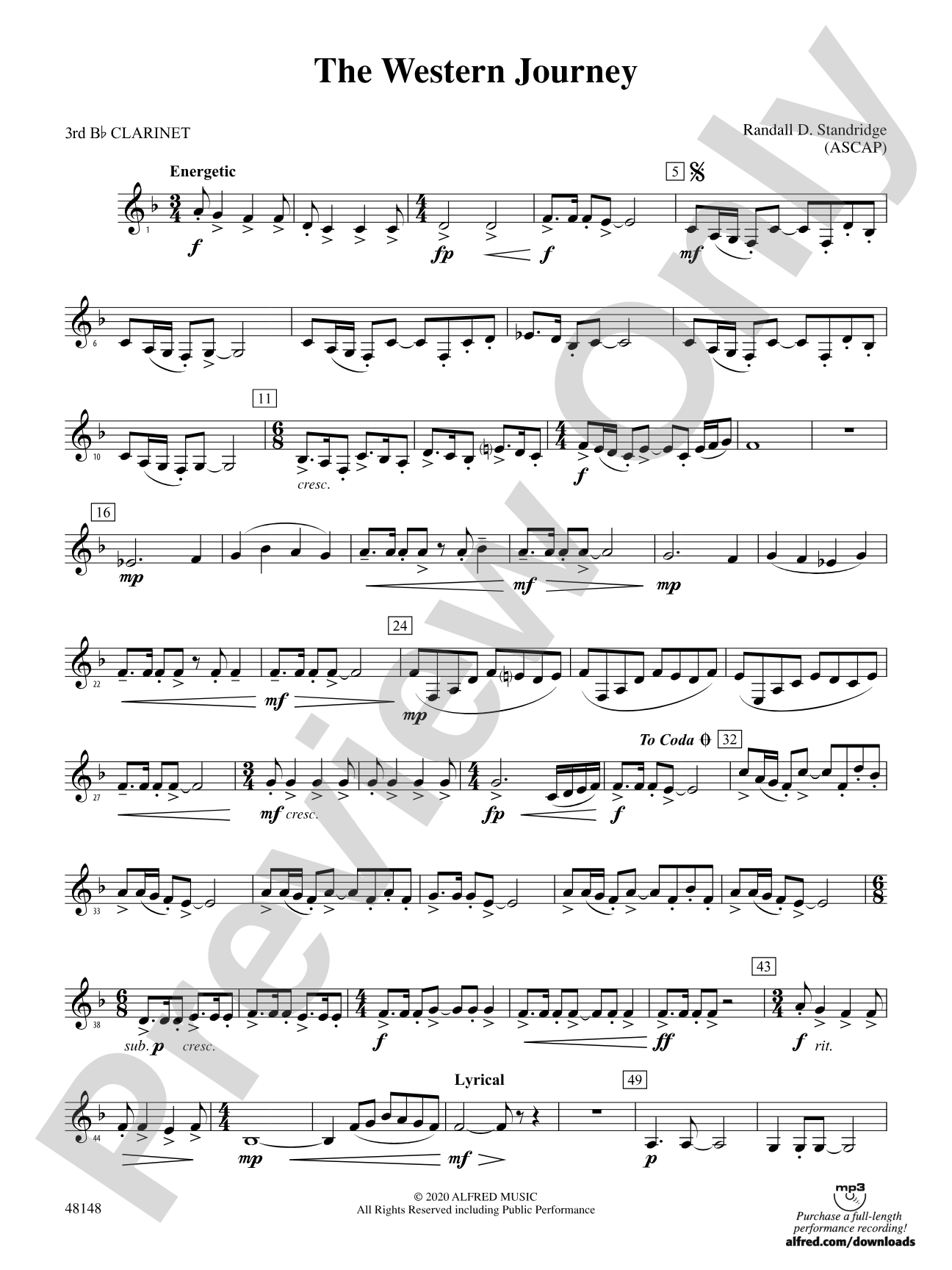
The Western Journey: 3rd B-flat Clarinet Sheet Music Preview

The Western Journey: 3rd B-flat Clarinet

By Randall D. Standridge

Grade: 3.5 (Medium)

Item: 00-PC-0018463_C3

Digital Download
$3.00
Description
Inspired by thoughts of the early American pioneers, this cinematic overture captures the essence of scores written for Westerns. It depicts travel to the western mountains, desert, and Great Plains and the sheer size of the landscape and vast openness. (4:30)

Don't just read it, hear it, play along with it, and watch your students grow with it. In MakeMusic Cloud, The Western Journey: 3rd B-flat Clarinet comes alive with professional accompaniment, adjustable tempo, and built-in practice tools that turn solo practice into real progress.

Sample Audio
0:00
0:00
Sample Video
Additional Details
Series: Alfred Concert Band
Publisher: Alfred Music
Page Count: 296
SKU: 00-PC-0018463_C3

More about this title

About the Composer: Randall D Standridge

Randall D Standridge is a prolific composer and arranger whose work appears regularly on concert band and wind ensemble programs across North America. His compositions span multiple genres and difficulty levels, earning recognition for their musicality, clear orchestration, and appeal to both student and professional ensembles.

Standridge has become known for writing accessible yet sophisticated concert band music that challenges young musicians without overwhelming them. His pieces often draw on Americana themes, film scoring techniques, and strong melodic writing that engages audiences and performers alike.

Why we love this

Standridge captures the visual sweep of Western cinema without resorting to cliché, allowing your band to paint a genuine landscape through sound. The Grade 3.5 difficulty strikes the right balance: students get to play substantial, rewarding material while you maintain control over balance and phrasing. At four and a half minutes, it lands perfectly for festival competition or as a centerpiece of a concert program without dominating the second half.

What to expect

The music unfolds like a journey across American terrain: you move through moments of quiet wonder and wide-open space punctuated by surges of forward momentum. Cinematic without being overwrought, the score invites listeners into the scale and scope of the landscape as much as the human story moving through it.

Who it's for

This work suits Grade 3.5 concert bands seeking programming that stands beyond the typical student repertoire. Teachers preparing ensembles for festival competition or concert performances will find a piece that sounds confident and complete while remaining within student technical grasp.

How to get the most out of it

  • Shape the opening themes with purposeful rubato rather than metronomic precision; the pioneer spirit emerges through slightly elastic phrasing that suggests both fatigue and resolve.
  • Balance your brass section carefully in the full-ensemble passages. The orchestration likely calls for prominent horns and trumpets, but clarity of inner voicing matters more than sheer volume.
  • Use the dynamic contrasts to clarify structural sections. Moving from desert stillness to Great Plains expansiveness requires distinct color and energy levels rather than simply turning up the volume.
  • Attend to the percussion parts as landscape elements, not just timekeeping. Timpani, cymbals, and mallets should evoke environment alongside melody.

How to use it

Open your spring concert or festival set with this overture to establish a sophisticated tone and capture attention immediately. It pairs well with lighter, shorter pieces afterward, allowing your strongest ensemble moment to lead the program. For festival contests, the Grade 3.5 rating and strong musical substance make it competitive without overshooting your ensemble's capabilities.

Skills your students will build

  • Sustaining long, shaped melodic lines across phrase boundaries
  • Balancing full-ensemble texture with clarity of inner parts
  • Responding to subtle dynamic and tempo shifts that create musical architecture
  • Interpreting cinematic expression in instrumental music
  • Maintaining ensemble cohesion during key and tonal shifts

You May Also Like