
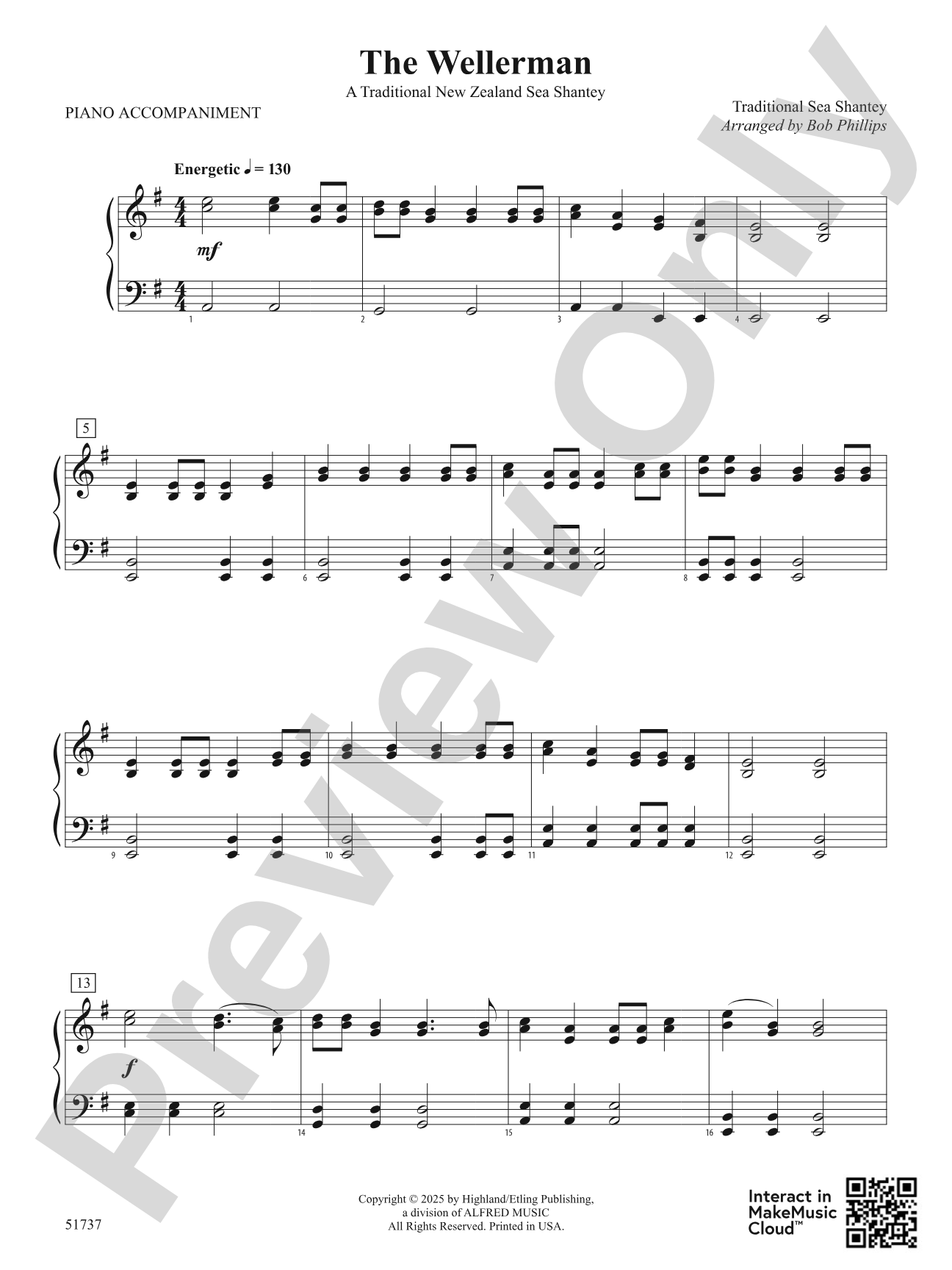

The Wellerman: Piano Accompaniment
A Traditional New Zealand Sea Shantey
Traditional Sea Shanty / arr. Bob Phillips
Grade: 1
Item: 00-PC-0019398_K
$3.00
Pickup currently not available
Description
Rousing sea shanteys are a popular listening trend, and here is one, arranged by Bob Phillips, that students can soon play! Perfect for most second-year players or even those at the end of the first year of instruction, this catchy folk tune, The Wellerman, uses quarter notes, paired eighths, and dotted quarters. The cello and bass parts are doubled, everyone gets the melody, and everyone stays primarily in first position. Most likely originating in the 1830s in New Zealand, the lyrics describe waiting for supplies to be delivered by ship by the Wellerman brothers. (1:45)


Don't just read it, hear it, play along with it, and watch your students grow with it. In MakeMusic Cloud, The Wellerman: Piano Accompaniment comes alive with professional accompaniment, adjustable tempo, and built-in practice tools that turn solo practice into real progress.
Open in the Player
Jump straight in and assign it today.
Start Your Free Trial
Open this title and explore the full library in minutes.
Sample Audio
1
Audio File
--:--
0:00
0:00
Sample Video
Additional Details
Series:
Sound Innovations Series for Strings
Publisher:
Alfred Music
SKU:
00-PC-0019398_K
More about this title
About the Arranger: Bob Phillips

Bob Phillips has spent decades shaping string education through innovative pedagogy and prolific composition. Since 1953, he has created over 200 works for orchestras and bands, establishing himself as a leading voice in making classical and eclectic styles accessible to student musicians. His Sound Innovations series alone has reached thousands of young string players, and his expertise in large ensemble teaching has informed everything from his arrangements to his conductor training.
For 27 years, Phillips built the string program in Saline, Michigan into a national model, eventually directing an ensemble that performed 80 shows annually and appeared at the White House and the Midwest Clinic. His work extends beyond the classroom: he founded the Saline Fiddlers Philharmonic, served as resident conductor for the Wintergrass Festival, and has guest conducted at state and all-state orchestras across the country. An ASCAP award winner, Phillips remains committed to demonstrating that rigorous musicianship and stylistic range belong together in string education.
Why we love this
Phillips knows exactly how to pace early repertoire so students stay engaged without feeling overwhelmed. The Wellerman moves at the right speed for second-year players while keeping the folk melody front and center, and the doubled lower voices mean your whole section sounds full immediately. It's the kind of piece that builds genuine confidence.
What to expect
Robust and propulsive, like a crew hauling rope to a shared rhythm. The doubling of lower voices creates a solid harmonic anchor while the melody passes around the ensemble, and the dotted-quarter figures give the whole piece a nautical stride. Playable doesn't mean dull here; students hear themselves making something full-voiced and alive.
Who it's for
Second-year string orchestra students will play this comfortably, though strong first-year ensembles can reach it by spring. This is also ideal for students who need repertoire that feels immediately rewarding; the folk melody and rousing character appeal to young musicians still building their confidence on their instruments.
How to get the most out of it
- Keep the pulse steady and energetic throughout. The shantey character demands rhythmic clarity, so lock in your tempo before rehearsal starts and maintain it even when players are still learning their parts.
- Encourage the string sections to listen across parts rather than inward. Since everyone plays the melody at different points, trading phrases creates the rousing effect Phillips built into the arrangement.
- Balance the harmonic foundation in cello and bass; the doubled parts give you room to let those lines breathe without losing support for the upper voices.
- Work the dotted quarter rhythms early and separately. Once that figure sits solidly, the entire piece clicks into place much faster.
How to use it
Program this early in a concert to establish energy and goodwill with your audience. It pairs well with classical repertoire on the same program because the folk idiom refreshes the ear, and its 1:45 duration leaves breathing room for longer works. Consider it for festival play or winter concerts where an uplifting, accessible piece serves as a anchor point for your ensemble's season.
Skills your students will build
- Reading and executing dotted quarter note rhythms
- Maintaining steady pulse in ensemble settings
- Playing primarily in first position across multiple string parts
- Balancing melody and harmonic foundation when parts trade primary material
- Executing paired eighth note figures with rhythmic precision