The Wayward Wind Sheet Music Preview

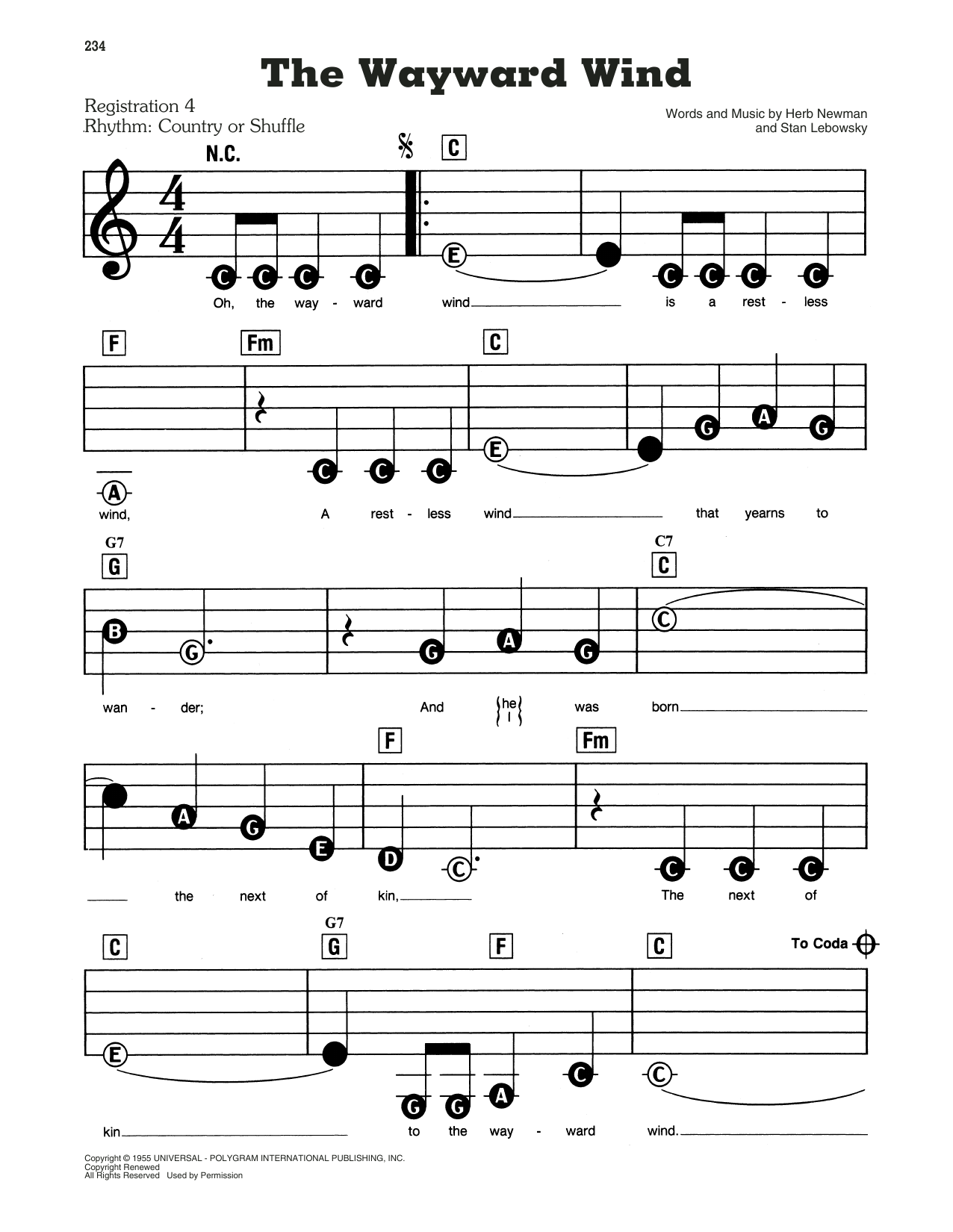
The Wayward Wind: E-Z Play Today

As performed by Gogi Grant / As performed by Patsy Cline

Item: 35-DS00456516

Digital Download
$4.99
Description

The Wayward Wind: E-Z Play Today isn't in MakeMusic Cloud just yet...but it could be. Let us know you'd like to see it, and you'll help shape what comes next. In the meantime, start a free trial and dive into thousands of interactive titles your students can play along with today.

Sample Audio
No sample audio found.
Sample Video
Additional Details
Publisher: Hal Leonard
Page Count: 2
SKU: 35-DS00456516

More about this title

About the Artist: Gogi Grant

Gogi Grant rose to prominence in the 1950s as one of country music's most distinctive vocalists, known for her rich contralto and emotional delivery. Her 1956 recording of "The Wayward Wind" became a crossover hit, establishing her as a bridge between country and pop audiences during a pivotal moment in American music history.

Why we love this

This arrangement captures the wistful, restless quality that made the original memorable without demanding virtuosic technique. Piano students get to explore expressive phrasing and dynamics in a song structure they likely recognize, making it an excellent repertoire choice for building interpretive confidence.

What to expect

A restless journey through open country landscapes, punctuated by moments of longing and quiet contemplation. The melody drifts unhurriedly, supported by straightforward harmonies that feel both familiar and slightly melancholic.

Who it's for

Pianists comfortable with lead sheet interpretation and simple chord changes will find this accessible. It works equally well for students exploring American song standards or for anyone seeking an expressive piece with modest technical demands.

How to get the most out of it

  • Pay attention to the song's narrative arc. The melody traces emotional restlessness, so shape each phrase to reflect subtle shifts in mood rather than playing through mechanically.
  • Balance the vocal melody line with understated accompaniment. The piano's role here is supportive; resist the urge to fill every space with activity.
  • Lean into the rubato possibilities, particularly in the verse sections. Slight temporal flexibility can enhance the wistful character without losing rhythmic clarity.

How to use it

Pair this with other mid-century pop and country crossover pieces for a concert exploring 1950s songwriting. It also serves as a comfortable intermediate-level solo during recitals or as an accompaniment option for singers exploring their jazz and standards repertoire.

Skills your students will build

  • Interpreting melody with dynamic shaping and phrase breathing
  • Reading lead sheet notation and making harmonic choices
  • Balancing vocal support with melodic clarity
  • Applying rubato stylistically within a popular song context

You May Also Like