
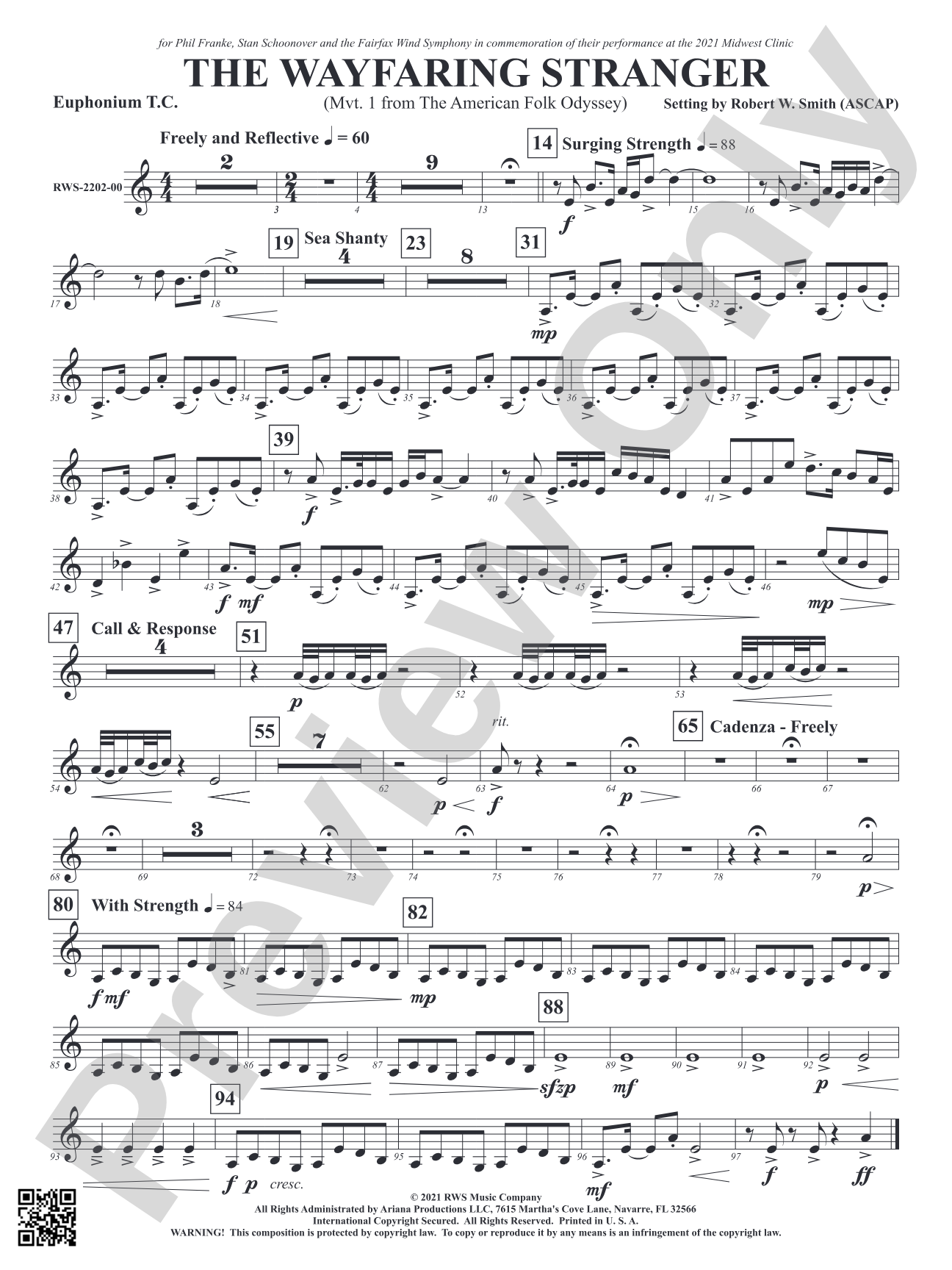

The Wayfaring Stranger - Mvt. 1 from The American Folk Odyssey: Baritone T.C.
Mvt. 1 from The American Folk Odyssey
Arranged by Robert W. Smith
Grade: 4.5
Item: 98-PC-RWS2202_BTC1
$3.99
Pickup currently not available
Description
Based on the American folk song "Poor Wayfaring Stranger", this work for euphonium and band is a movement from "The American Folk Odyssey", a suite for various soloists and concert band. Beginning with a mysterious and lyrical statement of the haunting melody, the piece quickly transitions to the high seas in homage to the early Americans that journeyed by ship to the American continent. The sea chanty setting provides technically rich and effective environment to feature the euphonium with full band interaction while engaging the audience. Following a virtuosic cadenza, the movement concludes in a powerful musical flurry leaving the soloist, band and audience breathless!
Original Item#: RWS-2202-00


Original Item#: RWS-2202-00
The Wayfaring Stranger - Mvt. 1 from The American Folk Odyssey: Baritone T.C. isn't in MakeMusic Cloud just yet...but it could be. Let us know you'd like to see it, and you'll help shape what comes next. In the meantime, start a free trial and dive into thousands of interactive titles your students can play along with today.
Request This Title
Tell us you want it.
Start Your Free Trial
Explore everything that's ready to play right now.
Sample Audio
1
Audio File
--:--
0:00
0:00
Sample Video
No sample videos found.
Additional Details
Series:
RWS - Symphony Band
Publisher:
RWS Music Company
SKU:
98-PC-RWS2202_BTC1
More about this title
About the Arranger: Robert W. Smith

Robert W. Smith stands among the most prolific composers writing for concert band and orchestra in contemporary America, with more than 400 published works spanning both genres. His education at Troy State University and the University of Miami provided the foundation for a compositional voice that has been performed across North America, Europe, Australia, and Asia, from major concert halls to the Olympic Games and network television broadcasts.
As both composer and conductor, Smith has shaped the modern band repertoire through works that balance accessibility with musical substance. His symphonies, including The Divine Comedy and The Odyssey, and staple works like The Tempest have become essential repertoire for developing and advanced ensembles alike. His work as a clinician and guest conductor across multiple continents has made him a trusted voice in music education.
Why we love this
Smith transforms a grave and introspective American spiritual into something far more theatrical and virtuosic. The arc from mysterious opening through rollicking sea chanty to euphonium cadenza gives your band a complete dramatic journey in a single movement, and the scoring ensures full ensemble engagement rather than relegating the band to accompaniment duty.
What to expect
The piece opens like a prayer, with the haunting melody floating above quiet band support. Then the sea breaks into the music; rhythms sharpen, the tempo quickens, and suddenly you're on deck with sailors and salt spray. The euphonium cuts through it all with brilliance before the final wave crashes down, leaving everything transformed.
Who it's for
This movement works for concert bands at the upper intermediate level (Grade 4.5) with a capable euphonium soloist who can handle both lyrical playing and virtuosic passages. It appeals to programs looking for American repertoire with cross-curricular potential and to directors seeking a showpiece that features the euphonium without compromising ensemble musicianship.
How to get the most out of it
- Shape the opening melody with restraint. The "mysterious and lyrical" character depends on space and resonance in that initial statement; allow the audience to lean in and listen.
- Balance the euphonium soloist carefully during the sea chanty section. The piece asks for full band interaction, which means the soloist must project above the texture without the band receding into mere accompaniment.
- Prepare the ensemble for the rhythmic energy of the sea chanty setting. The technical richness Smith mentions will demand precise articulation and rhythmic clarity from your sections.
- Build momentum into the cadenza and final section. The "powerful musical flurry" works only if the band understands the dramatic trajectory and commits to the accelerating energy rather than playing note-for-note.
How to use it
Program this as a concert centerpiece or festival entry when you have a strong euphonium soloist who can carry both the vulnerability of the opening and the swagger of the sea chanty. It pairs well with other Smith works or other Americana selections, and the dramatic arc makes it memorable as either an opening or mid-concert statement.
Skills your students will build
- Playing lyrical, exposed melodies with breath control and phrasing (euphonium)
- Maintaining rhythmic precision during fast-moving accompaniment figures
- Balancing a solo voice within a full ensemble texture
- Interpreting contrasting musical characters (mysterious, nautical, virtuosic) within one movement
- Executing technical figures at performance tempo with clarity