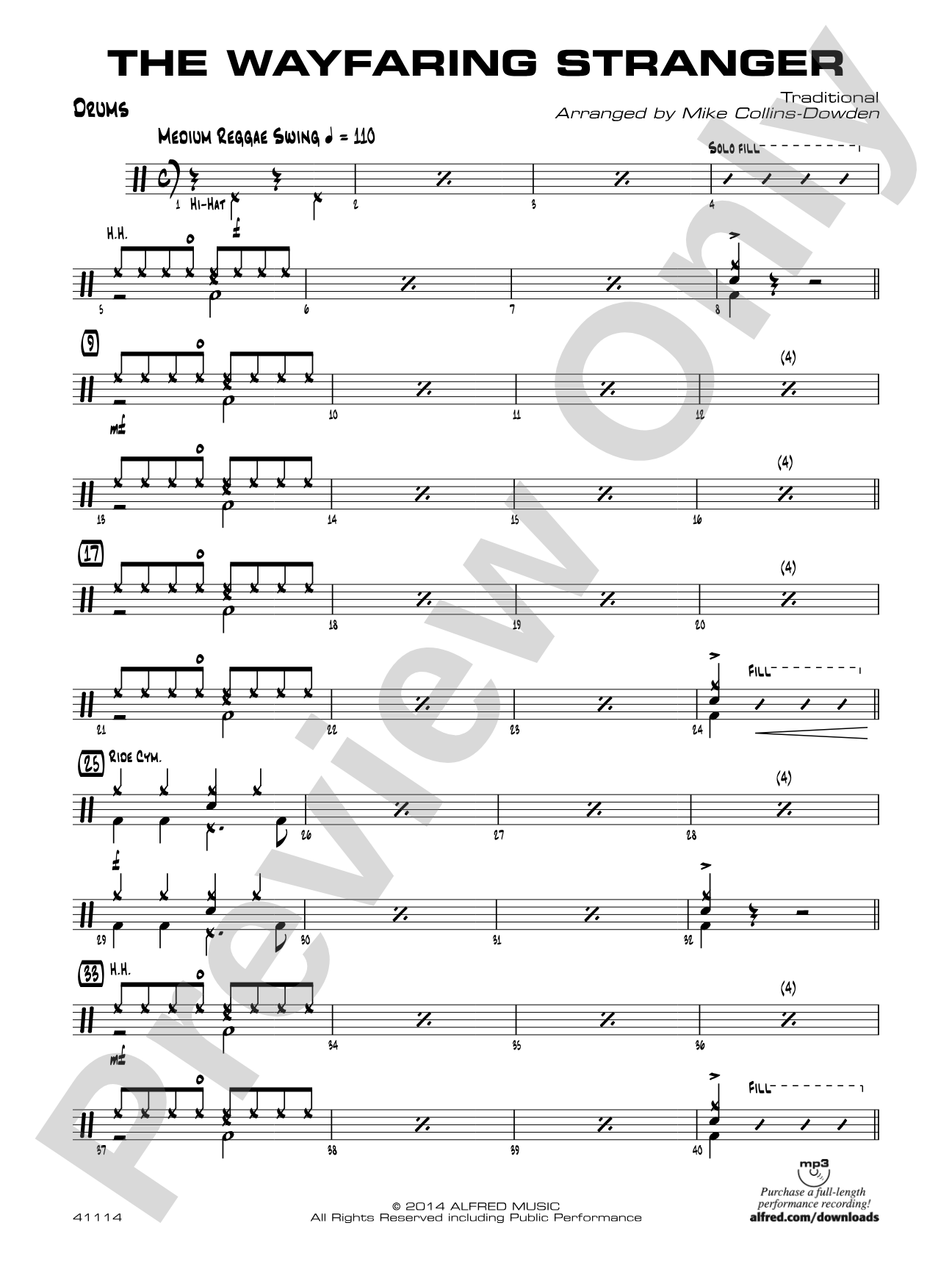
The Wayfaring Stranger: Drums Sheet Music Preview

The Wayfaring Stranger: Drums

Traditional / arr. Mike Collins-Dowden

Grade: 1 (Easy)

Item: 00-PC-0016254_D

Digital Download
$3.00
Description
A reggae-swing feel at 110 BPM. A modern spin on a traditional tune with written solos for trombone 1 and alto sax 1, and trumpet 1 range to written E top space. Includes various optional parts to include vibes. (2:57) This title is available in MakeMusic Cloud.

Don't just read it, hear it, play along with it, and watch your students grow with it. In MakeMusic Cloud, The Wayfaring Stranger: Drums comes alive with professional accompaniment, adjustable tempo, and built-in practice tools that turn solo practice into real progress.

Sample Audio
0:00
0:00
Sample Video
Additional Details
Series: First Year Charts for Jazz Ensemble
Publisher: Alfred Music
Page Count: 86
SKU: 00-PC-0016254_D

More about this title

About the Arranger: Mike Collins-Dowden

Mike Collins-Dowden

Mike Collins-Dowden has directed band at Pleasant Ridge School in Glenview, Illinois since 2007, where he teaches grades 4 and 5. He holds a B.M. in music education and trombone performance from the Eastman School of Music (2003) and an M.M. in music education from Temple University (2007). He performed with the Eastman Wind Ensemble during their 2004 Japan tour.

As both educator and composer, Collins-Dowden writes extensively for young ensembles, drawing directly from his classroom experience. His catalog exceeds 30 published works across concert and jazz band idioms, distributed through Alfred/Belwin, FJH, and Jalen Music. Beyond the classroom, he performs trombone and guitar and has explored music composition on Nintendo Game Boy.

Why we love this

Collins-Dowden's arrangement gives first-year jazz students immediate access to a beloved American spiritual without sacrificing genuine jazz vocabulary. The reggae-swing fusion feels contemporary and engaging rather than reverential, and the straightforward solo assignments (trombone 1 and alto sax 1) invite young improvisers to step into a real jazz tradition without overwhelming them.

What to expect

This arrangement walks a bridge between reverence and groove. The reggae-swing pocket gives the spiritual a contemporary heartbeat while the familiar melody anchors the arrangement in something timeless and warm. Solos emerge organically from the ensemble texture, creating moments of individual voice within the collective sound.

Who it's for

First-year and developing jazz ensembles ready to move beyond basic charts into genuine stylistic territory. Directors seeking repertoire that honors traditional music while meeting young players exactly where they are technically.

How to get the most out of it

  • Keep the reggae-swing feel grounded in the quarter-note pulse; the offbeat emphasis should feel relaxed rather than stiff at 110 BPM.
  • Encourage soloists to listen carefully to the written melody before their entry so the solos feel like a natural extension of the tune rather than a departure from it.
  • Balance the optional vibes parts so they enhance the rhythmic texture without obscuring the ensemble's tuning; use them strategically in section rehearsals to support ear training.
  • Check trumpet 1 range early in rehearsal; the written E in the top space sits comfortably for Grade 1 players with consistent work on upper-register security.

How to use it

Program this early in the jazz season when your ensemble needs encouragement and confidence building. It works beautifully alongside other First Year Charts for Jazz Ensemble to establish your group's stylistic range in a single concert, or pair it with concert band repertoire to demonstrate how your students are growing across both traditions.

Skills your students will build

  • Maintaining swing feel while incorporating reggae rhythmic elements
  • Reading and executing written jazz solos with stylistic authenticity
  • Balancing individual improvisation within ensemble texture
  • Tuning chord changes in a contemporary jazz context
  • Range extension into the upper staff for brass players

You May Also Like