

The Water Is Wide: Piano
Arranged by Lynn Freeman Olson
Level: Early Intermediate
Item: 00-PS-0016217
$3.99
Pickup currently not available
Related Items
The Water Is Wide: Piano Sheet |
$3.50
|
View |
Description
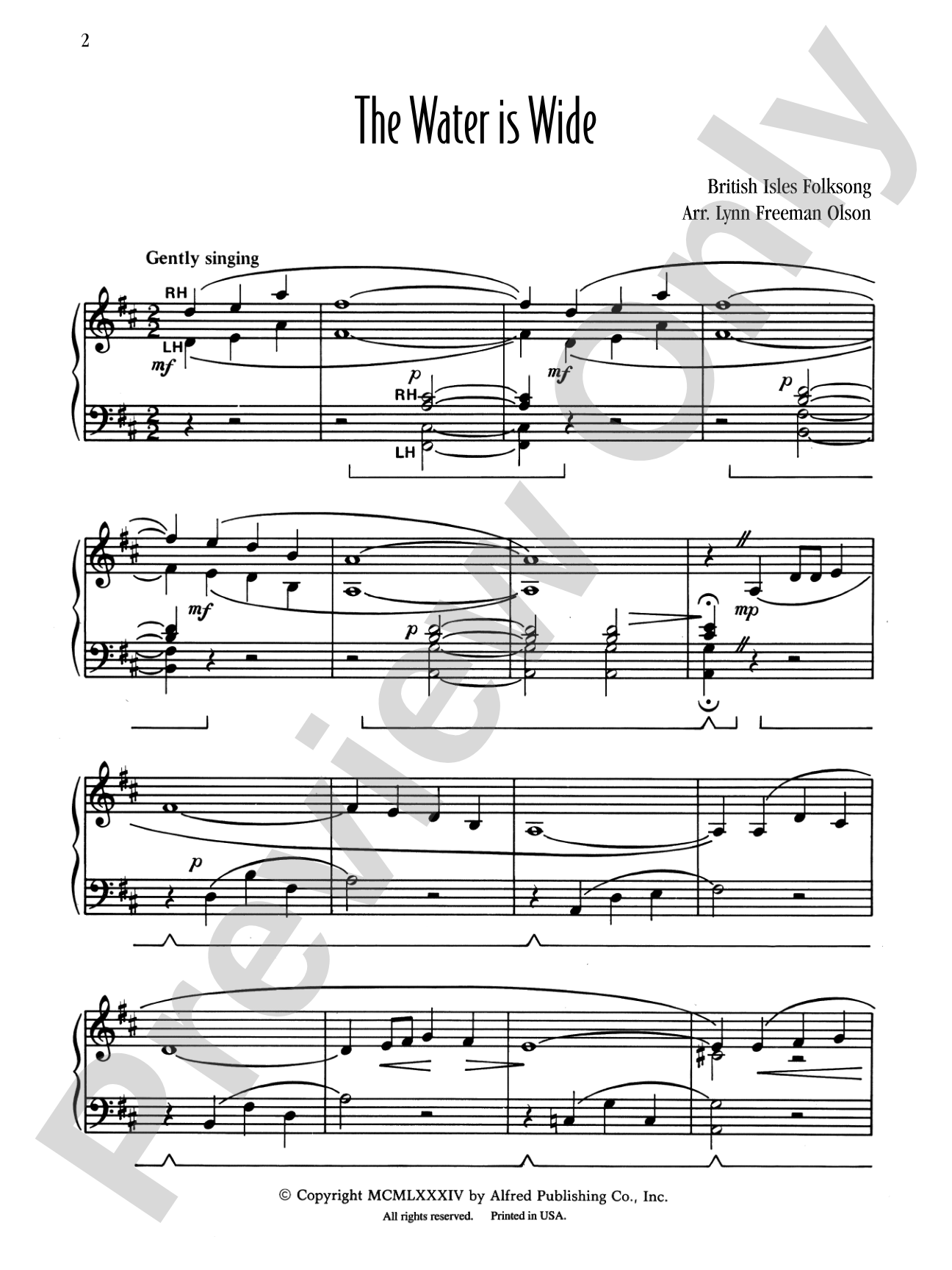
One of the British Isles' most beautiful songs is arranged here in D Major and G Major, with nicely filled-out harmonies and a wide use of the keyboard. In the first verse, there is a nice alternating of the hands, as the right hand sings the melody, and the left hand answers in broken chords. In the G Major 2nd verse, the accompaniment is block 2nd inversion chords, first by the left hand while the right hand plays melody, then a switch to left hand melody with chords on top. The entire piece is legato and very expressive dynamically. A Federation Festivals 2016-2020 selection. A Federation Festivals 2020-2024 selection.


The Water Is Wide: Piano isn't in MakeMusic Cloud just yet...but it could be. Let us know you'd like to see it, and you'll help shape what comes next. In the meantime, start a free trial and dive into thousands of interactive titles your students can play along with today.
Request This Title
Tell us you want it.
Start Your Free Trial
Explore everything that's ready to play right now.
Sample Audio
No sample audio found.
Sample Video
No sample videos found.
Additional Details
Series:
Signature Series
Publisher:
Alfred Music
Page Count:
4
SKU:
00-PS-0016217
More about this title
About the Arranger: Lynn Freeman Olson
Lynn Freeman Olson (1923-2022) was a prolific composer and arranger whose work shaped music education for generations. Her arrangements of folk songs and classical pieces earned recognition from the National Federation of Music Clubs, and her compositions and pedagogical materials appeared in countless studio and classroom settings throughout her career.
Olson's gift was translating beloved melodies into teachable, musically substantial arrangements that never talked down to students. Her keyboard writing balanced technical accessibility with genuine artistic expression, making her works staples of festival competitions and recital programs.
Why we love this
Olson doesn't simply accompany the melody here; she creates a conversation between the hands that makes each verse feel like a discovery. The first verse's alternating motion between hands gives early intermediate students something genuinely pianistic to sink their teeth into, while the second verse's textural shift to block chords demonstrates how a skilled arranger can reshape familiar material without losing its emotional core. Festivals have chosen this piece repeatedly because it rewards careful listening as much as practiced playing.
What to expect
The piece unfolds with the quiet intimacy of someone sharing a treasured song. The opening verse feels like a gentle conversation between two parts of the piano, unhurried and reflective. When the second verse arrives in G Major with its fuller, block chord accompaniment, the mood deepens into something more grounded and meditative, creating the sense that you're hearing the same old melody anew through richer harmonic light.
Who it's for
Early intermediate pianists preparing for festivals, competitions, or recitals will find this arrangement musically satisfying without overstepping technical demands. It suits students ready to move beyond simple folk song accompaniments into pieces where arranging choices matter and hand independence creates real musical texture. This is also an excellent choice for teachers seeking repertoire that teaches legato playing and dynamic shaping within a style students already know.
How to get the most out of it
- Shape the melody in the first verse with vocal phrasing while keeping the left hand's broken chords gentle and supportive; the accompaniment should color the tune, not compete with it.
- In the G Major second verse, commit to the switch from right hand melody to left hand melody with genuine intention. Pianists often rush this transition; pause a fraction to let listeners register the change.
- Approach the entire piece with legato throughout, but let your pedal work subtly. Change at harmonic points rather than mechanically, and listen for muddiness in the lower register where block chords accumulate.
- Explore the dynamic range the arrangement offers. This folk melody can sustain meaningful crescendos and diminuendos when you treat dynamics as structural, not decorative.
How to use it
Program this as a standalone recital piece or pair it with other arranged folk songs to create a thematic set. It also serves beautifully in a festival program where technical showpieces dominate; its restraint and expressive depth offer genuine contrast. The four pages make it manageable for sight-reading practice or unit study focused on arrangement techniques and keyboard voice leading.
Skills your students will build
- Hand independence and alternating motion between hands
- Legato playing across both hands with careful pedaling
- Dynamic shaping and expressive phrasing in folk melody
- Chord voicing awareness and the difference between broken and block chord accompaniment
- Textural variation and how arrangement choices reshape familiar melodies