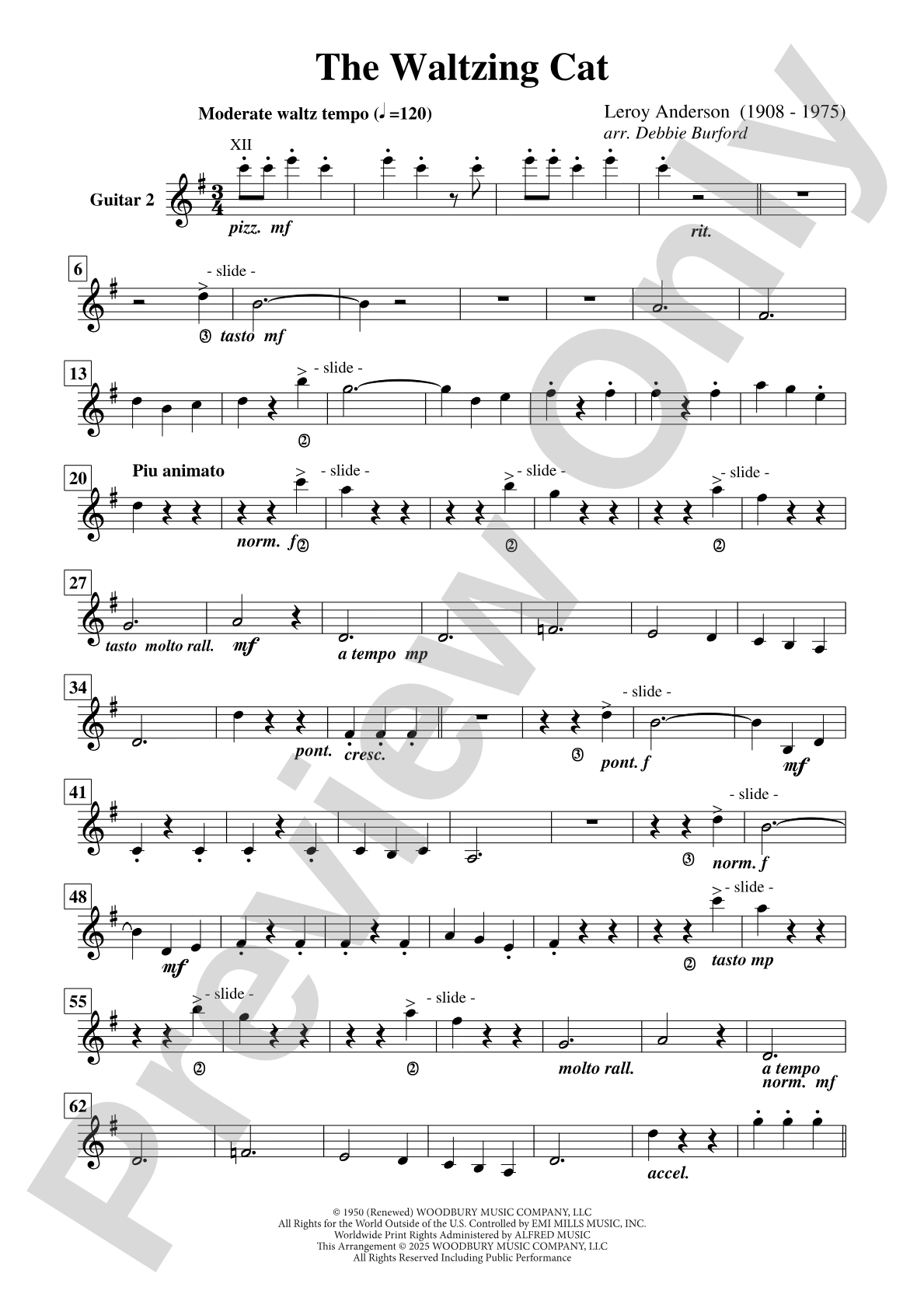
The Waltzing Cat: Guitar 2 Sheet Music Preview

The Waltzing Cat: Guitar 2

for Guitar Quartet

By Leroy Anderson / arr. Debbie Burford

Item: 00-PC-0019641_GTR2

Digital Download
$3.00
Description
Leroy Anderson's orchestral classic arranged for guitar quartet.

The Waltzing Cat: Guitar 2 isn't in MakeMusic Cloud just yet...but it could be. Let us know you'd like to see it, and you'll help shape what comes next. In the meantime, start a free trial and dive into thousands of interactive titles your students can play along with today.

Sample Audio
No sample audio found.
Sample Video
Additional Details
SKU: 00-PC-0019641_GTR2

More about this title

About the Composer: Leroy Anderson

Leroy Anderson (1908–1975) composed some of the most performed light orchestral works in the American canon. His gift was immediate melodic invention paired with orchestration that delighted audiences without condescension. Anderson wrote for pops orchestras, radio, and film; his pieces became staples of summer concerts and community ensembles because they balanced accessibility with genuine musicianship.

Anderson's works demand precision and musicality from performers at every level. The Waltzing Cat exemplifies his ability to write memorable, playable music that rewards careful attention to character and style.

Why we love this

Anderson's orchestral miniatures translate beautifully to guitar quartet, and this arrangement captures the charm and rhythmic clarity of the original without losing the character that makes the piece beloved. Guitarists working in ensemble settings need quality literature that sounds complete and satisfying in a small format, and this piece delivers exactly that.

What to expect

Elegant and whimsical, with the specific character of a cat in motion: graceful but with moments of sly humor and sudden shifts of direction. The waltz frame provides familiar harmonic ground while Anderson's orchestration ideas translate into colorful textural shifts across the four guitars.

Who it's for

Guitar quartet ensembles looking for repertoire that is playable, charming, and immediately satisfying to perform. This works equally well for student groups developing ensemble skills and for more experienced players seeking literature that prioritizes musicality over virtuosity.

How to get the most out of it

  • Maintain a clear sense of pulse even during the waltz's gentler moments; Anderson's writing depends on rhythmic control to land the comedic touches that make the piece memorable.
  • Balance the parts so that whichever guitarist carries the melody is clearly audible, but keep the harmonic voices present and voiced expressively rather than mechanically accompanying.
  • Lean into the wit of the title and concept. The piece has humor built into its phrasing; let that come through in your articulation and rubato choices.
  • Use dynamics across the quartet to shape phrases collectively. A single guitarist's dynamic swell won't carry as much weight; the ensemble needs to breathe and shape together.

How to use it

Program this as a short concert opener or lighter moment alongside more demanding repertoire. It works beautifully in chamber ensemble recitals, community concert settings, or educational showcases where you want to demonstrate that guitar quartet literature need not be austere or academic.

Skills your students will build

  • Ensemble balance and voice independence in four-part texture
  • Stylistic interpretation of light orchestral idioms adapted for guitar
  • Collective phrasing and dynamic shaping across multiple players
  • Clear articulation and rhythmic precision in waltz time

You May Also Like