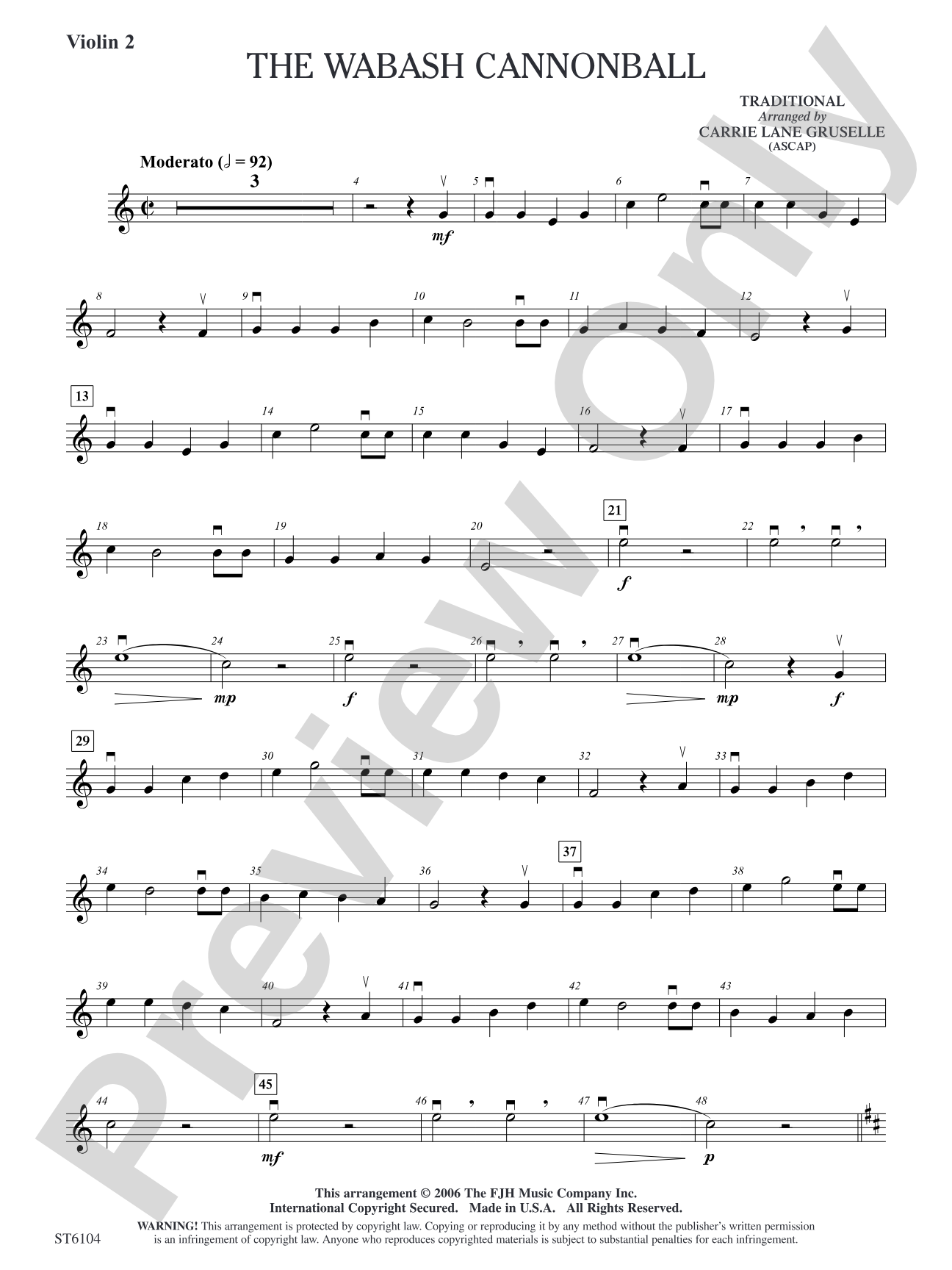
The Wabash Cannonball: Violin 2 Sheet Music Preview

The Wabash Cannonball: Violin 2

Arranged by Carrie Lane Gruselle

Grade: 2

Item: 98-PC-DST6104_VN2

Digital Download
$7.00
Description
Hop aboard as students learn about nineteenth-century American travelers who would jump aboard boxcars and journey to wherever their next destination leads. The sounds of the West abound in this lighthearted hobo tune, where audiences will hear the train whistle emanate from the orchestra. Students will develop their into-the-string fiddle bow stroke and have half- and whole-step finger patterns reinforced through a modulation from the key of C to D.

The Wabash Cannonball: Violin 2 isn't in MakeMusic Cloud just yet...but it could be. Let us know you'd like to see it, and you'll help shape what comes next. In the meantime, start a free trial and dive into thousands of interactive titles your students can play along with today.

Sample Audio
0:00
0:00
Sample Video
Additional Details
Series: FJH Developing Strings
Publisher: The FJH Music Company, Inc.
SKU: 98-PC-DST6104_VN2

More about this title

About the Arranger: Carrie Lane Gruselle

Carrie Lane Gruselle

Carrie Lane Gruselle earned her Bachelor of Music Education from the University of Wisconsin, Eau Claire, followed by a Master's degree in Music Education with Suzuki emphasis from the University of Wisconsin, Stevens Point. She brings this dual training into her work as an elementary and middle school strings teacher for the Appleton Area School District, where she shapes young musicians across multiple grade levels.

Beyond the classroom, Gruselle teaches cello at the Lawrence University Arts Academy in Appleton, Wisconsin, maintaining close ties to both K-12 music education and higher learning. Her arrangements reflect a deep understanding of where developing string players are in their technical and musical journey.

Why we love this

Gruselle takes a folk standard that Grade 2 orchestras can actually execute while keeping the rhythmic energy and character intact. The train whistle effect gives students something theatrical to anchor their attention, and the modulation from C to D serves real pedagogical work rather than feeling tacked on for variety.

What to expect

Rambling and resourceful. The tune carries the gait of someone boarding a train at dusk, traveling light and unburdened. Fiddle rhythms give it a folk authenticity that students recognize, while the orchestral arrangement reveals how a simple melody can be passed around and colored differently by each section.

Who it's for

Grade 2 string orchestras ready for a piece with genuine character and a touch of Americana flavor. The arrangement welcomes orchestras working on half- and whole-step patterns while also building confidence in bow control and shift technique.

How to get the most out of it

  • Isolate the into-the-string bow stroke in rehearsal before combining it with the full melodic line. Have students practice the motion on open strings first, then transfer the weight and control to the actual passages.
  • Mark the modulation clearly in the parts so string players understand they're shifting their finger patterns, not just reading new note names. A quick verbal rehearsal note about 'moving everything up by a step' helps younger players conceptualize the shift.
  • Assign the train whistle effect strategically. It works best when the section that plays it has committed to the sound they're making, whether that's a high harmonic, pizzicato pop, or bowed tremolo on the highest note available.
  • Shape the phrasing so the hobo tune doesn't flatten out. Even at this level, a light lift at phrase endings and subtle dynamic swells keep the narrative moving forward.

How to use it

This works as a standalone feature in a folk or Americana-themed concert, or nested into a program exploring regional American music traditions. It also serves as an excellent mid-season piece for festivals and contests, giving Grade 2 groups a confident, appealing entry that shows off clean intonation and rhythmic control without overwhelming technical demands.

Skills your students will build

  • Into-the-string bow stroke and weight transfer
  • Half-step and whole-step finger patterns in multiple positions
  • Reading and playing through a modulation (C major to D major)
  • Shifting between tonal colors and articulations (pizzicato, bowed, harmonic effects)
  • Phrasing and melodic shaping in a narrative-driven arrangement

You May Also Like