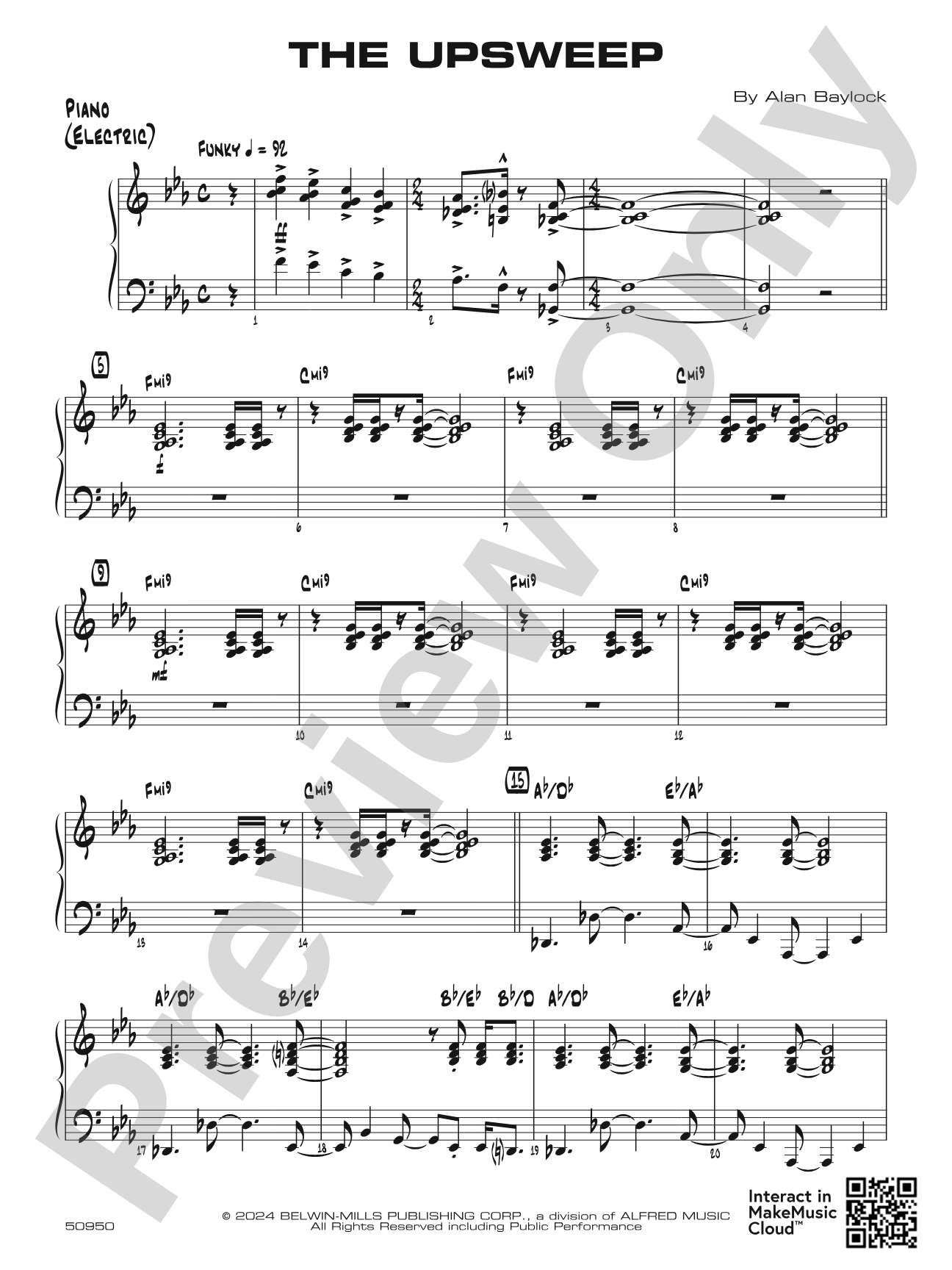
The Upsweep: Piano Accompaniment Sheet Music Preview

The Upsweep: Piano Accompaniment

By Alan Baylock

Grade: 3.5

Item: 00-PC-0019359_K

Digital Download
$3.00
Description
This chart is a very hip funky rock with a driving groove. Played around 92 BPM. Solos are provided for trombone 1 and alto 1. Lead trumpet range is to written G on top of the staff. This chart will really work best with electric bass and piano. The band will dig it! (4:15)

Don't just read it, hear it, play along with it, and watch your students grow with it. In MakeMusic Cloud, The Upsweep: Piano Accompaniment comes alive with professional accompaniment, adjustable tempo, and built-in practice tools that turn solo practice into real progress.

Sample Audio
0:00
0:00
Sample Video
Additional Details
Series: Jazz Band Series
Publisher: Alfred Music
SKU: 00-PC-0019359_K

More about this title

About the Composer: Alan Baylock

Alan Baylock

Alan Baylock has shaped jazz education and performance across three decades as a composer, arranger, and bandleader. He directed the One O'Clock Lab Band at the University of North Texas and spent 20 years as Chief Arranger for the Airmen of Note, the United States Air Force Band's premier jazz ensemble. His Alan Baylock Jazz Orchestra released three albums and toured nationally for over 15 years, earning critical recognition and performances by artists ranging from Maynard Ferguson to Joshua Redman.

Beyond the bandstand, Baylock has been a dedicated clinician and advocate, guest-conducting more than 100 jazz ensembles at high school, collegiate, and professional levels and serving as faculty at the National Jazz Workshop. In 2022, he co-founded Brava Jazz Publishing with composer Annie Booth to amplify women composers and arrangers in big band jazz. His work is published by Alfred Music, ProJazzCharts.com, and Sh, and he holds degrees from Shenandoah University and the University of North Texas.

Why we love this

Baylock writes grooves that stick with student ensembles long after rehearsal ends. The funky pocket and clear solo vehicles here give your rhythm section a showcase while keeping the chart fresh enough for festivals without sounding like every other Grade 3 funk tune in circulation.

What to expect

Hip, driving, and modern. The funky rock pocket pulls listeners in immediately while the energetic groove keeps the band engaged throughout. It's the kind of arrangement that makes students want to come to rehearsal.

Who it's for

Jazz ensembles at the Grade 3 to 3.5 level who want a contemporary-sounding chart with real solo opportunities and a groove that appeals to student players. Directors programming festival contests will find a piece that sounds sophisticated and confident without exceeding the technical reach of a developing ensemble.

How to get the most out of it

  • Lock the electric bass and piano into the pocket first before the full ensemble joins. This rhythm section foundation is non-negotiable for the chart to breathe properly at 92 BPM.
  • Push the trombone 1 and alto 1 soloists to listen actively to the rhythm section during their breaks rather than playing over it. The soloist who listens inside the groove will sound more musical than one chasing the tempo.
  • Balance the lead trumpet high notes (up to written G) without letting them puncture the ensemble sound. These peaks should feel earned, not strained.
  • Rehearse the ensemble hits and rhythmic punctuations with precision early on. Once your band feels the unison of the funky parts, the solos and accompaniment settle in faster.

How to use it

Program this as a first-half closer or second-half opener at jazz festival competitions where you want to show range and contemporary taste. It works equally well as a concert feature that bridges the gap between traditional jazz repertoire and music students actually want to play.

Skills your students will build

  • Pocket and groove awareness in a contemporary funk-rock idiom
  • Solo construction and listening within an ensemble context
  • Rhythmic precision and ensemble unison in syncopated figures
  • Lead trumpet high register control and projection
  • Rhythm section interdependence and groove locking

You May Also Like