The Troubadour Sheet Music Preview

The Troubadour: Piano

By Kevin Olson

Item: 98-DW9254

Digital Download
$2.95
Description
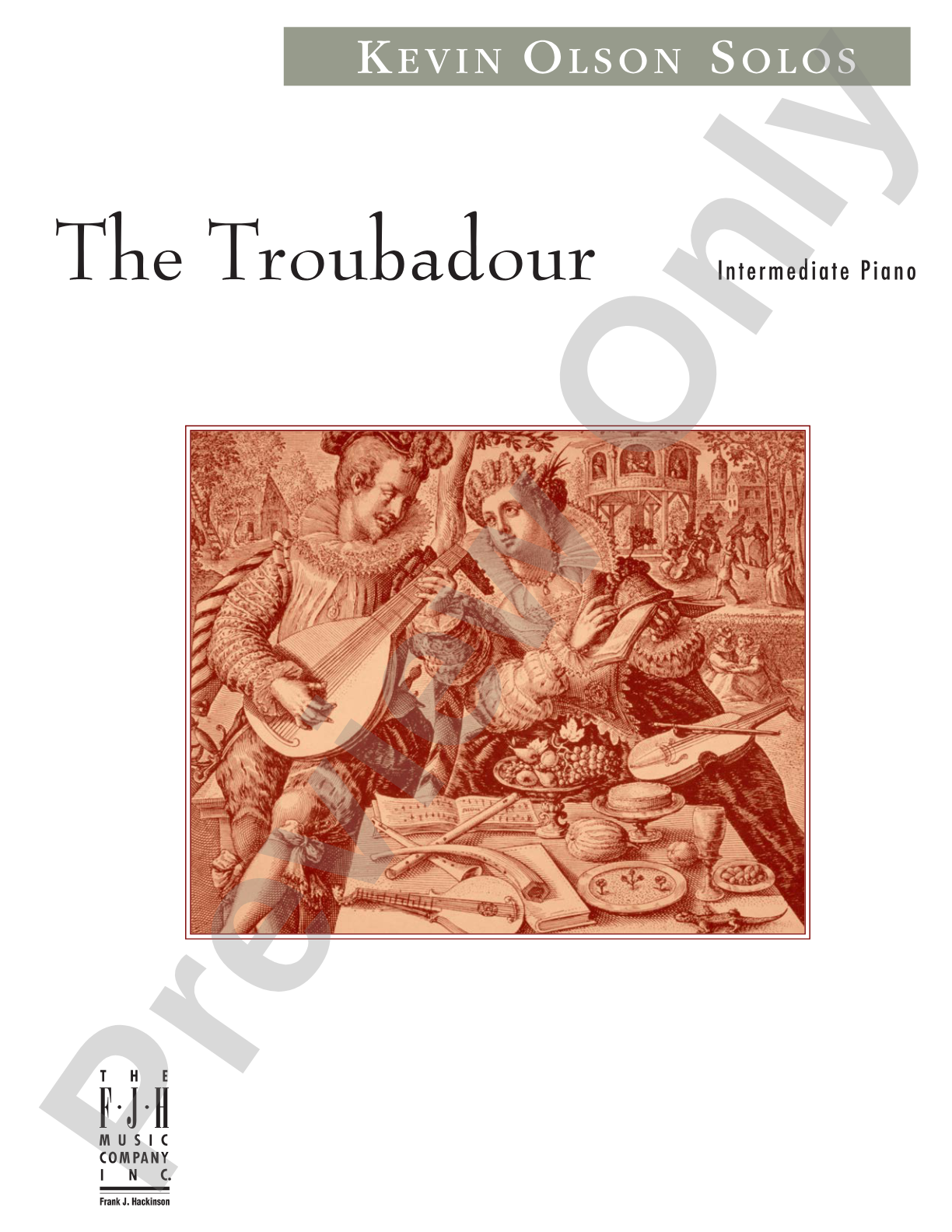
This piece is a great piece for the study of changing meters. Beginning in 8/8, changes between 7/8, 6/8, and 9/8. It has a Renaissance melodic sound based on The Troubadour - a Renaissance traveling musician.

The Troubadour: Piano isn't in MakeMusic Cloud just yet...but it could be. Let us know you'd like to see it, and you'll help shape what comes next. In the meantime, start a free trial and dive into thousands of interactive titles your students can play along with today.

Sample Audio
No sample audio found.
Sample Video
Additional Details
Series: Written For You
Publisher: The FJH Music Company, Inc.
SKU: 98-DW9254

More about this title

Why we love this

Kevin Olson crafts a meter study that never feels academic. The Renaissance melody grounds all those meter shifts in something genuinely singable, so students aren't just counting beats—they're following a story. It's the kind of piece that makes changing meters feel natural instead of punitive.

What to expect

Like following a traveling minstrel through different lands, each with its own musical time. The Renaissance melody floats above shifting foundations, creating a sense of motion and surprise without losing its ancient, wandering character.

Who it's for

Intermediate pianists ready to engage with rhythmic complexity without sacrificing musicality. This piece works well for students who have solid rhythm fundamentals and are beginning to explore mixed meters as a compositional tool rather than a technical exercise.

How to get the most out of it

  • Map out the meter changes (8/8, 7/8, 6/8, 9/8) on the score before sight-reading. Knowing where the shifts happen prevents the common trap of staying locked in the opening time signature.
  • Maintain the Renaissance character throughout the meter changes. The melodic contour should breathe like a medieval tune regardless of the underlying beat structure.
  • Practice the transitions between meters slowly at first. Play one measure in the new meter at tempo, then back up and approach it from the previous section to build fluency.
  • Listen for the pulse of each new meter rather than rushing to recount. 6/8 should feel like 2, not like 3+3; this shifts how you interpret phrasing and tempo.

How to use it

Ideal for a recital that explores rhythm as compositional choice rather than limitation. Pair it with other contemporary meter studies or with actual Renaissance keyboard music to show how modern composers draw inspiration from historical forms.

Skills your students will build

  • reading and performing mixed meters (8/8, 7/8, 6/8, 9/8) in a single piece
  • maintaining melodic coherence through meter shifts
  • understanding Renaissance musical style and ornamentation at the keyboard
  • managing metric modulation without losing rhythmic stability
  • interpreting historically-informed style in contemporary composition

You May Also Like