
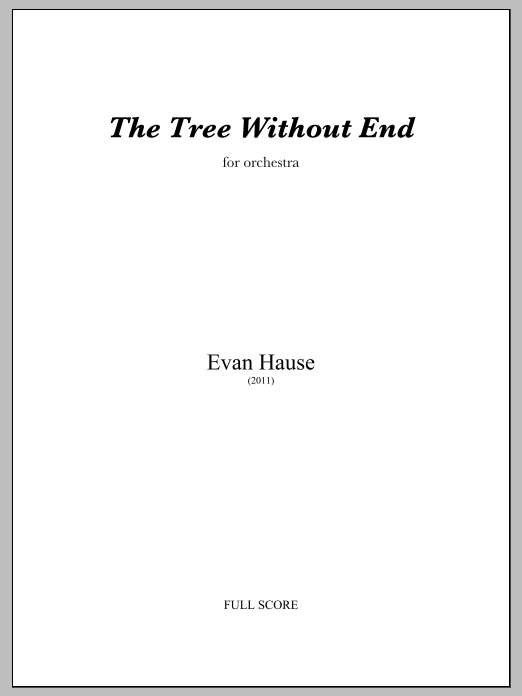

The Tree Without End: Full Orchestra Conductor Score & Parts
Arranged by Evan Hause
Item: 35-PK00269122
$30.35
Pickup currently not available
Buy Extra Parts (Digital PDF Download)
| Product | Price | Quantity |
|---|---|---|
| The Tree Without End - Tuba | $2.60 | |
| The Tree Without End - Timpani | $2.60 | |
| The Tree Without End - Full Score | $11.75 | |
| The Tree Without End - Flute | $2.90 | |
| The Tree Without End - Flute/Piccolo | $2.90 | |
| The Tree Without End - Oboe | $2.90 | |
| The Tree Without End - Oboe | $2.75 | |
| The Tree Without End - Clarinet | $2.75 | |
| The Tree Without End - Bb Clarinet/Bass Clarinet | $2.75 | |
| The Tree Without End - Bassoon | $2.75 | |
| The Tree Without End - Bassoon 3/Contrabassoon | $2.75 | |
| The Tree Without End - F Horn | $2.75 | |
| The Tree Without End - F Horn | $2.75 | |
| The Tree Without End - Trumpet | $2.75 | |
| The Tree Without End - Trumpet | $2.75 | |
| The Tree Without End - Trombone | $2.75 | |
| The Tree Without End - Percussion | $2.60 | |
| The Tree Without End - Harp | $3.20 | |
| The Tree Without End - Violin | $3.20 | |
| The Tree Without End - Violin | $3.20 | |
| The Tree Without End - Viola | $3.05 | |
| The Tree Without End - Violoncello | $3.05 | |
| The Tree Without End - Contrabass | $2.90 |
Parts Added to Cart!
Description
2*22*2* 2211 Timp+2 Harp Strings Duration: 17:00


The Tree Without End: Full Orchestra Conductor Score & Parts isn't in MakeMusic Cloud just yet...but it could be. Let us know you'd like to see it, and you'll help shape what comes next. In the meantime, start a free trial and dive into thousands of interactive titles your students can play along with today.
Request This Title
Tell us you want it.
Start Your Free Trial
Explore everything that's ready to play right now.
Sample Audio
No sample audio found.
Sample Video
No sample videos found.
Additional Details
Publisher:
Hal Leonard
SKU:
35-PK00269122
More about this title
Why we love this
Hause crafts an orchestration that sounds expansive without demanding excessive instrumental doubling, making this viable for mid-size ensembles while maintaining sophisticated color and depth. The 17-minute duration strikes that sweet spot for a centerpiece work—substantial enough to carry a concert segment, compact enough to rehearse thoroughly without consuming your entire season.
What to expect
The piece unfolds with contemplative momentum, drawing its title from a symbol of continuity and rootedness. Orchestral colors shift gradually, creating an arc that feels both inevitable and organic, as if the work grows rather than simply progresses.
Who it's for
Conductors leading orchestras with flexible doubling options who want a single, cohesive work that showcases ensemble capability without requiring specialized instrumentation. Intermediate to advanced programs will find this rewarding for both rehearsal and concert performance.
How to get the most out of it
- Balance the harp part carefully in exposed passages; it reads high on the staff but sits lower in the actual pitch spectrum, making it easy to cover if strings press too hard.
- Set a steady internal pulse before the first rehearsal with your principal timpanist. The percussion arrangement anchors transitions between longer melodic sections.
- Mark cue points in the string parts where the winds carry primary material. Players often expect to lead in full orchestra writing and will rush if they're uncertain of their supporting role.
- Listen critically to the horn section's intonation during chordal passages. The orchestration exposes brass choir work, so routine checks prevent balance issues from becoming obvious.
How to use it
Pair this as your program centerpiece when you want to demonstrate orchestral maturity without leaning on war horse repertoire. Its 17-minute length makes it ideal for a concert that includes chamber works or smaller ensemble contributions, anchoring the first half before lighter or more experimental programming.
Skills your students will build
- Sustained ensemble balance across multiple instrumental choirs
- Reading and executing sustained dynamic shapes (ppp to mf ranges)
- Responding to subtle cuing and gesture shifts in extended works
- Intonation control during sparse, exposed harmonic writing
- Rhythmic independence within flowing, non-metric passages