The Toreadors from Carmen: 1st Violin Sheet Music Preview

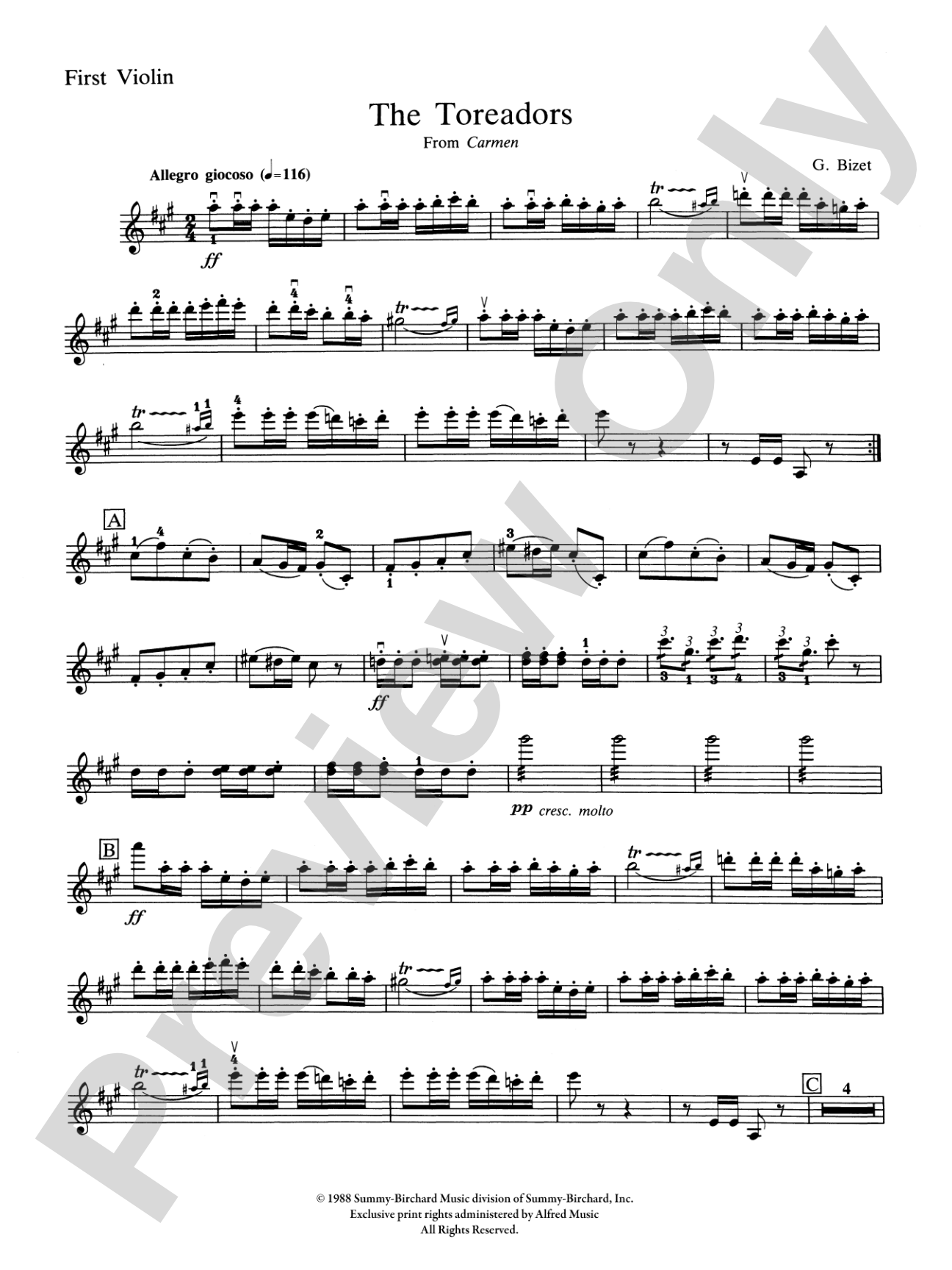
The Toreadors from Carmen: 1st Violin

By Georges Bizet / arr. William and Constance Starr

Item: 00-PC-0016159_VN1

Digital Download
$3.00
Description
These Sounds of the Symphony arrangements are intended to enrich the repertoire of Suzuki violin groups. Teachers are using these arrangements both for the enjoyment and musical development of the children. They are great for adding variety to the programming of group performances.

The Toreadors from Carmen: 1st Violin isn't in MakeMusic Cloud just yet...but it could be. Let us know you'd like to see it, and you'll help shape what comes next. In the meantime, start a free trial and dive into thousands of interactive titles your students can play along with today.

Sample Audio
No sample audio found.
Sample Video
Additional Details
Series: Sounds of the Symphony Series
Page Count: 78
SKU: 00-PC-0016159_VN1
Instrumentation: Violin with Piano (Viola, Cello, Bass & Flute Opt.)

More about this title

About the Composer: Georges Bizet

Georges Bizet (1838-1875) composed Carmen late in his career, and the opera remains one of the most frequently performed works in the repertoire worldwide. His gift for memorable melody and orchestral color made him a master of dramatic music, and the famous themes from Carmen have transcended their operatic origins to become concert staples across countless arrangements and ensembles.

For young string players, Bizet's music offers immediate accessibility. The melodies are direct and singable, the harmonic language is clear, and the orchestration translates beautifully to smaller ensembles. Carmen taught generations of composers how to write for strings with both passion and clarity, making it an ideal choice for enriching Suzuki group repertoire.

Why we love this

The Toreadors march has infectious rhythmic drive and a melody that sits naturally on the violin, making it engaging for players at this level without sacrificing musical substance. William and Constance Starr's arrangement preserves the orchestral character of the original while creating flexible instrumentation that works for groups of varying sizes, and the optional parts mean you can use this whether your group includes flutes, violas, or just violins and cello.

What to expect

Brilliant and buoyant, with the swaggering confidence of a Spanish processional. The melody bounces with theatrical flair while the harmonic foundation remains sturdy and grounded, creating music that feels both celebratory and driven by clear dramatic purpose.

Who it's for

This arrangement serves intermediate Suzuki violin students who are ready to explore repertoire beyond the method books and benefit from ensemble experience with a genuine masterwork. Group directors using Suzuki-based curricula will find this particularly valuable for adding orchestral literature to performances without requiring large instrumentation.

How to get the most out of it

  • Maintain steady pulse throughout the march character; the piece relies on rhythmic momentum to convey the energy of the bullfight processional.
  • Balance the optional instrumental parts carefully so the melody line in the violin remains clear and prominent.
  • Attend to the articulation markings in both the string and piano parts to capture the crisp, forward-moving character typical of march style.
  • Work with the piano accompanist on independence; the keyboard part sits slightly behind the strings rhythmically in several passages to support rather than drive the line.

How to use it

Program this as a showstopper in a Suzuki group performance, especially when you have multiple violin sections or mixed instruments available. The Latin character and operatic provenance make it an excellent anchor piece for a concert focused on Romantic era masterworks or a thematic program exploring music from different cultures.

Skills your students will build

  • Sustained melodic phrasing in a march tempo
  • Ensemble balance with flexible instrumentation
  • Reading and execution of opera-derived orchestral music
  • Rhythmic precision in a driving, Latin-influenced style

You May Also Like