
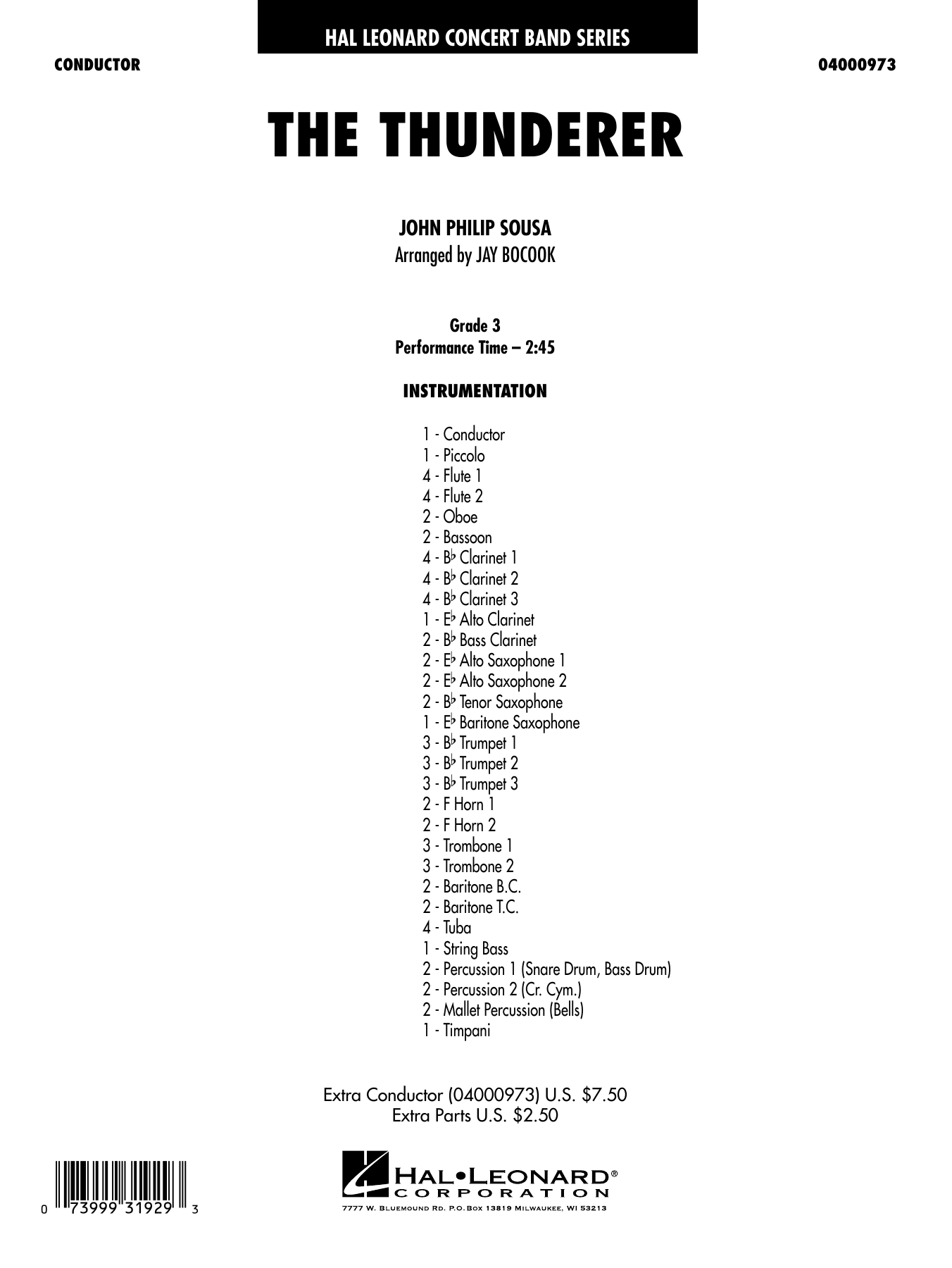

The Thunderer: Concert Band Conductor Score & Parts
By John Philip Sousa / Arranged by Jay Bocook
Grade: 3
Item: 35-PK01615547
$60.00
Pickup currently not available
Buy Extra Parts (Digital PDF Download)
Parts Added to Cart!
Description
On the all-time hit list of best-known marches, this tuneful Sousa favorite is near the top of the list. Jay's masterful adaptation makes it playable by younger bands without sacrificing any of the charm or style of the original. This is one of those marches that belongs in every band's library.


Discover MakeMusic Cloud: thousands of interactive titles your students can play along with today.
Sample Audio
No sample audio found.
Sample Video
Additional Details
Publisher:
Hal Leonard
SKU:
35-PK01615547
More about this title
About the Composer: John Philip Sousa
John Philip Sousa (1854–1932) shaped American wind band music more than any other composer. His marches defined a genre, and his gift for memorable melody combined with sophisticated orchestration set the standard that directors still measure against today. Sousa's understanding of band instrumentation and what players could accomplish made him an essential voice in music education, and his works remain central to building ensemble musicianship.
Why we love this
Bocook's adaptation preserves every ounce of Sousa's swagger and harmonic sophistication while genuinely serving younger players. The Grade 3 level never feels like a compromise because the melodic writing stays bold and the march structure remains intact. You get a piece that builds real conducting and ensemble skills without the performance anxiety that can come with more exposed original scoring.
What to expect
The Thunderer marches with purpose and stride, full of character that bounces between grand statements and moments of lyrical warmth. It carries the confidence of a piece that knows exactly who it is, and that certainty is contagious. Playing it feels like stepping into something bigger than yourself.
Who it's for
Bands at the Grade 3 level ready to tackle genuine repertoire with historical weight. This works equally well for groups building their first march library and ensembles looking for a standard that teaches musicianship alongside tradition.
How to get the most out of it
- Find the lift in the melodic line rather than pushing for volume. Sousa's marches live in the phrasing, not the dynamics, and younger bands often nail the character by focusing on shape first.
- Balance the solo voices in the trio section so the flugelhorn or soprano sax has room to sing. These moments define the march's personality and deserve careful sectional work.
- Lock the snare drum and bass drum partnership early. The rhythmic precision between them transforms the entire ensemble's sense of forward motion and confidence.
- Tempo should feel inevitable, not rushed. Most directors take this slightly slower in rehearsal than the performance will demand, giving time for phrasing and articulation clarity to land.
How to use it
Open a concert with this to set the tone immediately, or close a program with it for a sendoff that leaves audiences smiling. It pairs well with contemporary concert works because its structural clarity and historical authenticity remind listeners what wind band music can accomplish. Include it early in the fall when you need repertoire that builds sectional independence and rhythmic foundation.
Skills your students will build
- March form and structure (introduction, strain progression, trio, return)
- Lyrical phrasing within a strict metric framework
- Melodic independence from harmonic background
- Snare drum and bass drum coordination in traditional march style
- Style and character interpretation in American patriotic music