
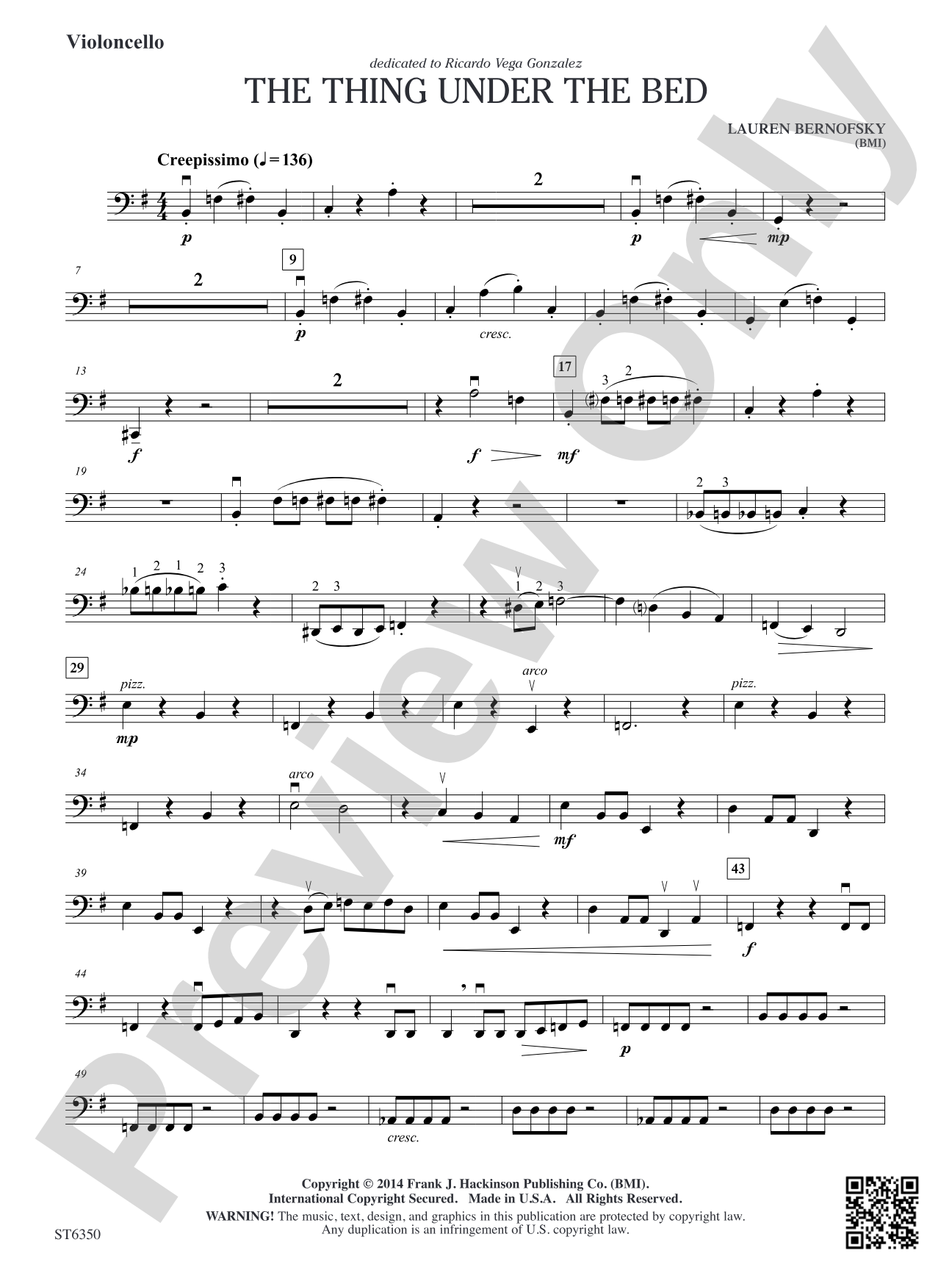

The Thing Under The Bed: Violoncello
By Lauren Bernofsky
Grade: 3.5;4
Item: 98-PC-DST6350_VC1
$7.00
Pickup currently not available
Description
Add a unique programming twist with this fantastic piece that blends humor with darkness. The "spooky" opening uses playable chromatics to set the stage for the "thing," which comes across as potentially scary, yet clumsy and whimsical all at the same time. If you are looking for something fun and completely different, you just found it!


Don't just read it, hear it, play along with it, and watch your students grow with it. In MakeMusic Cloud, The Thing Under The Bed: Violoncello comes alive with professional accompaniment, adjustable tempo, and built-in practice tools that turn solo practice into real progress.
Open in the Player
Jump straight in and assign it today.
Start Your Free Trial
Open this title and explore the full library in minutes.
Sample Audio
1
Audio File
--:--
0:00
0:00
Sample Video
No sample videos found.
Additional Details
Series:
FJH String Orchestra
Publisher:
The FJH Music Company, Inc.
SKU:
98-PC-DST6350_VC1
More about this title
About the Composer: Lauren Bernofsky

Lauren Bernofsky has composed over a hundred works across solo, chamber, orchestral, operatic, and ballet genres, earning recognition from luminaries like conductor Lukas Foss as "a master composer." Her music consistently balances emotional depth with intellectual rigor, blending 21st-century compositional technique with lyrical accessibility. Her accolades include the National Flute Association's Newly Published Music Competition (for Sonatine), the Opera Puppets Award at Boston Metro Opera (for Mooch the Magnificent), and the Dalai Lama Composition Contest, which led to a premiere performance attended by the Dalai Lama himself.
Bernofsky holds degrees from The Hartt School (Bachelor's in violin and composition), New England Conservatory (Master's in composition), and Boston University (DMA in composition). She has taught at the Peabody Institute and Interlochen Center for the Arts, and her works have been commissioned and performed by ensembles and orchestras worldwide. Her compositions have been featured on PBS and in peer-reviewed music journals, cementing her place among today's most performed contemporary composers.
Why we love this
Bernofsky gives directors a piece that actually delivers on the promise of fun without sacrificing musical substance. The writing is inventive and playful, yet structurally sound enough to hold students' attention and challenge their ensemble skills. It's the kind of novelty piece that makes audiences laugh and musicians want to play it again.
What to expect
The opening draws you into genuine suspense with chromatic tension, but the moment the "thing" shambles onto stage, any real menace evaporates into something charmingly inept. It's Halloween as performed by characters who are trying very hard to be scary but keep tripping over their own feet.
Who it's for
String orchestras at the intermediate level (Grades 3-4) seeking concert or festival material with personality and humor. Directors who want students to engage with contemporary composition without the density of "serious" modern works will find this an accessible entry point into 21st-century writing.
How to get the most out of it
- Shape the chromatic opening with clear phrasing and intonation; the spookiness depends on precise ensemble work in the "setting the stage" section.
- Embrace the clumsy, whimsical character of the "thing" when it emerges. Overly polished playing dulls the humor; let the awkwardness breathe.
- Balance articulation between sections so the contrast between atmospheric passages and the creature's appearances stays vivid throughout.
- Use the conductor score to highlight where the character shifts from genuinely unsettling to endearingly goofy, cueing that tonal shift clearly to the ensemble.
How to use it
Perfect for a fall or holiday concert where a lighter moment breaks up heavier repertoire, or as a festival piece that stands out from conventional string orchestra selections. Its novelty appeal and crowd-pleasing humor make it an excellent closer or intermission opener that audiences remember long after the concert ends.
Skills your students will build
- Chromatic intonation and ensemble blend in dissonant textures
- Character and expression through articulation and dynamic shaping
- Rhythmic precision in playful, irregular rhythmic figures
- Following a conductor's interpretive choices in contemporary music