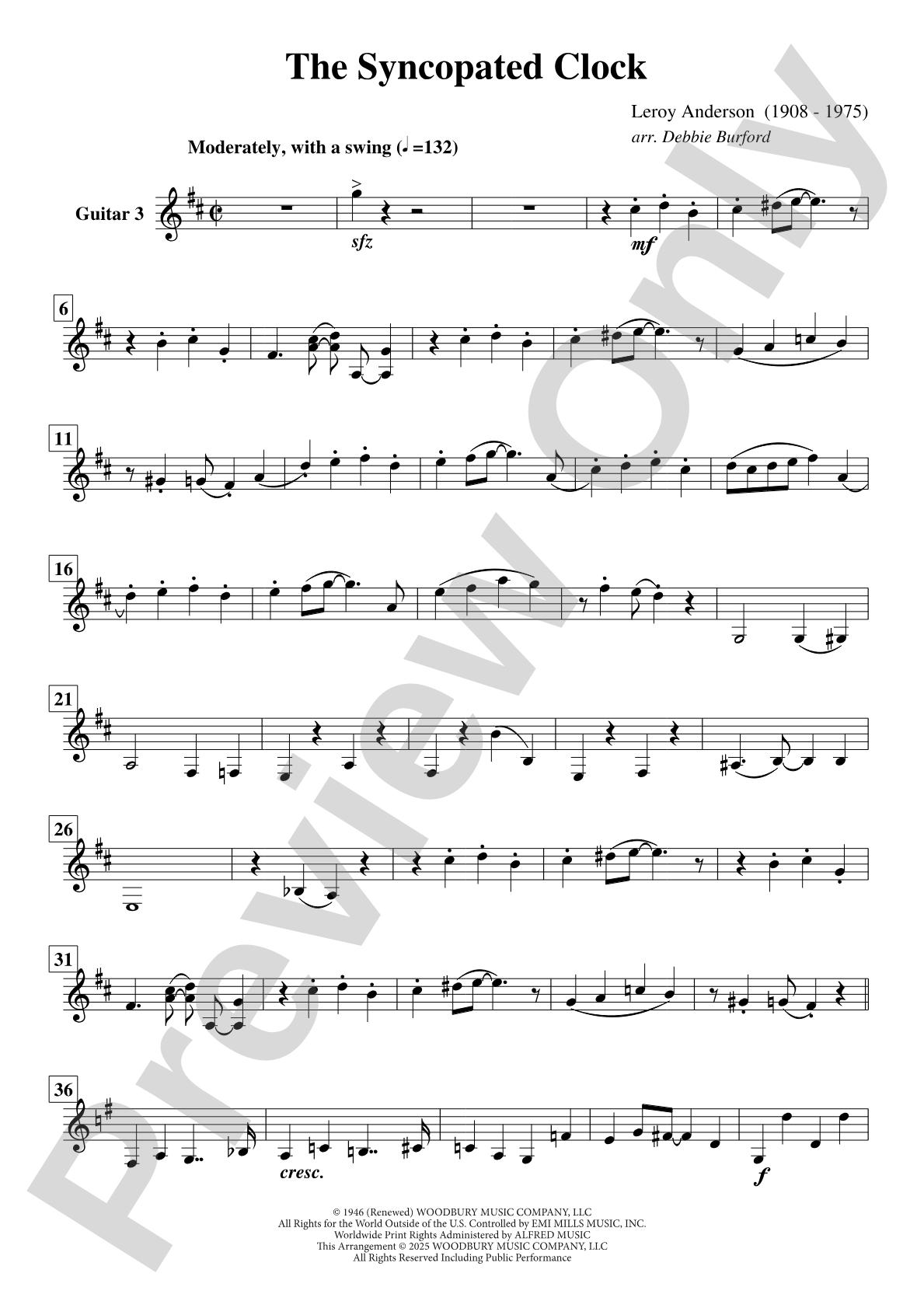
The Syncopated Clock: Guitar 3 Sheet Music Preview

The Syncopated Clock: Guitar 3

for Guitar Quartet

By Leroy Anderson / arr. Debbie Burford

Item: 00-PC-0019640_GTR3

Digital Download
$3.00
Description
Leroy Anderson's orchestral classic arranged for guitar quartet.

The Syncopated Clock: Guitar 3 isn't in MakeMusic Cloud just yet...but it could be. Let us know you'd like to see it, and you'll help shape what comes next. In the meantime, start a free trial and dive into thousands of interactive titles your students can play along with today.

Sample Audio
No sample audio found.
Sample Video
Additional Details
SKU: 00-PC-0019640_GTR3

More about this title

About the Composer: Leroy Anderson

Leroy Anderson (1908-1975) was an American composer and conductor who became one of the most performed orchestral composers of the twentieth century, despite working largely outside the classical canon. His gift for writing accessible, tuneful music with rhythmic sophistication made him a staple of pops concerts and radio broadcasts. Anderson composed over 140 works, many of them short orchestral pieces that combined classical craftsmanship with a wry sense of humor and genuine melodic invention.

Anderson's training at Harvard and in Europe gave him the harmonic and structural knowledge to write with precision, yet his instinct was always toward clarity and charm. Works like "Plink, Plank, Plunk!" and "The Typewriter" showcase his talent for sonic storytelling and clever orchestration. His music remains ideal for developing musicians because it demands accurate rhythm and ensemble cohesion while rewarding players with genuinely fun material to perform.

Why we love this

Anderson's orchestral voice translates beautifully to guitar quartet, and this arrangement captures the whimsy and rhythmic precision that made the original a concert favorite. The syncopated writing gives four guitarists a chance to lock into a groove together while maintaining the melodic charm that audiences immediately recognize and enjoy.

What to expect

The piece ticks along with perpetual motion and barely suppressed humor, as if a clock mechanism has learned to swing. Syncopation ripples through the texture while the main melody bounces between voices with infectious charm, creating the sense of watching gears turn at slightly wrong angles.

Who it's for

Guitar quartet ensembles looking for substantial repertoire beyond transcriptions of classical chamber works will find this an engaging alternative. The piece works well for college guitar ensembles, advanced high school guitar classes with strong players, and chamber groups seeking crowd-pleasing material for concerts and recitals.

How to get the most out of it

  • Lock the rhythmic framework first. The syncopation will feel awkward until all four parts understand their relationship to the pulse; establish a clear internal beat before adding interpretive flexibility.
  • Balance the melody across parts rather than assigning it all to first guitar. Anderson's original orchestration distributes the tune, and respecting that distribution keeps the texture light and prevents any one voice from dominating.
  • Shape the phrasing with subtle dynamic contours. Even in a comedic piece, musical lines benefit from gentle rise and fall that mirrors the harmonic movement underneath.
  • Let the plucked articulation breathe. Guitar quartet can sound dense; use space between phrases and lighter touch on accompanying figures to keep the comic timing intact.

How to use it

Program this as a concert opener or palette cleanser between heavier works. Its relatively short duration and immediate appeal make it ideal for mixed recitals featuring diverse guitar repertoire, and audiences consistently respond to its playful energy and recognizable melodic character.

Skills your students will build

  • Syncopated rhythm reading and ensemble coordination
  • Precise note articulation and attack consistency across four parts
  • Independent part responsibility within a unified ensemble texture
  • Balance and blend in guitar quartet sonority
  • Collaborative listening and rhythmic ensemble playing

You May Also Like