
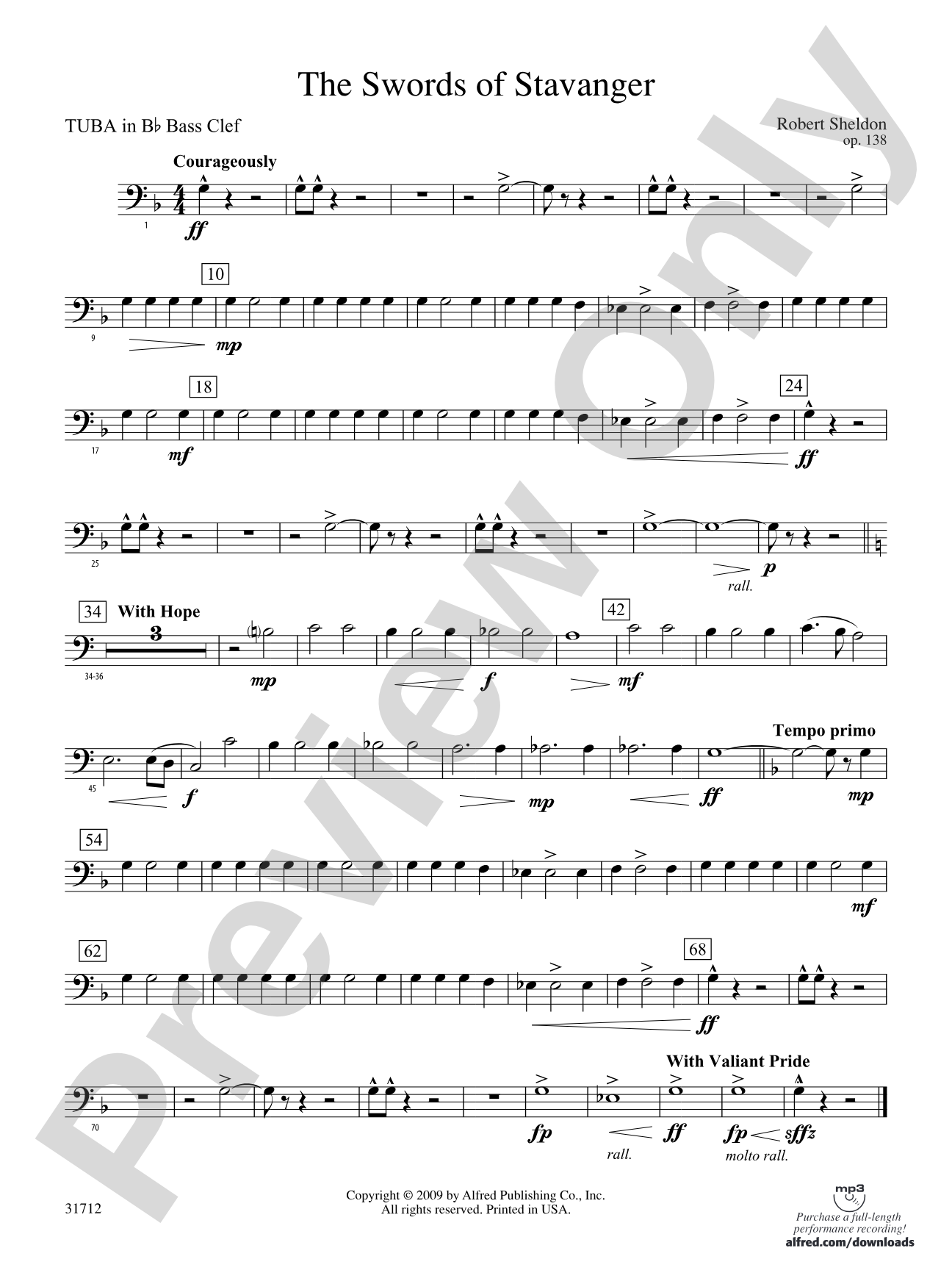

The Swords of Stavanger: (wp) B-flat Tuba B.C.
By Robert Sheldon
Grade: 2 (Medium Easy)
Item: 00-PC-0001807_wpTBBBC
$3.00
Pickup currently not available
Description
The unification of the Viking tribes is of great significance to the people living in the southwest region of Norway. The International School of Stavanger lies only one kilometer from a small fjord called Hafrsfjord where a monument, "Swords in Stone," was constructed consisting of three large bronze swords stuck in an outcropping on the shore. The monument commemorates a battle which unified the Viking tribes of Norway under one king, Harald Hårfagre, or Harald the Fairhaired. According to legend, in 872 Harald invited the other tribal leaders to a meeting, then had his boats cut off their retreat and they battled until the other leaders submitted to Harald's rule. Harald then became the first king of Norway. The Swords of Stavanger seeks to provide a musical backdrop to this legend of Viking heroism and conquest. This title is available in MakeMusic Cloud.


Don't just read it, hear it, play along with it, and watch your students grow with it. In MakeMusic Cloud, The Swords of Stavanger: (wp) B-flat Tuba B.C. comes alive with professional accompaniment, adjustable tempo, and built-in practice tools that turn solo practice into real progress.
Open in the Player
Jump straight in and assign it today.
Start Your Free Trial
Open this title and explore the full library in minutes.
Sample Audio
1
Audio File
--:--
0:00
0:00
Sample Video
No sample videos found.
Additional Details
Series:
Young Symphonic
Publisher:
Alfred Music
Page Count:
128
SKU:
00-PC-0001807_wpTBBBC
More about this title
About the Composer: Robert Sheldon

Robert Sheldon stands among the most frequently performed composers writing for wind band today. His works appear regularly on national contest and concert lists, and his commissions span ensembles across every performance level. He has conducted his own compositions at Carnegie Hall, Orchestra Hall, the Kennedy Center, and major venues internationally, earning recognition through numerous awards from the American School Band Directors Association, Phi Beta Mu, and ASCAP. In 2020, VanderCook College of Music bestowed upon him an honorary doctorate in recognition of his contributions to music education.
Beyond composing, Sheldon serves as lead author of Sound Innovations for Concert Band and maintains an active schedule as a guest conductor for All-State and Regional Honor Bands. He has clinicked and presented at universities and state music education conferences across the United States and abroad, including extended teaching residencies in Japan, Canada, Italy, Germany, Australia, and China.
Why we love this
Sheldon writes Grade 2 music that never talks down to young ensembles. The programmatic architecture here invites students into a genuine historical narrative without sacrificing musical substance. Conductors appreciate how the scoring balances accessibility with genuine expressive possibilities, allowing solid developing bands to deliver a performance that feels epic and cohesive.
What to expect
The piece unfolds like a saga told around a fire. Heroic themes emerge from reflective passages, building toward moments of genuine dramatic intensity as the battle sequences unfold, then resolving into a sense of hard-won unity. It captures the scale of legend without requiring orchestral complexity.
Who it's for
Young concert bands (Grade 2) ready to program meaningful, story-driven music that engages both performers and audiences. This works equally well for festivals, concerts, or contest settings where students need to grow into expressive ensemble playing without technical overwhelm.
How to get the most out of it
- Build the dynamic arc from the opening through the climactic battle sequences. This piece thrives on contrast, so resist the urge to play everything at a uniform level. Let the quieter moments breathe and earn their space before the surge returns.
- Attend carefully to the sectional balance, particularly in the thematic material shared across woodwinds and brass. Young ensembles often inadvertently bury melodic lines, so mark exposed passages in rehearsal and confirm each section knows when the story belongs to them.
- Establish the tempo relationships early and commit to them. The shifting moods of legend and battle demand clear temporal anchors that your band can trust throughout the performance.
How to use it
Program this as an opener or centerpiece on a concert where you want to set an ambitious tone for your band's season. It pairs well with lighter character pieces or with other Grade 2-3 works that explore non-Western or historical themes, creating a cohesive concert narrative around cultural heritage.
Skills your students will build
- Sustained dynamic control across longer musical phrases
- Thematic development and recognition of recurring melodic material
- Balance and blend in passing harmonic material between sections
- Interpretation of programmatic intent and historical context
- Confidence in performance of Grade 2 music with expressive maturity