
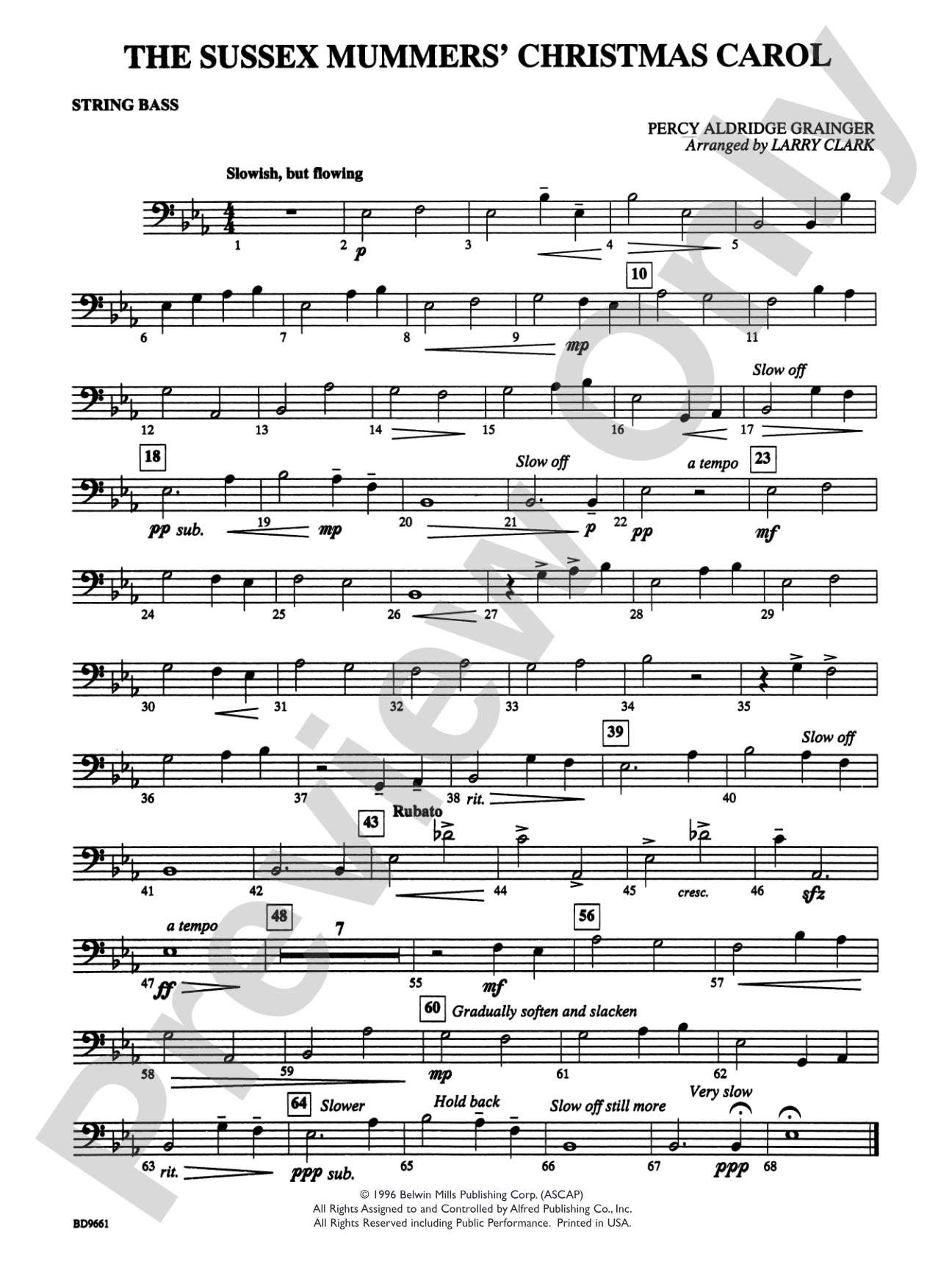

The Sussex Mummers' Christmas Carol: String Bass
By Percy Aldridge Grainger / arr. Larry Clark
Grade: 4 (Medium)
Item: 00-PC-0002034_SB
$3.00
Pickup currently not available
Description
While Percy Grainger was known for creating a variety of ensemble settings for many of his folk songs, he never scored this work for wind band. Arranger Larry Clark here emulates Grainger's style to bring this lush carol alive with musical passion. Rhythmic notation has been elongated to allow more flexibility in interpreting each musical phrase. A vital and important addition to the library of every serious musician and conductor.


Don't just read it, hear it, play along with it, and watch your students grow with it. In MakeMusic Cloud, The Sussex Mummers' Christmas Carol: String Bass comes alive with professional accompaniment, adjustable tempo, and built-in practice tools that turn solo practice into real progress.
Open in the Player
Jump straight in and assign it today.
Start Your Free Trial
Open this title and explore the full library in minutes.
Sample Audio
No sample audio found.
Sample Video
No sample videos found.
Additional Details
Series:
Belwin Symphonic Band
Publisher:
Alfred Music
Page Count:
136
SKU:
00-PC-0002034_SB
More about this title
About the Composer: Percy Aldridge Grainger
Percy Aldridge Grainger (1882-1961) was an Australian-born composer and pianist who spent much of his career in America, becoming one of the most distinctive voices in early 20th-century music. He developed a passionate commitment to collecting and arranging folk melodies, believing that traditional songs deserved settings as sophisticated and varied as art music itself. His approach to orchestration was revolutionary; he experimented relentlessly with instrumental combinations and textures, creating multiple versions of the same work for different ensembles to suit varying performance contexts.
Grainger's arrangements transcend simple adaptation. He viewed folk material as a foundation for genuine musical invention, layering harmonies, varying timbres, and exploring rhythmic flexibility to bring new life to traditional melodies. His influence on band and choral music remains substantial; educators value his works for their musical substance, accessibility to students, and the way they honor folk traditions while pushing performers toward greater interpretive maturity.
Why we love this
Larry Clark's arrangement captures the essence of Grainger's aesthetic without simply imitating his orchestral voice, creating something genuinely idiomatic for concert band. The elongated rhythmic notation gives your ensemble real interpretive agency; this isn't a piece that demands metronomic precision, but rather invites musical breathing and phrasing. At Grade 4, it offers substantial musical reward without excessive technical demand, making it an excellent choice for bands ready to explore nuance and ensemble blend.
What to expect
The Sussex Mummers' Christmas Carol emerges as lush, harmonically rich, and deeply human. The familiar melody rises and dips through warm, complex chords that suggest nostalgia without sentimentality, while the elongated rhythmic notation allows each phrase to breathe as if the music is being told rather than merely performed. There's a festive quality here, but it's the celebration of something genuine and time-honored rather than the artificial cheer of commercial holiday music.
Who it's for
Concert bands at the Grade 4 level and above, especially ensembles with the maturity to handle rubato and interpretive flexibility. This work suits programs that include accomplished student players capable of independent musicianship and bands where the director has time to rehearse refined blend and phrasing. It's equally valuable for community bands and college ensembles seeking substantive holiday repertoire.
How to get the most out of it
- Treat the flexible rhythmic notation as an invitation to shape phrases rather than a barrier to ensemble unity. Work on locking the harmonic foundation (low brass and reeds) first, then let the upper voices float expressively around that anchor.
- Balance the carol's inherent sweetness with structural clarity. Resist making it sentimental; Grainger's harmonic language is sophisticated enough to support a reading that emphasizes the music's architectural integrity.
- Pay attention to the color palette available in your instrumentation. Grainger's original instinct was to explore instrumental combinations, so shift doubled passages between sections to highlight different timbral possibilities across the band.
How to use it
Program this as the centerpiece of a winter concert, allowing its substantial length and musical depth to anchor a set of shorter contrasting works. It works particularly well as the second half of a concert (after establishing energy with another piece), where audiences and performers alike can settle into its reflective, unhurried character. Include it when your band is ready to demonstrate not just technical skill but musical maturity and interpretive imagination.
Skills your students will build
- Interpreting flexible rhythmic notation and understanding rubato in ensemble context
- Blending harmonically complex chords and balancing voice leading across the ensemble
- Listening for structural coherence while maintaining individual phrasing and expression
- Understanding folk melody traditions and their relationship to art music settings