The Sun Will Shine Today: Guitar Sheet Music Preview

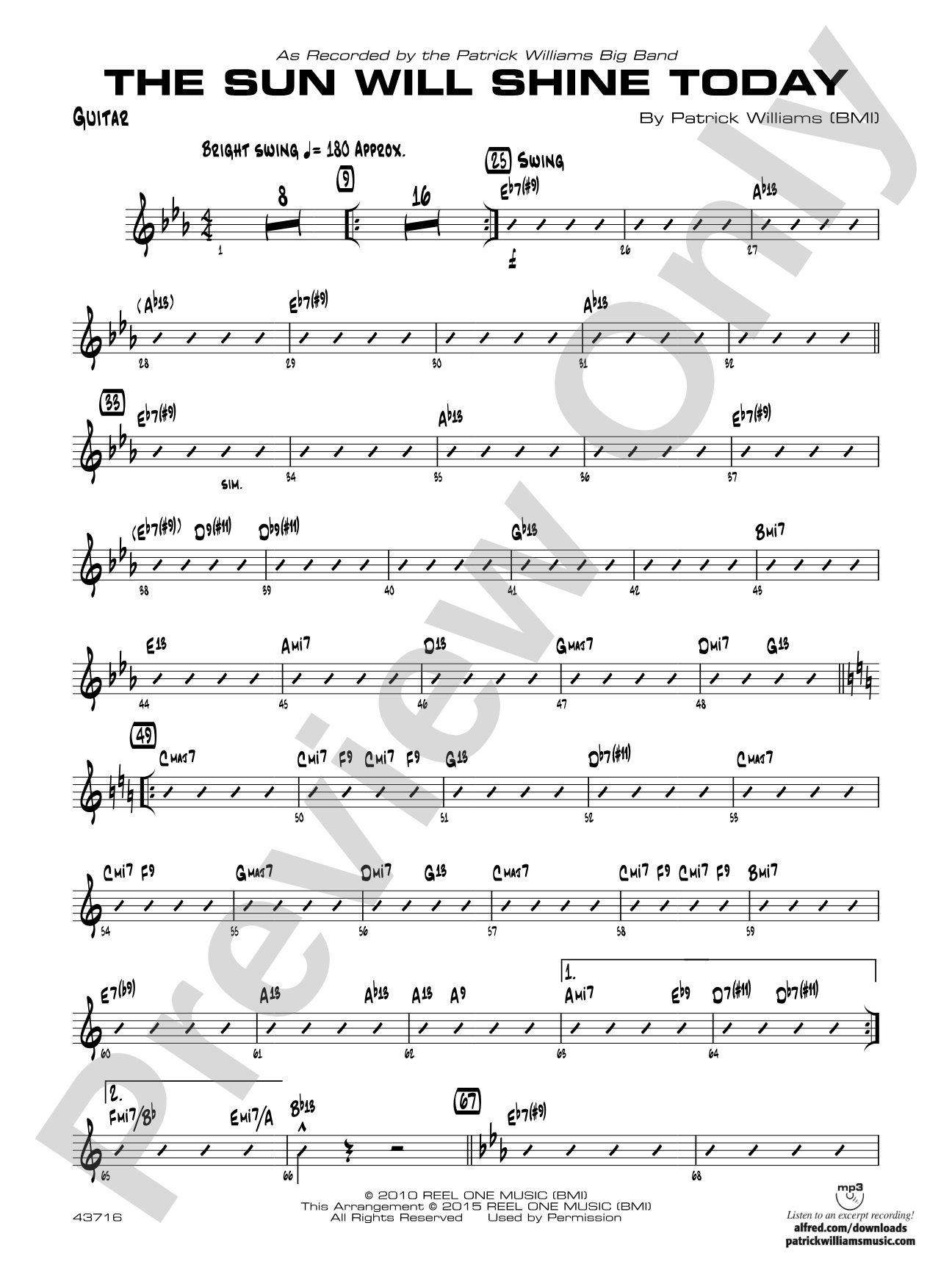
The Sun Will Shine Today: Guitar

By Patrick Williams

Grade: 6 (Professional / Very Advanced)

Item: 00-PC-0016838_G

Digital Download
$3.00
Description
A bright swinger solo feature at 180 BPM, Patrick Williams' "The Sun Will Shine Today" has standard instrumentation plus optional horn in F parts. It was originally scored for clarinet, but includes solo parts for trombones, B-flat instruments, and E-flat instruments. An ideal vehicle to feature your soloist and swing all the way home! (2:20)

Don't just read it, hear it, play along with it, and watch your students grow with it. In MakeMusic Cloud, The Sun Will Shine Today: Guitar comes alive with professional accompaniment, adjustable tempo, and built-in practice tools that turn solo practice into real progress.

Sample Audio
0:00
0:00
Sample Video
Additional Details
Series: Belwin Jazz: The Patrick Williams Series
Publisher: Alfred Music
Page Count: 114
SKU: 00-PC-0016838_G

More about this title

About the Composer: Patrick Williams

Patrick Williams is a prolific composer and arranger whose work spans film, television, and jazz. His compositions for jazz ensemble have become staples in educational and professional settings, known for their accessibility, strong melodic content, and sophisticated harmonic language. Williams has a gift for writing features that showcase individual soloists while maintaining ensemble cohesion, making his scores equally rewarding for advanced high school groups and professional ensembles.

Why we love this

Williams writes swing charts that actually swing, and this one gives your soloist real space to stretch over a solid, playable ensemble foundation. The orchestration across multiple solo voices (clarinet, trombone, B-flat and E-flat instruments) means you can rotate soloists throughout the year or feature different players in different performances without relearning the piece. At Grade 6, it's genuinely challenging for the ensemble parts without being fussy about intonation or articulation details.

What to expect

Optimistic and groovy, with a title that matches its character. The swinging tempo and bright harmonic movement create forward momentum, while the feature passages invite soloists to play with genuine lyricism and blues inflection. The overall effect is uplifting without being saccharine, a piece that lands as confidently in a jazz festival as it does in a pops concert.

Who it's for

Jazz ensemble directors working with advanced high school, college, or professional groups who want a feature vehicle that serves both the soloist and the ensemble. Musicians at this level appreciate the harmonic sophistication and the opportunity to play authentic swing phrasing without the complexity of difficult ensemble rhythms or exposed tuning challenges.

How to get the most out of it

  • Lock in the rhythm section first, especially the walking bass and ride cymbal pattern at 180 BPM. Once the groove sits, the ensemble parts fall into place naturally.
  • Give your soloist several rehearsals to develop phrasing and dynamics independently before running full sections. The best swing solos emerge from conversation with the rhythm section, not from following the printed rhythm exactly.
  • Balance the ensemble voicings so the soloist never has to oversing to be heard. Reeds and brass should sit comfortably behind, not underneath.
  • Use the optional horn in F parts strategically. If you have strong horn players, they add warmth to the mid-range; if not, the piece works completely without them.

How to use it

Close a first half or program finale with this one. Its energy and clear structure make it an excellent closer that leaves audiences wanting to applaud, and the 2:20 length fits perfectly in contest or festival time slots. It also works beautifully as a feature during a jazz showcase or in a mixed program pairing chamber works with larger ensemble pieces.

Skills your students will build

  • Swing rhythmic feel and articulation (eighth-note triplet interpretation)
  • Ensemble balance in feature accompaniment contexts
  • Jazz voicing and harmonic awareness (reading chord changes from conductor charts)
  • Solo phrasing and blues-inflected language
  • Sight-reading multiple solo parts (clarinet, trombone, B-flat and E-flat options)

You May Also Like