
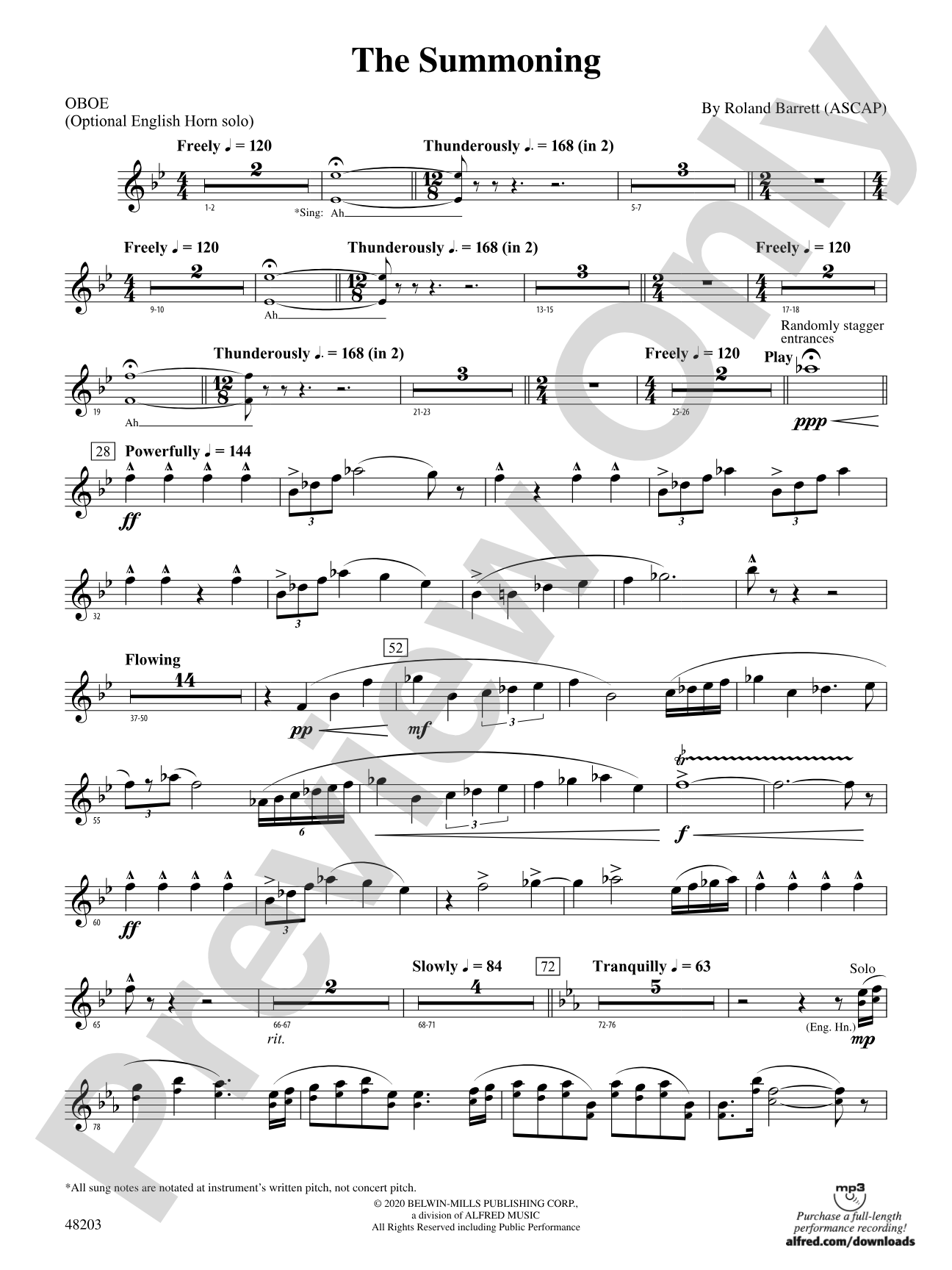

The Summoning: Oboe
By Roland Barrett
Grade: 3.5 (Medium)
Item: 00-PC-0018560_O1
$3.00
Pickup currently not available
Description
Featuring vividly contrasting dynamics and style with an occasional hint of contemporary notations, this stunning work was commissioned by the Honeove Falls-Lima High School Wind Ensemble in New York and their director Mark Borden. Opening with four brass soloists stationed throughout your performance area are interrupted with thunderous percussion punctuation. The composer seamlessly transitions from vigorous musical statements to chaotic motifs resolving to flowing charismatic melodies. Certain to command attention and arouse the senses. (5:45)


Don't just read it, hear it, play along with it, and watch your students grow with it. In MakeMusic Cloud, The Summoning: Oboe comes alive with professional accompaniment, adjustable tempo, and built-in practice tools that turn solo practice into real progress.
Open in the Player
Jump straight in and assign it today.
Start Your Free Trial
Open this title and explore the full library in minutes.
Sample Audio
1
Audio File
--:--
0:00
0:00
Sample Video
Additional Details
Series:
Belwin Concert Band
Publisher:
Alfred Music
Page Count:
292
SKU:
00-PC-0018560_O1
More about this title
About the Composer: Roland Barrett

Roland Barrett has been composing and arranging for concert band, chamber ensembles, and marching arts since joining the University of Oklahoma's faculty in 2001. His work spans more than two hundred published compositions and arrangements, earning recognition from the Dallas Wind Symphony, countless honor bands across the country, and national platforms including NPR, the Midwest Band & Orchestra Convention, and the International Trumpet Guild.
Beyond the concert stage, Barrett serves as the musical arranger for the Pride of Oklahoma marching band while teaching undergraduate and graduate theory and composition courses with emphasis on twentieth-century techniques. His contributions to the field have been recognized multiple times through ASCAP Plus awards, affirming his standing as both an active educator and prolific voice in contemporary band literature.
Why we love this
The Summoning commands the full architecture of the concert band through spatial and sonic drama. Four brass soloists distributed across your performance space create an immediate territorial claim, while the percussion punctuation keeps ensemble and audience perpetually alert. What sets this apart is Barrett's fluency with contrast itself: the work doesn't just move between loud and soft or fast and slow, but between fundamentally different musical languages, making the final resolution to flowing melody feel genuinely earned rather than formulaic.
What to expect
The opening summons: brass voices calling from different directions, lonely and purposeful, until percussion shatters the moment with raw force. From there, the music fractures into disorientation and restless energy before gradually coalescing into a lyrical statement that feels like resolution. The entire arc suggests something being called forth, resisting, and finally taking its true form.
Who it's for
This work belongs in the library of any Grade 3.5 concert band serious about programming that energizes and commands attention. Directors seeking a piece with contemporary compositional voice but clear accessibility will find The Summoning rewarding for both rehearsal engagement and audience impact.
How to get the most out of it
- Place the opening brass soloists in actual corners or wings of your concert space if possible; the physical separation amplifies the spatial drama before the full band enters.
- Balance the contemporary notational elements carefully in rehearsal by modeling the exact articulation and decay you want rather than assuming prior exposure to extended techniques.
- Shape the transition passages with conductor clarity; the chaotic sections need obvious metric or gestural signposts so the ensemble understands when ensemble unity returns.
- Give the percussion section independent rehearsal time on the thunderous punctuation figures so they lock in as unified interruptions, not scattered hits.
How to use it
Program The Summoning as a high-impact concert opener or as the centerpiece of a concert exploring contemporary band writing. Its five-minute-forty-five-second duration and dramatic arc make it a natural choice for festival and contest play, where it will command judges' and audiences' full attention without demanding excessive rehearsal time from an intermediate ensemble.
Skills your students will build
- Spatial awareness and intonation across distributed ensemble formations
- Reading and executing contemporary notations with precision
- Contrast and dynamic control across stylistically diverse sections
- Ensemble unity when transitioning between chaotic and lyrical musical language
- Rhythmic precision in accompanying soloists and punctuation figures