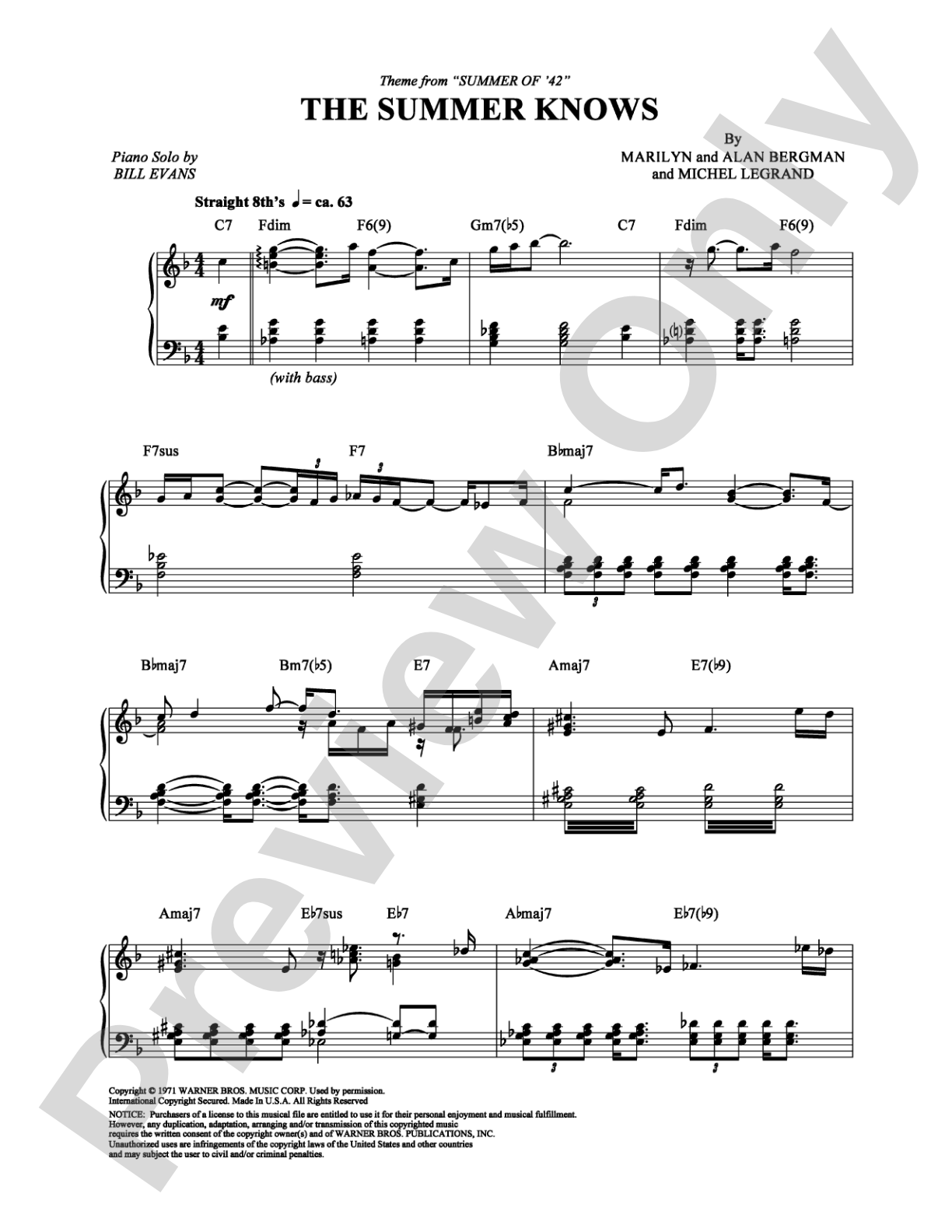
The Summer Knows (Theme From "Summer of '42"): Piano Digital Sheet Music

The Summer Knows (Theme From "Summer of '42"): Piano Digital Sheet Music

Bill Evans, Michel Legrand

Item: 00-PS-0005419

Digital Download
$3.99
Description

The Summer Knows (Theme From "Summer of '42"): Piano Digital Sheet Music isn't in MakeMusic Cloud just yet...but it could be. Let us know you'd like to see it, and you'll help shape what comes next. In the meantime, start a free trial and dive into thousands of interactive titles your students can play along with today.

Sample Audio
No sample audio found.
Sample Video
Additional Details
SKU: 00-PS-0005419

More about this title

About the Artist: Bill Evans

Bill Evans (1929-1980) was a pianist and composer who fundamentally changed how jazz musicians approach harmony and melody. His innovative touch at the keyboard, refined harmonic sensibilities, and ability to accompany himself shaped modern jazz piano across three decades. Evans recorded prolifically as a leader, in trios, and as a sideman, leaving behind a catalog that rewards close study from both performance and theoretical perspectives.

His work demonstrates how a classical music foundation (he studied at Southeastern Louisiana University) could deepen rather than limit jazz expression. For music students, Evans's recordings and compositions offer a masterclass in listening: his sense of space, his use of tension and release, and his melodic phrasing across complex chord changes remain endlessly instructive.

Why we love this

This digital arrangement captures one of Evans's signature interpretations of Michel Legrand's elegant theme, giving students and teachers access to a piece that demonstrates how jazz pianists reimagine popular material through harmonic sophistication and restraint. The Summer Knows sits at an accessible entry point to Evans's musical language: listeners can immediately hear his touch and sensibility without requiring advanced jazz literacy, yet the harmonic language rewards deeper study.

What to expect

Unhurried and reflective, with a bittersweet warmth. The melody unfolds over gently shifting harmonies that seem to float rather than anchor, creating a sense of wistfulness without sentimentality. Evans's interpretation invites the listener into an intimate space, almost as if you're hearing him think through the tune at the piano.

Who it's for

Piano students and teachers exploring jazz standards and the intersection of popular melody with sophisticated harmony will find this piece both playable and instructive. Advanced intermediate players comfortable with jazz comping and seventh chords will have the most direct path to performance.

How to get the most out of it

  • Pay attention to Evans's use of silence and space; resist the urge to fill every moment with sound. His approach to comping and melody is architectural, built on what he leaves out as much as what he plays.
  • Study the recording to understand his touch and pedal work. The digital score reflects the notes, but Evans's tone and sustain are equally part of the composition.
  • Work through the harmonic progressions separately from the melodic line. Understanding the chord movement underneath helps you shape the melody with intention rather than habit.
  • Balance the lyrical quality of the theme with rhythmic precision in the accompaniment. Evans never rushes; the feeling of ease comes from secure time, not rubato.

How to use it

This works well in a jazz recital or concert exploring standards and their interpretations, or as part of a program theme around film music. It can also serve as a repertoire choice for students studying jazz arranging and harmonic analysis, since Evans's reading of the chords differs meaningfully from the original.

Skills your students will build

  • Reading and performing jazz chord symbols and extended harmony
  • Balancing melody and comping in a single-pianist context
  • Understanding how to reharmonize familiar material while respecting its essential character
  • Developing control over touch and pedal to shape tone and sustain
  • Interpreting rhythmic flexibility and space within a steady underlying pulse

You May Also Like