
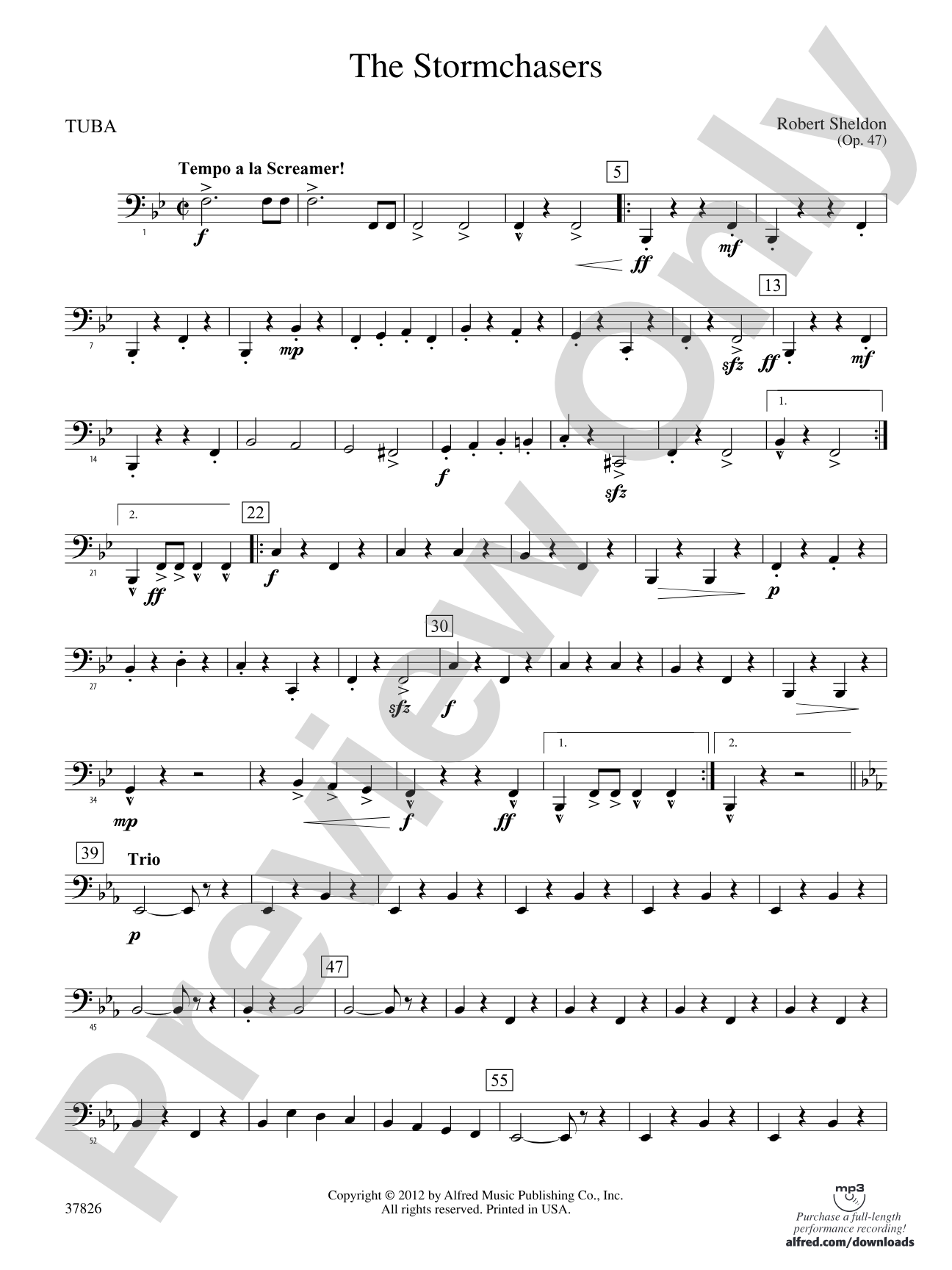

The Stormchasers: Tuba
By Robert Sheldon
Grade: 4 (Medium Difficult)
Item: 00-PC-0015356_TB1
$3.00
Pickup currently not available
Description
Commissioned by and written for the Dixon (IL) Municipal Band, "The Stormchasers" is a march in the style of a circus "screamer," featuring fanfares, flourishes and tuneful melodies, all played at a very aggressive tempo. Having been raised in Florida and attending the University of Miami, the composer's nod to "Uncle Henry" is sure to bring a smile to anyone who is a lover of those great Fillmore marches. (2:00)


Don't just read it, hear it, play along with it, and watch your students grow with it. In MakeMusic Cloud, The Stormchasers: Tuba comes alive with professional accompaniment, adjustable tempo, and built-in practice tools that turn solo practice into real progress.
Open in the Player
Jump straight in and assign it today.
Start Your Free Trial
Open this title and explore the full library in minutes.
Sample Audio
1
Audio File
--:--
0:00
0:00
Sample Video
No sample videos found.
Additional Details
Series:
Alfred Concert Band
Publisher:
Alfred Music
Page Count:
258
SKU:
00-PC-0015356_TB1
More about this title
About the Composer: Robert Sheldon

Robert Sheldon stands among today's most widely performed composers for wind band, with works that appear on honor band lists and concert stages across the globe. His honors include recognition from the American School Band Director's Association, Phi Beta Mu, and the American Society of Composers, Authors and Publishers. Beyond composition, Sheldon has shaped music education as lead author of Sound Innovations for Concert Band and maintains an active schedule conducting All-State and Regional Honor Bands.
Sheldon's conducting and clinician work spans six continents, from Japan and Australia to Germany and Canada. His commissions and annual publications demonstrate a sustained commitment to the wind band repertoire. In 2020, VanderCook College of Music granted him an honorary doctorate in recognition of his contributions to the field.
Why we love this
Sheldon captures the energy and pageantry of the classic American march without relying on tired formulas. The "screamer" style, complete with fanfares and flourishes, gives your band permission to play with abandon, while the tuneful melodies ensure the piece stays rooted in musicality rather than spectacle. This is the kind of commission that reminds audiences why the march remains a cornerstone of concert band repertoire.
What to expect
Imagine a circus tent full of activity: bright brass fanfares burst through the air, melodies leap and flourish, and the whole ensemble charges forward with urgency and joy. This march pulses with the kind of infectious momentum that makes audiences sit up and smile, rooted in the great Fillmore tradition that Sheldon admires and reimagines for today's bands.
Who it's for
Concert bands working at Grade 4 level who are ready to tackle a piece with high energy and technical demands without excessive difficulty. Ensembles that thrive on audience engagement will find this march rewarding; it's written for performers who can handle aggressive tempos and articulate playing, not beginners.
How to get the most out of it
- Commit fully to the aggressive tempo; any hesitation will rob the march of its kinetic drive and circus energy.
- Balance the fanfare textures so that the trumpet and horn lines sit clearly above the foundation without drowning out the melodic material underneath.
- Shape the tuneful sections with vibrant articulation and phrase contour; these melodies deserve to sing even when the tempo demands urgency.
- Use the percussion section as your rhythm anchor, especially during the fastest passages, to keep ensemble cohesion sharp.
How to use it
Program this as a high-energy opener or closer that showcases your band's technical precision and musical confidence. It pairs especially well on a concert that mixes standard repertoire with newer commissions, or on a pops or community concert where the audience expects accessible, exciting music. The 2:00 duration makes it ideal for filling a concert slot without requiring extended rehearsal resources.
Skills your students will build
- Playing with control at aggressive tempos
- Balancing fanfare textures across multiple sections
- Articulate execution of rapid scalar and technical passages
- Sustained phrasing and musicality within a fast-moving march context
- Ensemble cohesion and rhythmic precision under demanding tempo