
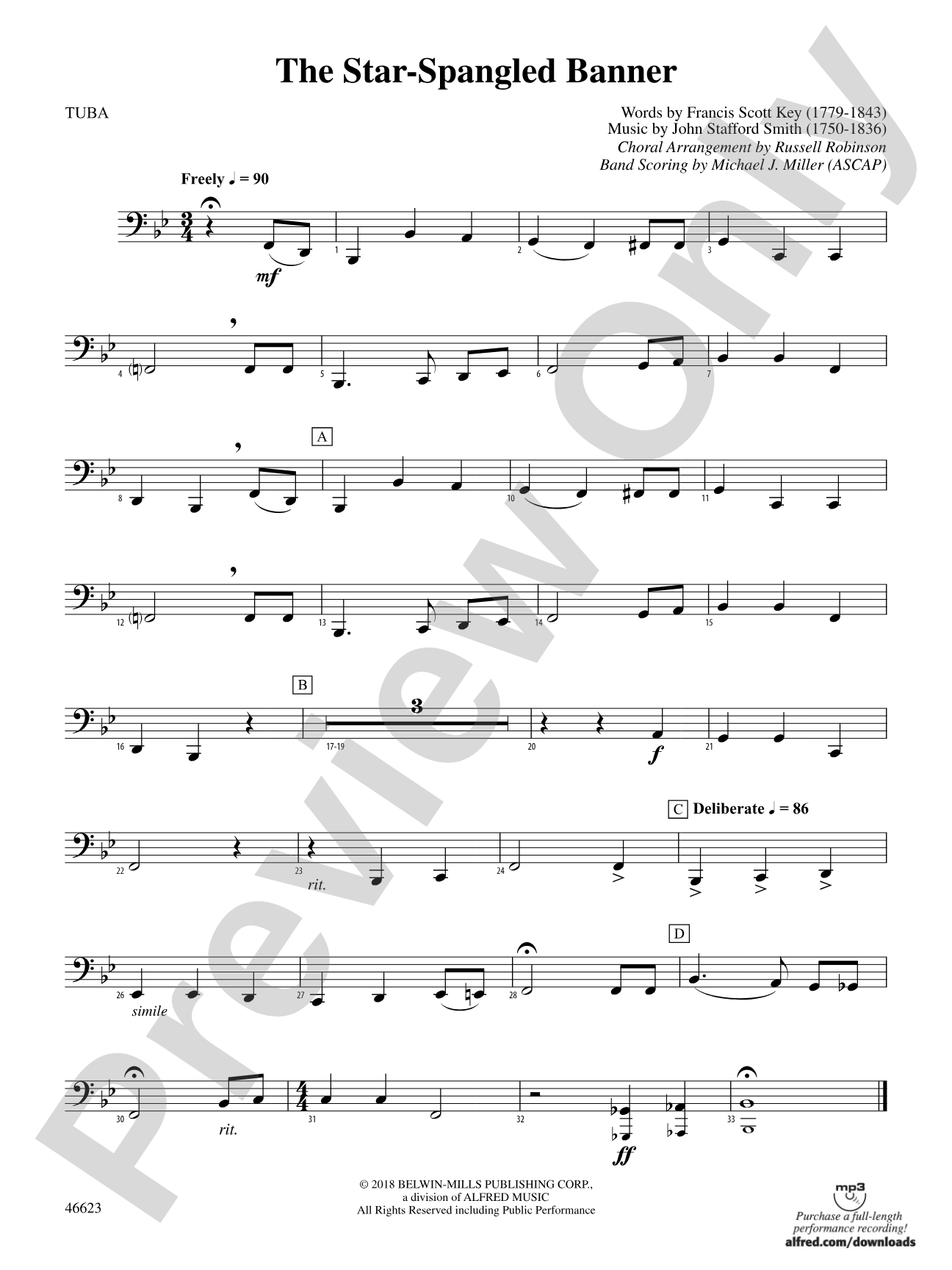

The Star-Spangled Banner: Tuba
(for Band and Optional Choir)
Words by Francis Scott Key, music by John Stafford Smith / choral arrangements by Russell Robinson, band scoring by Michael J. Miller
Grade: 2 (Easy)
Item: 00-PC-0018057_TB1
$3.00
Pickup currently not available
Description
With lush textures, this setting is perfect for performance on the stage or outdoors as a band-only setting or with any of Russell Robinson's industry standard choral voicings: SATB (00-SV9722), 3-Part Mixed (00-SVM03013), SSAA (00-SVM01013), TTBB (00-SV9913), and 2-Part (00-SVM05042). The setting is so versatile it also works as a woodwind sextet or a brass quintet for instrumental performance or as an accompaniment. A must-have in every library! (1:15)


Don't just read it, hear it, play along with it, and watch your students grow with it. In MakeMusic Cloud, The Star-Spangled Banner: Tuba comes alive with professional accompaniment, adjustable tempo, and built-in practice tools that turn solo practice into real progress.
Open in the Player
Jump straight in and assign it today.
Start Your Free Trial
Open this title and explore the full library in minutes.
Sample Audio
1
Audio File
--:--
0:00
0:00
Sample Video
Additional Details
Series:
Belwin Young Band
Publisher:
Alfred Music
Page Count:
122
SKU:
00-PC-0018057_TB1
More about this title
About the Composer: John Stafford Smith
John Stafford Smith (1750-1819) was an English composer and organist whose melodic gift shaped choral and vocal music for generations. Though he composed numerous works across sacred and secular genres, his most enduring legacy comes from a single melody: the tune he composed in 1773 that would eventually carry the words of "The Star-Spangled Banner." Smith's ability to craft memorable, singable lines made his music accessible to amateur musicians and professionals alike.
Smith served as organist at several English churches and held positions in London's musical establishment during the late 18th century. His output included glees, catches, and vocal music that reflect the refined taste of his era. Today, his melody stands as one of the most recognized tunes in American culture, a testament to the power of a well-crafted, noble musical phrase.
Why we love this
Robinson and Miller have engineered an arrangement that works seamlessly as a concert band piece on its own while remaining fully compatible with any of five different choral voicings. This flexibility means you can program it with your band, add voices when you want them, or adapt it across an entire season without maintaining separate scores. The Grade 2 scoring ensures young musicians can execute the patriotic material convincingly without technical barriers getting in the way.
What to expect
Noble and expansive. The lush orchestration creates a sense of occasion and dignity while remaining accessible to younger musicians. The setting breathes space around the melody, allowing the tune's inherent character to shine without bombast.
Who it's for
Band directors working with Grade 2 ensembles who need a patriotic anchor for concerts, ceremonies, or outdoor performances. This arrangement serves directors who want the option to add choral voices later in the season or for special events, since the conductor score makes it simple to layer in any of the compatible voicings without reworking the band parts.
How to get the most out of it
- Balance the melodic line across your first-chair players and upper woodwinds; the lush textures can obscure the tune if the primary melody doesn't sing through clearly.
- Shape the phrase endings with a slight ritardando to honor the ceremonial character, especially approaching the final cadence.
- If combining with choral parts later, rehearse the band arrangement first in isolation so instrumentalists own their parts before layering voices on top.
- Engage your low brass and woodwinds to anchor the harmonic foundation; the full texture depends on solid support underneath.
How to use it
Open a patriotic concert or ceremony with this arrangement as a band-only statement of identity and place. Because the voicing is so clean at Grade 2, it also works well as a transition piece into more complex repertoire within the same concert, or as the emotional anchor for an all-American program in the spring.
Skills your students will build
- Balancing melodic and harmonic voices within a full ensemble texture
- Executing sustained, singing lines at a moderate tempo
- Responding to shape and phrase direction from the conductor
- Reading and performing parts in concert band format at Grade 2 difficulty