
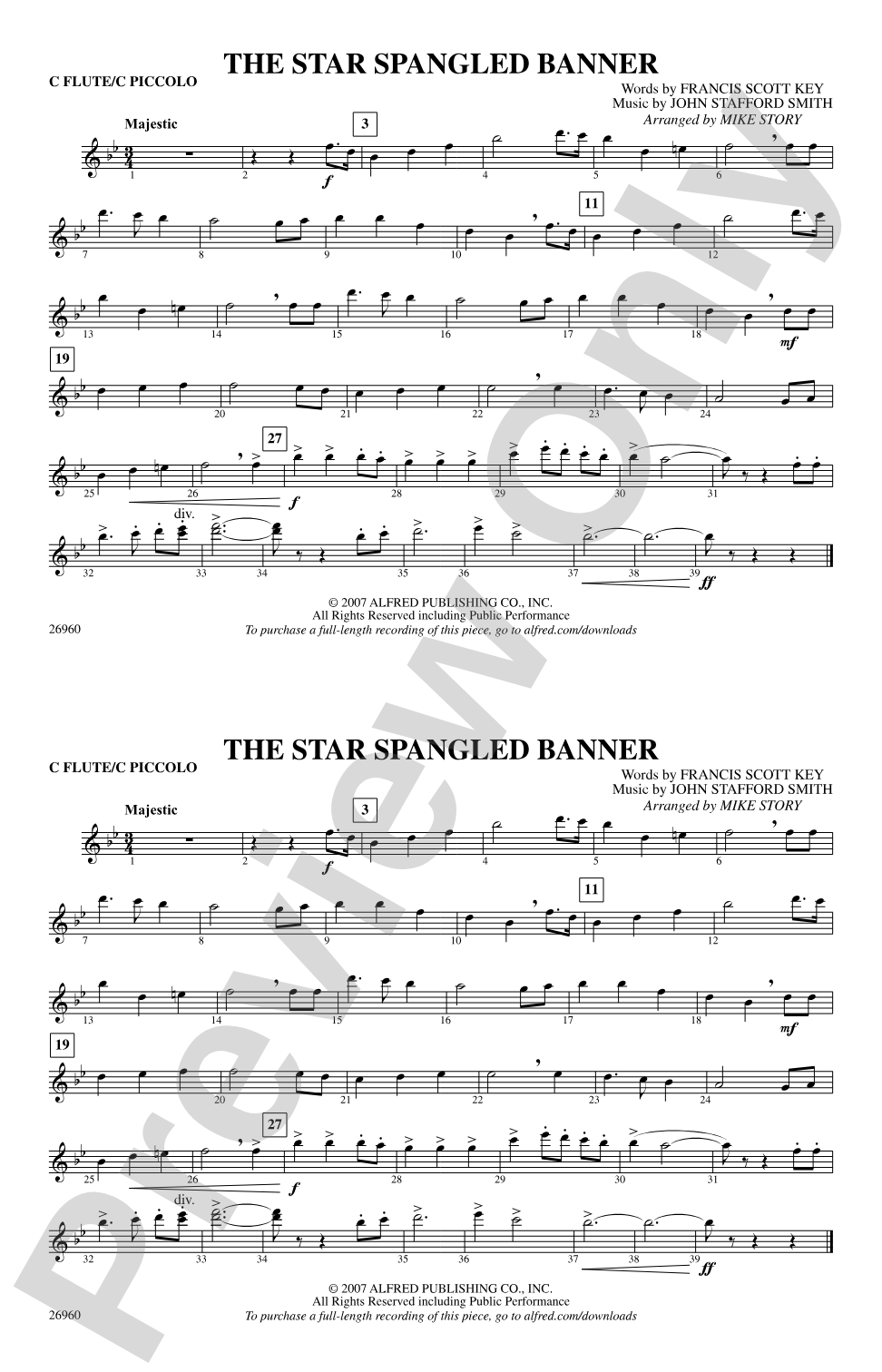

The Star-Spangled Banner: Flute
By Francis Scott Key / arr. Mike Story
Grade: 2 (Easy)
Item: 00-PC-0018133_F1
$3.00
Pickup currently not available
Description
Here is an extremely easy arrangement of America's national anthem. Written not only for the young band, but for any group with limited instrumentation or rehearsal time. Mike has eliminated the fermatas and the ritard by carefully placing extra measures in the last two phrases. Stunning!


Don't just read it, hear it, play along with it, and watch your students grow with it. In MakeMusic Cloud, The Star-Spangled Banner: Flute comes alive with professional accompaniment, adjustable tempo, and built-in practice tools that turn solo practice into real progress.
Open in the Player
Jump straight in and assign it today.
Start Your Free Trial
Open this title and explore the full library in minutes.
Sample Audio
1
Audio File
--:--
0:00
0:00
Sample Video
Additional Details
Series:
Big and Easy
Publisher:
Alfred Music
Page Count:
114
SKU:
00-PC-0018133_F1
More about this title
About the Composer: Francis Scott Key
Francis Scott Key (1779-1843) was an American lawyer, author, and amateur poet who witnessed the British bombardment of Fort McHenry in Baltimore Harbor during the War of 1812. Inspired by the sight of the American flag still flying over the fort after the night-long attack, he composed the lyrics to "The Star-Spangled Banner" in September 1814, setting them to the tune of a popular British song. His words captured the resilience and defiance of a young nation under siege, and the anthem has endured as one of the most recognizable and emotionally potent songs in American culture.
For music educators, Key's legacy extends beyond the historical moment. Teaching his anthem requires students to engage with melody that demands careful phrasing, dynamic control, and respect for the text. The piece invites conversations about American history, patriotism, and the relationship between music and national identity.
Why we love this
Mike Story's arrangement strips away the technical obstacles that often derail young bands while preserving the dignity and impact of the anthem. By replacing fermatas and ritards with structural measures, the piece becomes playable for groups with limited rehearsal time without sacrificing musicality. This is the kind of practical, intelligent arranging that allows beginning musicians to perform something genuinely meaningful on 4th of July concerts and patriotic events.
What to expect
Reverent yet energized, this version honors the anthem's solemnity while remaining nimble enough for young performers to handle without tension. The familiar melody unfolds with clarity, allowing the emotional substance of the words to land even in an instrumental setting. There is pride in this sound, not struggle.
Who it's for
Young bands and less experienced ensembles that want to perform the national anthem for patriotic events without a steep learning curve. Groups with incomplete instrumentation or limited rehearsal time will find this arrangement immediately accessible. Any director seeking a Grade 2 patriotic piece that carries genuine weight and occasion.
How to get the most out of it
- Balance the melody across your brass section so the tune projects clearly; resist the urge to overload the lead voice, especially in marching contexts where acoustics can work against you.
- Shape the phrases with subtle crescendos and diminuendos even within the Grade 2 framework; the anthem's emotional arc depends on breathing room, not stasis.
- Establish a solid tempo early in rehearsals and stick with it. Since fermatas are eliminated, your ensemble needs confidence in the pulse to maintain forward motion through the two final phrases.
- Pay attention to articulation consistency between sections. Young bands often fragment the sound when different parts use different tonguing or attack styles on the same note.
How to use it
Perform this as the opening or closing statement of any summer concert with a patriotic or Americana theme. It works exceptionally well on 4th of July programs, Memorial Day observances, or any concert where you need an anthem that does not require months of rehearsal. Consider pairing it with other Grade 2 Americana selections to build thematic cohesion.
Skills your students will build
- Playing sustained, singing melodic lines at the Grade 2 level
- Maintaining ensemble balance between melody and accompaniment in a marching band context
- Executing clean articulation and releases in a group setting
- Understanding the relationship between tempo, phrasing, and emotional expression in patriotic music
- Reading and responding to conductor cues for dynamic and tempo control