The Star-Spangled Banner Sheet Music Preview

The Star-Spangled Banner: Piano

Arranged by Brian Chung

Item: 00-PS-0017797

Digital Download
$7.99
Description
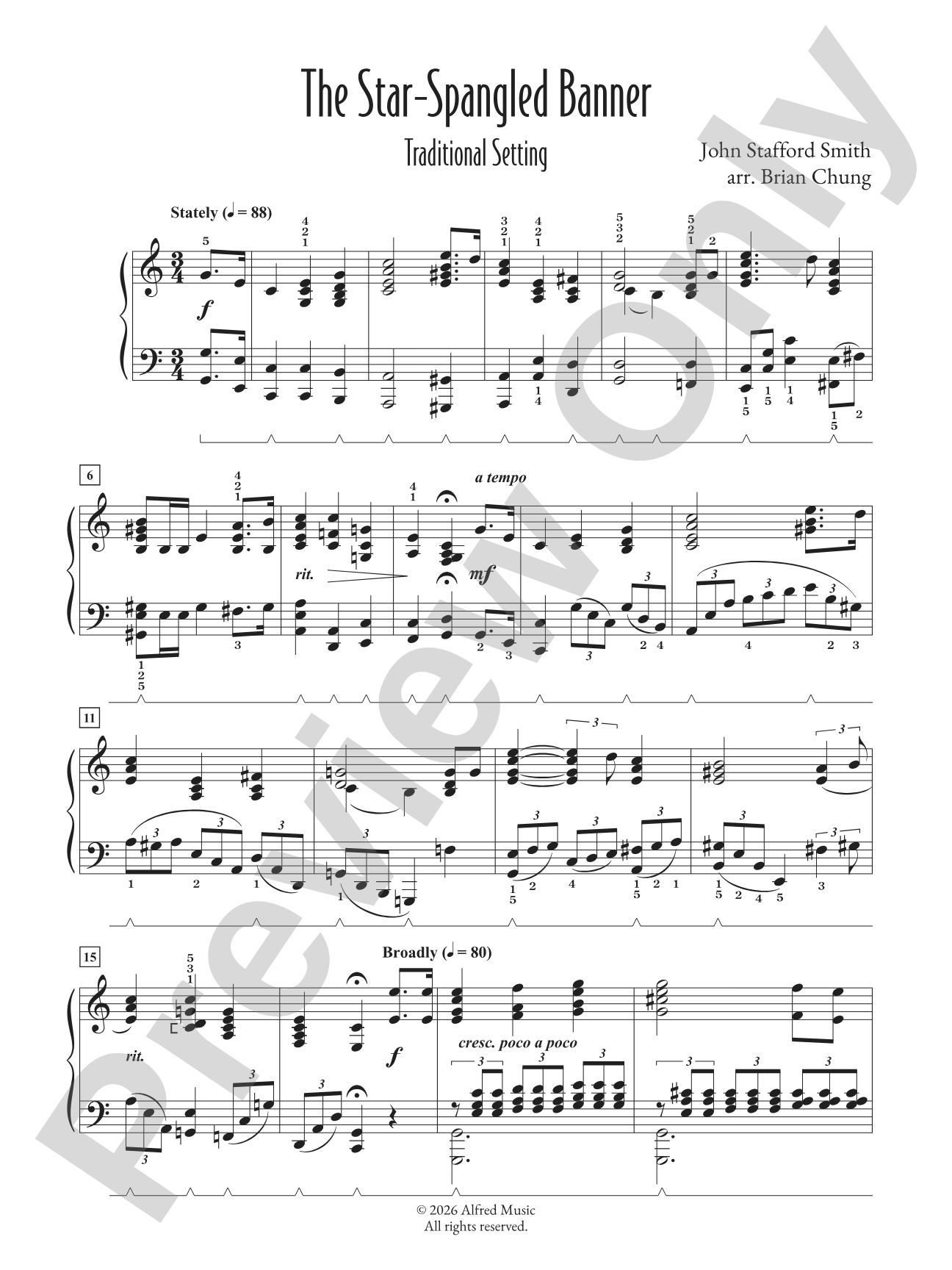
This collection presents two contrasting musical interpretations of The Star-Spangled Banner for late-intermediate pianists. The first setting is a rousing and energetic rendition featuring brilliant fanfare-like passages, colorful harmonies, and a strong patriotic spirit. In contrast, the second arrangement takes a more relaxed and expressive approach in 4/4 time, with rich jazz-inspired harmonies and a lyrical, reflective style. Together, these settings showcase both the grandeur and heartfelt beauty of America's national anthem.

The Star-Spangled Banner: Piano isn't in MakeMusic Cloud just yet...but it could be. Let us know you'd like to see it, and you'll help shape what comes next. In the meantime, start a free trial and dive into thousands of interactive titles your students can play along with today.

Sample Audio
1 1 Star Spangled Banner (Traditional Setting) --:--
2 2 Star Spangeld Banner (Artistic Style) --:--

1 Star Spangled Banner (Traditional Setting)

0:00
0:00
Sample Video
Additional Details
Series: Signature Series
SKU: 00-PS-0017797

More about this title

About the Arranger: Brian Chung

Brian Chung

Brian Chung has spent decades shaping the music world from multiple angles: as a performer at the keyboard, a composer and arranger crafting new works, and an executive who spent over three decades leading Kawai America Corporation. His educational foundation combines an undergraduate degree in business from the University of Michigan with conservatory training in piano and conducting at the Guildhall School of Music and Drama in London, rounded out by an MBA from Northwestern University's Kellogg School.

His contributions to music education have earned him recognition as a 2004 MTNA Foundation Fellow, a 2010 MTNA Distinguished Service Award recipient, the 2019 MTNA Citation for Leadership, and the 2024 Lifetime Achievement Award from the California Association of Professional Music Teachers. He remains an active conference speaker and dedicated member of the music-making community.

Why we love this

Offering two distinct interpretations of the same anthem gives students agency to choose their musical voice rather than settling for a single definitive version. The contrast between fanfare-driven grandeur and jazz-inflected introspection means you can program this twice in a season without repetition, or let advanced students explore both arrangements as studies in orchestration and harmonic language.

What to expect

The first reading sweeps in with ceremonial energy and colorful harmonic turns that honor the anthem's grandeur without veering into bombast. The second settles into a more intimate space, letting jazz voicings soften the melody into something contemplative and deeply felt.

Who it's for

Late-intermediate pianists ready to navigate more sophisticated harmonic language and develop interpretive maturity. This works equally well for recital preparation, concert encores, or students exploring how arrangement choices reshape a familiar melody.

How to get the most out of it

  • Let the fanfare passages in the first setting breathe with clear articulation; these brilliantly harmonized moments are the arrangement's showpiece, so resist the urge to rush.
  • In the second arrangement's jazz-influenced harmonies, aim for warmth in the midrange rather than heavy pedal work. The reflective mood relies on clarity of voice leading.
  • Record yourself playing both versions back-to-back to hear how the contrasting moods frame each other. This reinforces the interpretive choices inherent in each setting.

How to use it

Pair these as a prelude and postlude to a patriotic concert program, using the energetic first setting to open and the reflective second to close. Alternatively, feature one version in a recital focused on American music, then reserve the other for a different concert season so the arrangement stays fresh.

Skills your students will build

  • Interpreting harmonic color and voicing choices specific to jazz idioms
  • Balancing accompaniment patterns with melodic prominence in both fanfare and lyrical textures
  • Pedaling for clarity in thick, jazz-influenced chord structures
  • Understanding how arrangement choices alter the emotional impact of a well-known melody
  • Developing performance maturity through contrasting musical characterizations

You May Also Like