
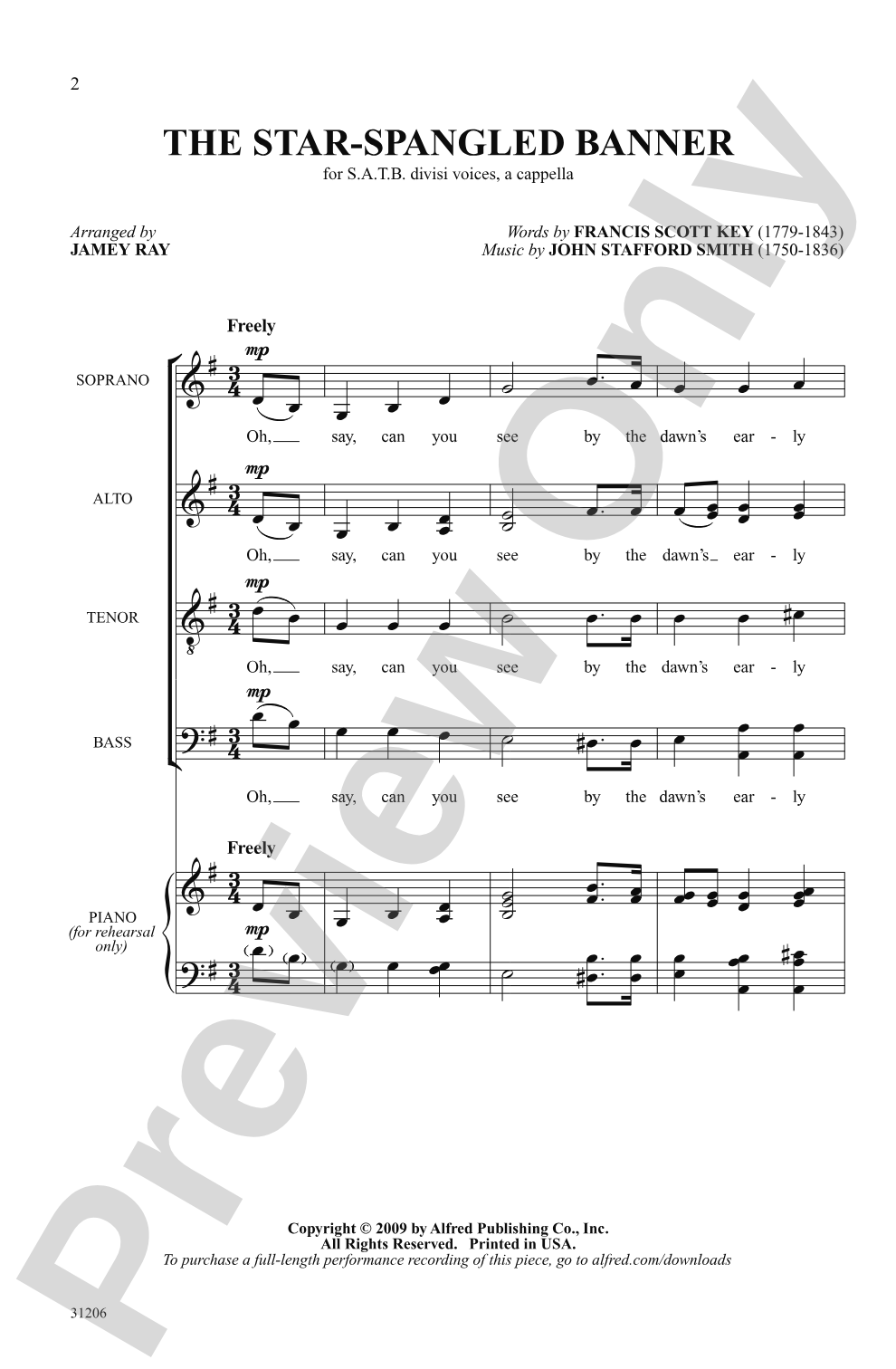

The Star-Spangled Banner: SATB, a cappella Choral Octavo
Words by Francis Scott Key, music by John Stafford Smith / arr. Jamey Ray
Item: 00-PO-0000816
$2.05
Minimum order quantity: 20 copies
Pickup currently not available
Related Items
The Star-Spangled Banner: SATB, a cappella Choral Octavo |
$2.05
|
View |
Description
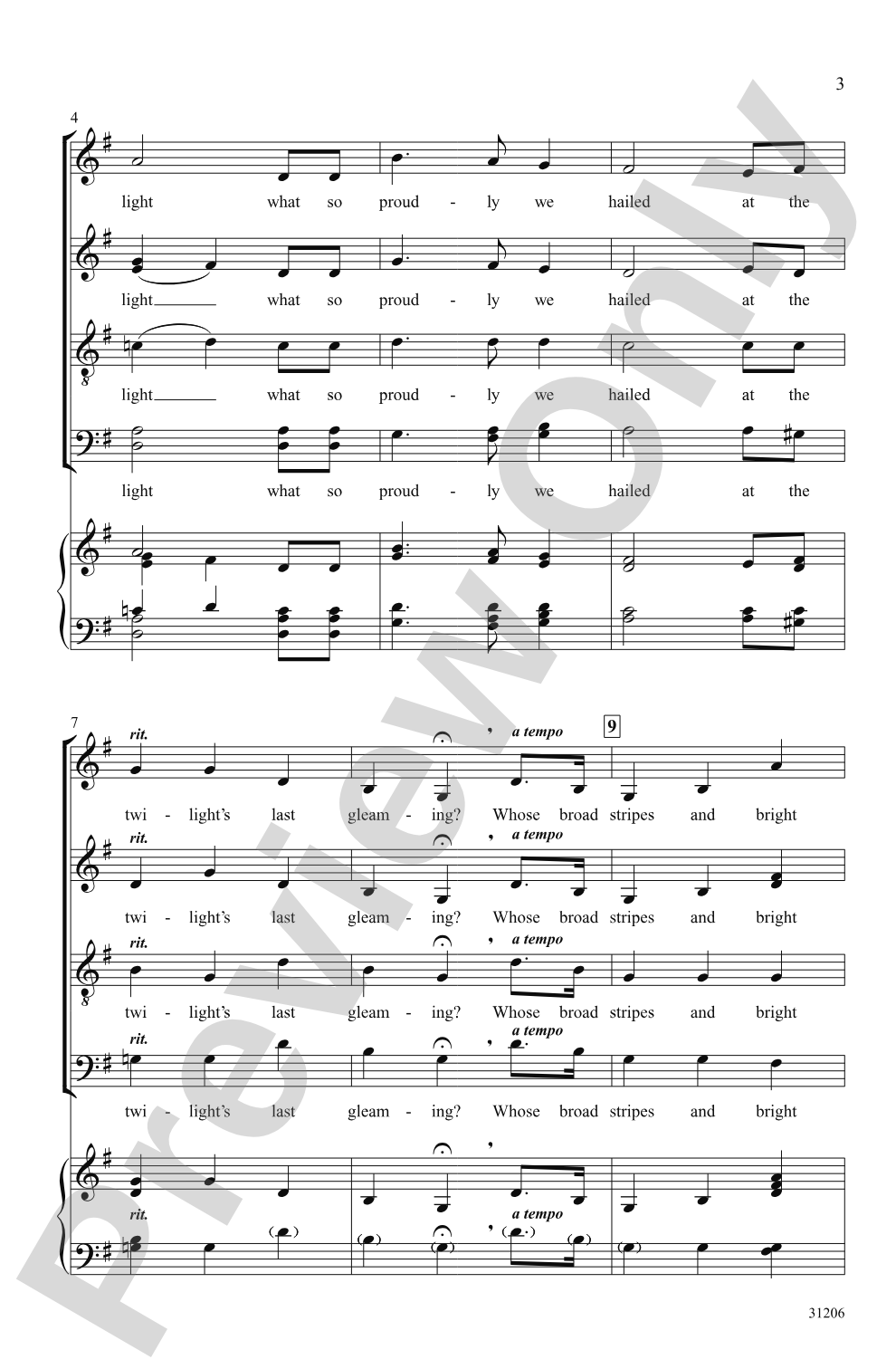
Make a powerful impression with this contemporary a cappella setting of America's national anthem. A standout arrangement with glorious divisi that becomes even more expansive toward the end. It will be remembered about long after the concert or game is over. This title is available in MakeMusic Cloud.


The Star-Spangled Banner: SATB, a cappella Choral Octavo isn't in MakeMusic Cloud just yet...but it could be. Let us know you'd like to see it, and you'll help shape what comes next. In the meantime, start a free trial and dive into thousands of interactive titles your students can play along with today.
Request This Title
Tell us you want it.
Start Your Free Trial
Explore everything that's ready to play right now.
Sample Audio
1
Audio File
--:--
0:00
0:00
Sample Video
No sample videos found.
Additional Details
Series:
Alfred Choral Designs
Publisher:
Alfred Music
Page Count:
8
SKU:
00-PO-0000816
More about this title
About the Composer: John Stafford Smith
John Stafford Smith (1750-1836) was an English composer and organist whose prolific output spanned sacred music, glees, and vocal works. Though largely forgotten outside music education circles for most of the 20th century, he secured immortality through a single melody: the tune now universally paired with "The Star-Spangled Banner." Smith originally composed this tune for a poem titled "To Anacreon in Heaven," written for a London gentlemen's social club in the 1770s. Francis Scott Key's words, penned after the War of 1812, eventually transformed Smith's composition into America's national anthem.
Smith's gift lay in writing memorable, singable melodies with clear harmonic architecture. His tune endures because it balances accessibility with genuine musical substance, a hallmark of his best work across all genres. For music educators, his legacy reminds us that a single well-crafted composition can outlive its original context and find new meaning across generations.
Why we love this
Jamey Ray's arrangement honors the familiar melody while expanding its harmonic palette through strategic divisi, giving even intermediate choirs the tools to sound polished and impressive. The piece respects singers' voices while demanding musicality; there's no hiding in unison, and the expanding texture toward the final statement creates a genuine sense of occasion. For programs needing a patriotic anchor that transcends "safe" or "easy," this delivers genuine artistry.
What to expect
The piece opens with the familiar melody stated clearly, allowing singers and listeners to immediately connect with the tune. As the arrangement unfolds, additional voice parts create harmonic richness and complexity, building toward a swelling final statement where expanded divisi gives the national anthem a contemporary yet respectful treatment. The lack of instrumental accompaniment places all expressive responsibility on the singers, creating an intimate yet grand musical moment.
Who it's for
This arrangement suits intermediate to advanced high school and college choirs, adult community choirs, and skilled club singers seeking a patriotic piece with musical substance. It works equally well for concert programming and special occasion performances where impact matters. Any ensemble confident with a cappella singing and comfortable with divisi voicing will find this arrangement within reach.
How to get the most out of it
- Balance the divisi carefully in rehearsal by sectioning each part independently first. Lock vowels across all sections singing the same text simultaneously, then layer parts back together to ensure blend.
- Shape the melody with long-line phrasing that lets the familiar tune breathe. Avoid scooping into notes or rushing through text, especially in the opening phrase.
- Use dynamic contrast strategically. The expanding divisi toward the end will naturally build excitement, so keep earlier sections slightly more restrained to preserve that trajectory.
- Mark breath points clearly on scores so all singers breathe together. With no instrumental support, ensemble breathing becomes a visible musical gesture.
How to use it
Reserve this for moments requiring genuine ceremony: opening a patriotic concert, concluding a summer community event, or standing as the centerpiece of a July 4th performance. Its contemporary harmonic language allows it to sit comfortably alongside both traditional and modern choral repertoire without sounding out of place. The eight-page format and manageable range make it a strong choice for a mid-program placement rather than an encore.
Skills your students will build
- Singing a cappella with ensemble precision and no instrumental reference
- Reading and balancing divisi voices within SATB texture
- Sustaining melodic integrity across rearrangement and harmonic expansion
- Breathing as a unified ensemble in the absence of instrumental phrasing
- Shaping long-line melody with clear articulation and dynamic control