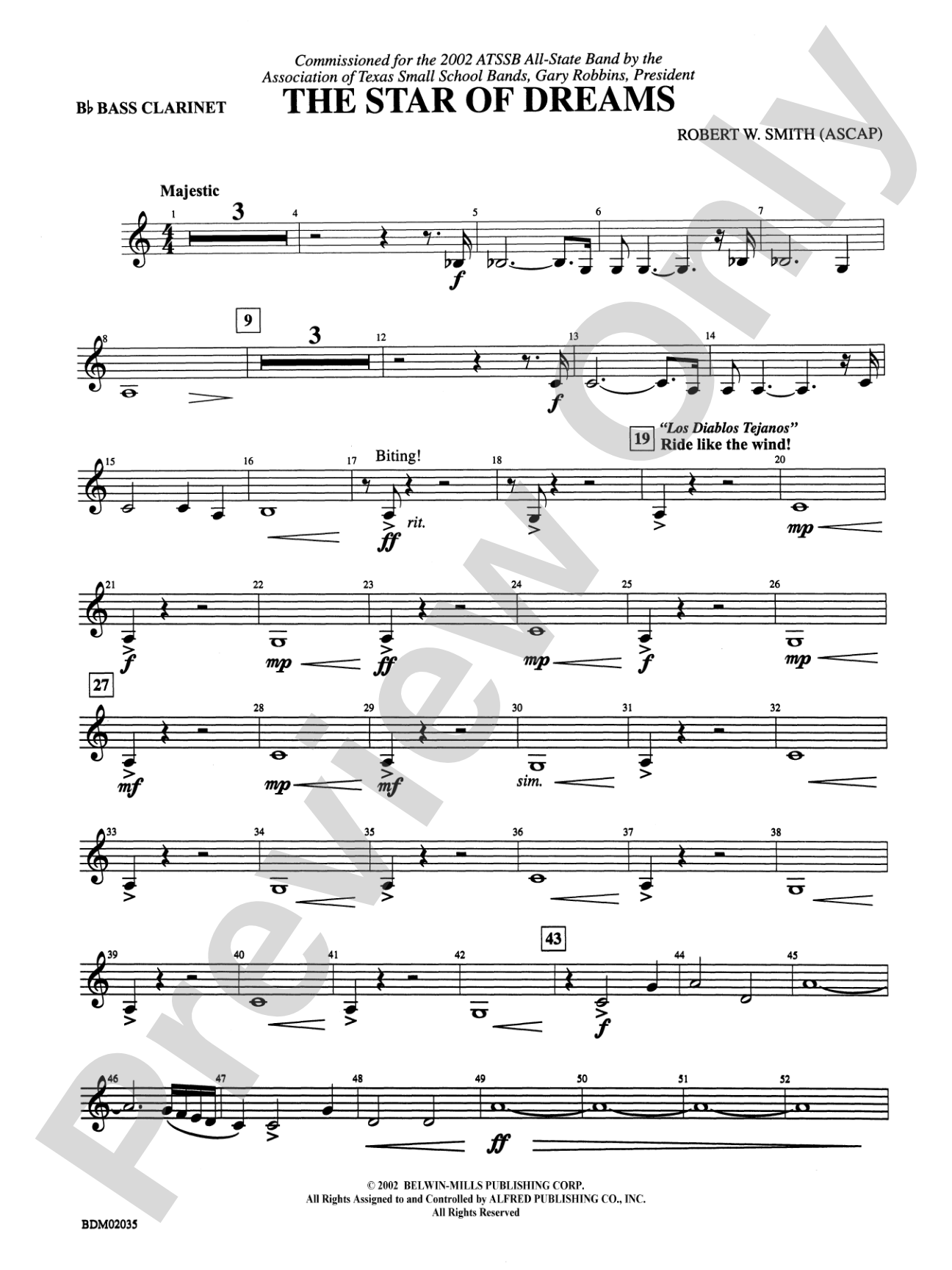
The Star of Dreams: B-flat Bass Clarinet Sheet Music Preview

The Star of Dreams: B-flat Bass Clarinet

By Robert W. Smith

Grade: 3 (Medium Easy)

Item: 00-PC-0002168_BC

Digital Download
$3.00
Description
This brilliantly exciting composition was inspired by the exhilaration of life in the Old West. The stampede of the livestock is interrupted with pointed bursts of musical energy. (6:37)

Don't just read it, hear it, play along with it, and watch your students grow with it. In MakeMusic Cloud, The Star of Dreams: B-flat Bass Clarinet comes alive with professional accompaniment, adjustable tempo, and built-in practice tools that turn solo practice into real progress.

Sample Audio
0:00
0:00
Sample Video
Additional Details
Series: Belwin Concert Band
Publisher: Alfred Music
Page Count: 260
SKU: 00-PC-0002168_BC

More about this title

About the Composer: Robert W. Smith

Robert W. Smith

Robert W. Smith stands among the most performed composers of concert band and orchestral music in the United States. With more than 400 published works predominantly distributed through Alfred Music, his compositions span symphonies, original concert pieces, and arrangements that have reached audiences across North America, Europe, Australia, and Asia. Smith holds a Bachelor of Music Education from Troy State University in Alabama and a Master of Music from the University of Miami.

Beyond the concert hall, Smith's music has secured a distinctive place in American culture. His works have underscore Olympic broadcasts, graced opening ceremonies honoring dignitaries, and anchored major television productions from the Macy's Thanksgiving Day Parade to the Ringling Brothers/Barnum & Bailey Circus. As both a composer and active clinician, he has conducted and taught throughout the United States, Canada, Japan, Australia, and Europe, building a reputation for creating music that resonates with developing and advanced ensembles alike.

Why we love this

Smith captures the raw energy of the American frontier in a piece that Grade 3 bands can handle without sacrificing excitement or sophistication. The contrasting sections between the livestock stampede and bursts of musical intensity create natural points for pacing within a rehearsal and memorable moments in performance that audiences immediately understand.

What to expect

The energy of dust and thunder on an open landscape. Rhythmic propulsion and bursts of brass excitement evoke the chaos of a livestock stampede, punctuated by moments of tension and release that keep the listener engaged throughout.

Who it's for

Grade 3 concert bands seeking a substantial performance piece that works equally well for festival competitions and concert programming. Directors looking to capture student enthusiasm through vivid programmatic writing will find this especially effective with intermediate players who respond to musical storytelling rather than purely technical display.

How to get the most out of it

  • Balance the brass figures that depict the stampede with clarity. These need to cut through the full band without overwhelming the other voices; clarity matters more than volume.
  • Shape the pointed bursts of energy as sudden accents and dynamic shifts rather than indiscriminate loudness. Let the silence or reduced volume surrounding them amplify their impact.
  • Work the percussion section early to establish the rhythmic momentum of the stampede. Their foundation will steady the horns and woodwinds through the most active passages.
  • Bring out the contrasting melodic material between sections. The piece's storytelling hinges on recognizing when the action shifts from one character to another.

How to use it

Program this as a high-energy centerpiece that bridges lighter opening works and more contemplative selections. Its western imagery and contest-friendly duration (6 minutes 37 seconds) make it ideal for festival performances or concerts themed around American music or nature.

Skills your students will build

  • Sustaining rhythmic momentum through repeated figures without losing precision
  • Balancing dynamic contrasts between sections of varying density
  • Responding to sudden musical cues and accented figures with ensemble unity
  • Interpreting programmatic content to shape phrase direction and intensity

You May Also Like