
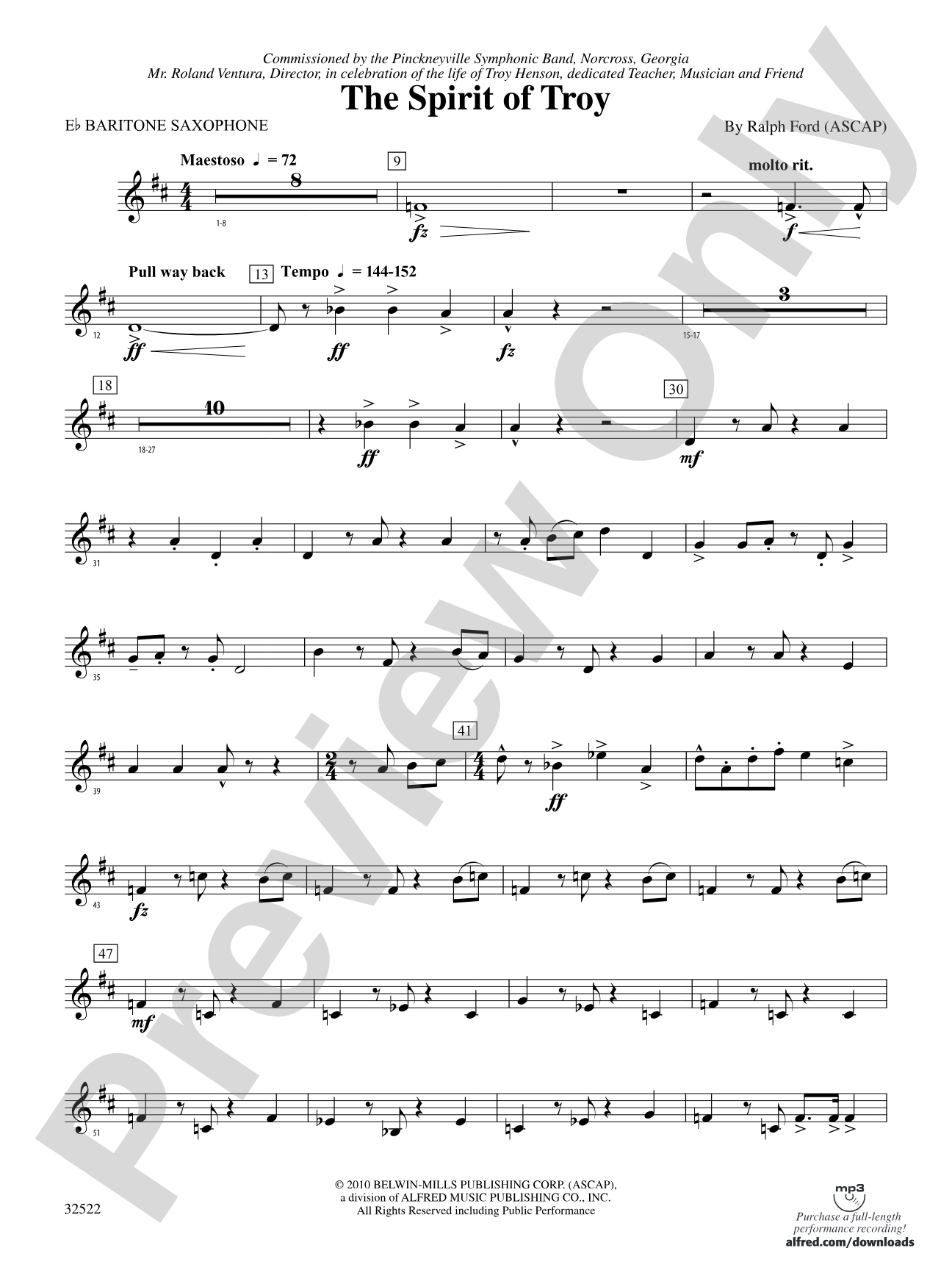

The Spirit of Troy: E-flat Baritone Saxophone
By Ralph Ford
Grade: 3 (Medium Easy)
Item: 00-PC-0014399_BTX
$5.99
Pickup currently not available
Description
Spirited indeed, this Ralph Ford original overture provides ample opportunity to showcase every member of your ensemble. Opening with a broad and building fanfare, the work bursts with energy featuring a charismatic rhythmic foundation that sets the stage for several soloist statements. The work builds to a frenzy and develops quietly and reflectively to a dramatic, grandiose conclusion. Diverse and endearing, this is an outstanding choice for concert and contest alike! This title is available in MakeMusic Cloud.


Don't just read it, hear it, play along with it, and watch your students grow with it. In MakeMusic Cloud, The Spirit of Troy: E-flat Baritone Saxophone comes alive with professional accompaniment, adjustable tempo, and built-in practice tools that turn solo practice into real progress.
Open in the Player
Jump straight in and assign it today.
Start Your Free Trial
Open this title and explore the full library in minutes.
Sample Audio
1
Audio File
--:--
0:00
0:00
Sample Video
No sample videos found.
Additional Details
Series:
Belwin Concert Band
Publisher:
Alfred Music
Page Count:
254
SKU:
00-PC-0014399_BTX
More about this title
About the Composer: Ralph Ford
Ralph Ford has shaped concert band and orchestra repertoire for decades through his dual work as both composer and arranger. Since 1986, he has served on university music faculties teaching orchestration, arranging, theory, and applied brass while simultaneously building an extensive catalog of original works and arrangements for Belwin Alfred Music in Los Angeles. His output exceeds 250 published titles spanning concert band, orchestra, jazz ensemble, and marching band, many of them premiered and performed by university, military, professional, and school ensembles internationally.
Beyond the concert hall, Ford's versatility extends into media and broadcast production, where he has composed news packages for national television affiliates, created commercial jingles and animation scores, and produced recordings across traditional and digital platforms. His early appointment as Director of Jazz Ensemble I during his undergraduate years at Troy State University set the trajectory for a career defined by mentorship, commission work, and the creation of accessible yet musically substantial repertoire for developing ensembles.
Why we love this
The Spirit of Troy delivers genuine architectural interest across a single movement, moving from a commanding fanfare through rhythmic vigor, reflective development, and a powerful finale without feeling episodic or scattered. Ford structures the piece to highlight individual sections and soloists without requiring extensive independence from younger players, making it equally effective for contest adjudicators and concert audiences who value coherent musical storytelling.
What to expect
The Spirit of Troy announces itself with unambiguous energy and purpose, drawing listeners in immediately through its opening fanfare before settling into a grooved, rhythmic character that propels the middle section forward. The work's emotional landscape shifts without warning, pulling back into introspection before erupting into a finale that feels both celebratory and earned, leaving performers and audiences equally energized.
Who it's for
Concert band directors seeking a Grade 3 original that moves beyond theme-and-variations into genuine dramatic arc. This overture suits ensembles performing at contests, festivals, and standard concert settings where you want music that showcases every section without requiring soloists of exceptional maturity or technical facility.
How to get the most out of it
- Establish the fanfare's foundational pulse before dynamics swell; the opening gains impact through precision and control rather than immediate volume, allowing the build to feel organic and inevitable.
- Balance the rhythmic foundation (likely in lower brass and percussion) so it sits underneath soloist statements rather than competing; this brings clarity to the charismatic moments Ford highlights throughout.
- Shape the quiet reflective section with intentional phrase direction and air; rushing here diminishes the contrast before the grandiose conclusion.
- Release the final climax completely rather than sustaining; a clean cutoff punctuates the dramatic arc and leaves the audience with decisive closure.
How to use it
Position this as your concert opener to establish ensemble confidence and audience engagement, or save it for a festival performance where its combination of contest appeal and musical substance maximizes impact. The single-movement structure and moderate length make it ideal for mixed programs featuring longer classical works or a concert dedicated entirely to contemporary American overtures.
Skills your students will build
- Balancing ensemble texture when multiple sections voice simultaneous thematic and rhythmic material
- Executing clear dynamic shapes and transitions across mood changes
- Sustaining rhythmic precision within a driving pulse
- Responding to sudden textural shifts from full ensemble to sparse textures
- Building and releasing tension through phrasing rather than tempo manipulation