
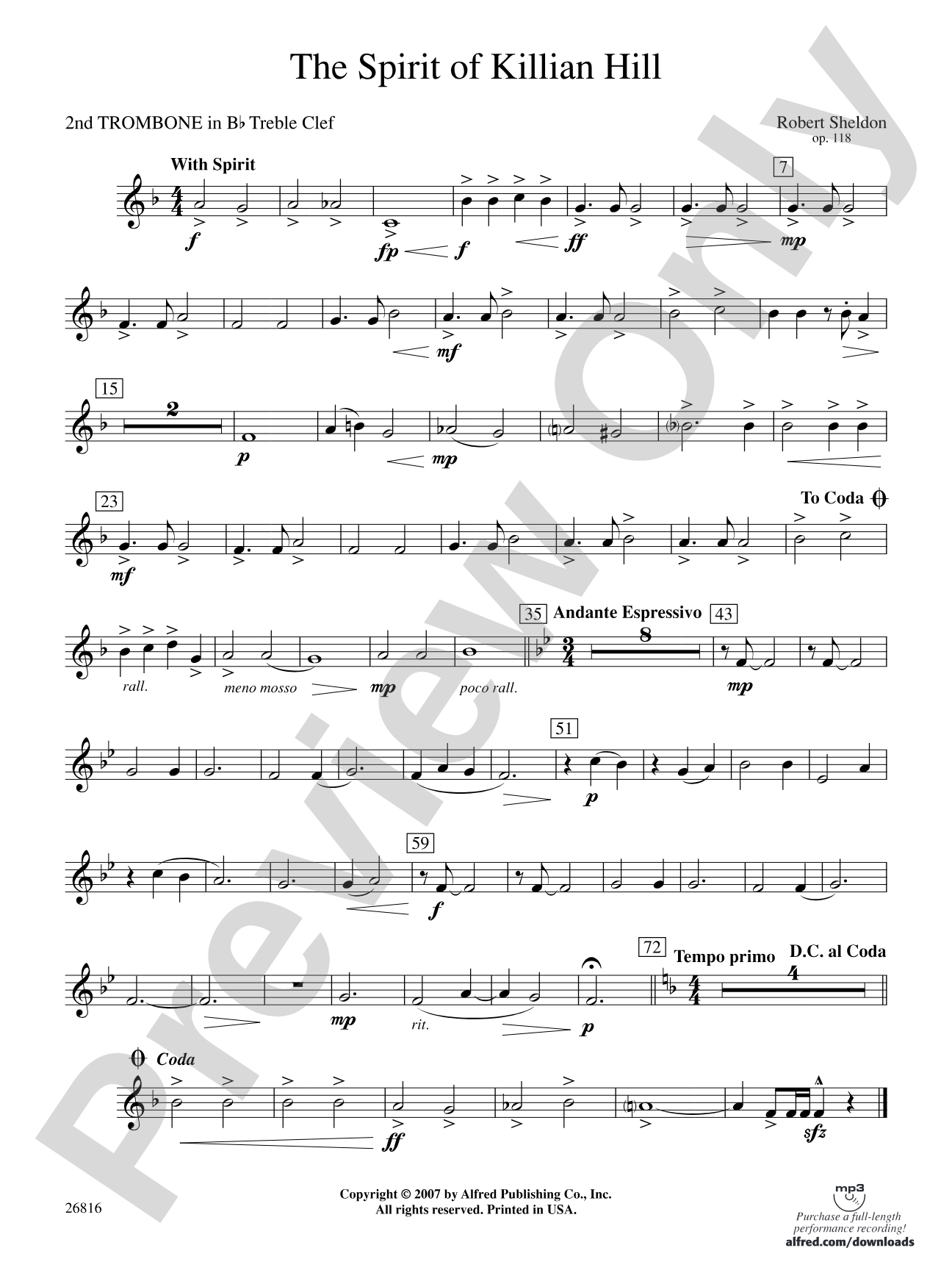

The Spirit of Killian Hill: (wp) 2nd B-flat Trombone T.C.
By Robert Sheldon
Grade: 2.5 (Medium Easy)
Item: 00-PC-0001254_wpTN2TC
$3.00
Pickup currently not available
Description
The Spirit of Killian Hill is a concert overture that begins with a spirited march-like theme that transitions to a lyrical contrasting section in three-four time. A Da Capo and Coda round out this tuneful piece that is not only fun to play, but very enjoyable for the audience as well. This title is available in MakeMusic Cloud.


Don't just read it, hear it, play along with it, and watch your students grow with it. In MakeMusic Cloud, The Spirit of Killian Hill: (wp) 2nd B-flat Trombone T.C. comes alive with professional accompaniment, adjustable tempo, and built-in practice tools that turn solo practice into real progress.
Open in the Player
Jump straight in and assign it today.
Start Your Free Trial
Open this title and explore the full library in minutes.
Sample Audio
1
Audio File
--:--
0:00
0:00
Sample Video
No sample videos found.
Additional Details
Series:
Young Symphonic
Publisher:
Alfred Music
Page Count:
67
SKU:
00-PC-0001254_wpTN2TC
More about this title
About the Composer: Robert Sheldon

Robert Sheldon's works dominate the wind band repertoire at every level. His compositions have earned recognition from the American School Band Director's Association, Phi Beta Mu, and ASCAP, and his music appears on contest and concert programs internationally. Beyond the page, Sheldon maintains an active schedule as guest conductor for All-State and Regional Honor Bands, and regularly leads clinics at universities and state music education conferences.
Sheldon's influence extends globally. He has conducted and clinicked throughout North America, Europe, Asia, and Australia, leading performances of his works in some of the world's most prestigious venues including Carnegie Hall, Orchestra Hall, and the Kennedy Center. VanderCook College of Music honored him with a doctorate in 2020, recognizing his sustained impact on music education and wind band literature.
Why we love this
Sheldon strikes the right balance here: enough musical substance to engage serious musicians, but zero pretension or technical overreach. The harmonic movement and orchestration reward good voicing and sectional independence without requiring virtuosity, making this an excellent confidence-builder for intermediate bands while remaining genuinely satisfying for audiences and musicians alike.
What to expect
The opening march-like theme arrives with immediate energy and clarity. When the piece shifts into the contrasting 3/4 section, the texture becomes more intimate and singing; woodwinds carry a genuine lyrical voice while accompaniment parts create warm harmonic support. The return to the opening material feels inevitable and earned, and the coda provides a bright, satisfying conclusion.
Who it's for
This overture fits bands working at the 2.5 level who want to program a piece that sounds larger than its technical demands suggest. Directors will appreciate that Sheldon's craftsmanship means students develop real musicianship while building repertoire they can perform confidently in concert and festival settings.
How to get the most out of it
- Emphasize the rhythmic precision of the march section. Clean articulation and tight attacks in the opening theme create the forward momentum that carries into the lyrical material.
- Let the 3/4 section breathe. This contrasting passage works best when musicians resist rushing; shape the melodic phrases with natural rubato rather than mechanical phrasing.
- Balance the full ensemble sound during the Da Capo return. The section will feel fresher if brass entries are confident but not overpowering to the woodwind countermelody.
- Shape the Coda with a clear sense of harmonic direction. Use dynamic shaping and slight tempo flexibility to build toward a satisfying close rather than simply repeating material.
How to use it
Program this as your concert opener to establish an energetic, approachable tone for the audience. Its combination of march-like vitality and lyrical substance also makes it an ideal selection for festival competitions where judges value both technical clarity and musical maturity without excessive complexity.
Skills your students will build
- Navigating key changes and harmonic rhythm across contrasting sections
- Balancing sectional independence in march-style writing
- Executing smooth stylistic transitions between rhythmic and lyrical material
- Ensemble balance and blend when multiple lines carry equal melodic weight
- Expressive phrasing in sustained passages within a grade-appropriate context