
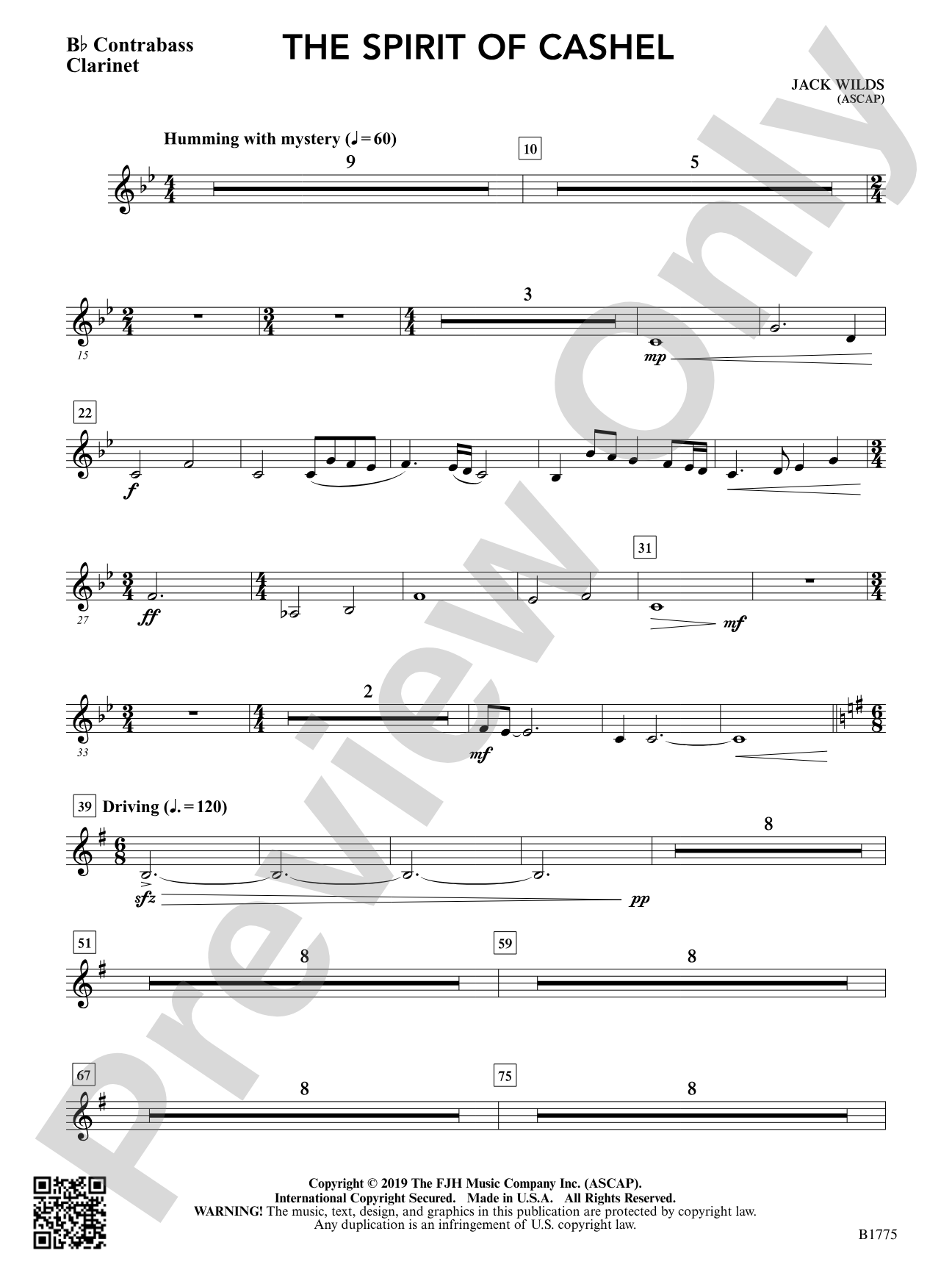

The Spirit of Cashel: B-flat Contrabass Clarinet
By Jack Wilds
Grade: 3.5;4
Item: 98-PC-DB1775_BCBC
$7.00
Pickup currently not available
Description
The legend and history of Ireland come alive in this work that captures the sense of ancient mystery and latent wildness that characterizes the Rock of Cashel. A beautifully crafted lyrical section and fiery jig combine to create a powerful piece that will energize the entire concert hall!


Don't just read it, hear it, play along with it, and watch your students grow with it. In MakeMusic Cloud, The Spirit of Cashel: B-flat Contrabass Clarinet comes alive with professional accompaniment, adjustable tempo, and built-in practice tools that turn solo practice into real progress.
Open in the Player
Jump straight in and assign it today.
Start Your Free Trial
Open this title and explore the full library in minutes.
Sample Audio
1
Audio File
--:--
0:00
0:00
Sample Video
Additional Details
Series:
FJH Concert Band
Publisher:
The FJH Music Company, Inc.
SKU:
98-PC-DB1775_BCBC
More about this title
About the Composer: Jack Wilds

Jack Wilds composes across all ages and ensembles, from children's choirs through professional orchestras, consistently drawing inspiration from visual art, literature, philosophy, and music itself. His chamber works have been performed by the Attacca Quartet, members of the New York Philharmonic and Atlanta Symphony, and at major festivals including the International Trombone Festival and Wyoming Festival.
As a former public school band director, Wilds has published over 40 works for developing musicians. His wind band compositions appear regularly on festival required repertoire lists worldwide and have been heard at the Midwest Clinic and national educator conferences. He serves as lecturer in composition, theory, and music technology at Texas State University and as Co-Director of Music at First Presbyterian Church in San Marcos, where he also maintains an active schedule as clinician and adjudicator.
Why we love this
Wilds crafts this work with real knowledge of what moves both audiences and young musicians. The structure itself teaches something valuable: pairing a lyrical middle section with a driving jig demonstrates how contrasting musical ideas can build momentum and emotional depth, giving students a masterclass in form and energy management they'll feel as they play.
What to expect
The piece conjures the weathered stone and windswept landscape of an Irish landmark, beginning with an air of ancient mystery before giving way to lyrical warmth and intimate expression. From there it ignites into the spirited motion of a jig, channeling wildness and joy in a way that transforms the ensemble from observers into storytellers.
Who it's for
Concert bands at the Grade 3.5 to 4 level who want repertoire with personality and contest appeal. Directors seeking a piece that balances musical substance with technical accessibility will find real value here; students engage more deeply when a work has narrative and cultural grounding rather than existing purely as a technical exercise.
How to get the most out of it
- Shape the lyrical section with genuine legato phrasing in the woodwinds; balance the melodic voices so the primary line emerges without drowning supportive harmonies.
- Let the jig section snap into place with crisp articulation across the ensemble, particularly in the rhythmic figures that drive the piece forward.
- Use the conductor score to map the dramatic arc from the atmospheric opening through the lyrical center and into the propulsive finale so your ensemble understands the journey they're taking the audience on.
How to use it
Place this as a concert closer when you want to leave audiences energized rather than reflective, or program it in the second half to shift the mood after a contrasting piece. The concert/festival designation makes it equally at home in a spring festival performance or as a legitimate competitive selection that judges will recognize as substantive work at its grade level.
Skills your students will build
- Stylistic contrast and expressive control (lyrical phrasing versus rhythmic vitality)
- Ensemble balance and blend across woodwind and brass choirs
- Articulation clarity in jig-style rhythmic figures
- Structural awareness through contrasting A-B-A form
- Cultural context and storytelling through music