The Sound Of Silence (arr. Mark Hayes) Sheet Music Preview

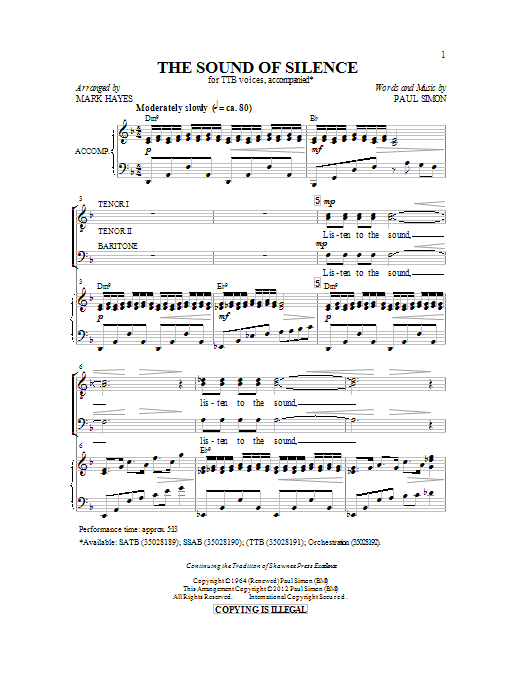
The Sound Of Silence (arr. Mark Hayes): TTB Choral Octavo

As performed by Simon Garfunkel / Arranged by Mark Hayes

Item: 35-DS00217717

Digital Download
$2.99

One moment…

Description

The Sound Of Silence (arr. Mark Hayes): TTB Choral Octavo isn't in MakeMusic Cloud just yet...but it could be. Let us know you'd like to see it, and you'll help shape what comes next. In the meantime, start a free trial and dive into thousands of interactive titles your students can play along with today.

Sample Audio
No sample audio found.
Sample Video
Additional Details
Publisher: Hal Leonard
Page Count: 11
SKU: 35-DS00217717

More about this title

About the Artist: Simon Garfunkel

Simon and Garfunkel defined the sound of 1960s folk rock, bringing poetic lyricism and intricate vocal harmonies to a generation. Their influence on contemporary choral arranging is profound; their songs have become staples in educational settings because they marry accessibility with genuine musical substance.

Why we love this

Mark Hayes understands how to preserve the introspective beauty of this song while giving it new life through three-part writing. The arrangement respects the original's quiet power without oversimplifying it, creating a piece that feels both familiar and freshly arranged.

What to expect

A moment of collective quiet in a busy world. The arrangement honors the song's meditative quality, with voices creating rich vertical sonorities that feel contemplative rather than elaborate. It invites listeners into the stillness of the text.

Who it's for

High school and community choirs seeking repertoire that speaks to contemporary audiences while offering real harmonic substance. Directors looking for a secular concert piece that connects with students because they know the original but challenges them to inhabit it differently.

How to get the most out of it

  • Balance the bass and second tenor lines carefully in the opening; they anchor the harmony but shouldn't overpower the melody.
  • Shape the text with intention, letting the quietness of the lyrical content guide your dynamic choices rather than relying on the familiar recording.
  • Allow space for breath and reflection between phrases; this song thrives on restraint, not momentum.
  • Blend vowels precisely in the sustained chords, paying special attention to the transition between sections where voices shift.

How to use it

Pair this with other folk or pop arrangements to build a set that spans decades of American songwriting. It works particularly well as a thoughtful contrast to more energetic concert material, or as the centerpiece of a program exploring how popular songs become choral standards.

Skills your students will build

  • Blending sustained harmonies in close voicing
  • Singing mixed meter or asymmetrical phrasing without losing shape
  • Interpreting familiar material with new musical perspective
  • Balancing part independence with ensemble unity in TTB texture

You May Also Like