The Sound Of Music Sheet Music Preview

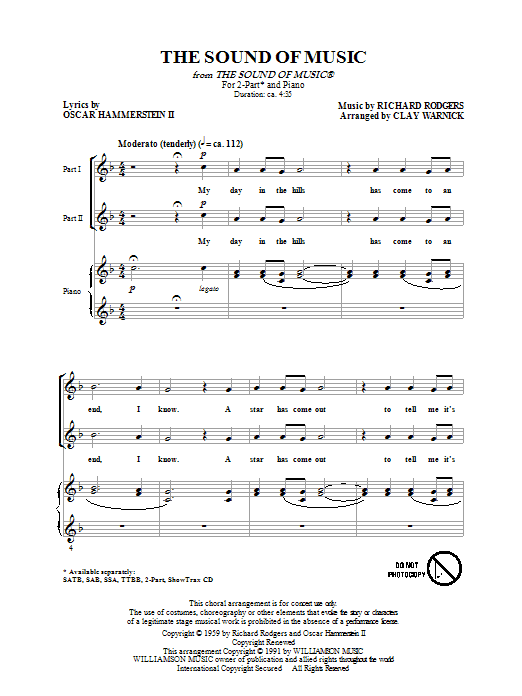
The Sound Of Music: 2-Part Choral Octavo

By Richard Rodgers / By Oscar Hammerstein II / Arranged by Clay Warnick

Item: 35-DS00126629

Digital Download
$2.50
Description

The Sound Of Music: 2-Part Choral Octavo isn't in MakeMusic Cloud just yet...but it could be. Let us know you'd like to see it, and you'll help shape what comes next. In the meantime, start a free trial and dive into thousands of interactive titles your students can play along with today.

Sample Audio
No sample audio found.
Sample Video
Additional Details
Publisher: Hal Leonard
Page Count: 7
SKU: 35-DS00126629

More about this title

About the Composer: Richard Rodgers

Richard Rodgers shaped American musical theater across five decades, composing melodies that became part of the cultural fabric. His partnership with Oscar Hammerstein II produced some of the most enduring scores in the genre, including The Sound of Music, South Pacific, and The King and I. For music educators, Rodgers represents accessible sophistication: his melodies sit naturally in the voice, his harmonic language is clear without being simplistic, and his ability to serve dramatic intent makes every phrase purposeful.

Why we love this

Clay Warnick's arrangement captures the heart of this beloved song while respecting what makes it work: the melody soars without strain, and the two-part writing creates genuine harmonic interest rather than settling for unison doubling. Directors reach for this piece because it works across ability levels and never feels condescending. It's the kind of arrangement that lets your singers experience genuine musicality and leaves the audience genuinely moved.

What to expect

Warmth, optimism, and quiet beauty fill this familiar melody. The two-part writing creates space rather than thickness, letting the lyrics breathe and the humanity of the song come through clearly.

Who it's for

This arrangement suits choirs ranging from community groups to school programs looking for repertoire that's genuinely singable and dramatically satisfying. It works equally well as a concert finale, a community event centerpiece, or a teaching tool for understanding how Broadway songwriting principles differ from classical choral writing.

How to get the most out of it

  • Shape the melody with long musical phrases rather than stopping at every bar line. This song breathes, and your singers should too.
  • Balance the two parts so neither disappears. The lower line has its own character and deserves audibility without overshadowing the melody.
  • Let the harmonic movement support the text. The shifts in harmony align with shifts in meaning, so your singers will find expressive depth if they're listening for it.
  • Explore dynamic contrast between the verse and refrain. The piece can build naturally without feeling forced if you trust the architecture Warnick has created.

How to use it

This piece excels as a closing number when you want to send an audience out moved but not exhausted. It also serves as an excellent bridge between classical and musical theater repertoire, showing singers how different traditions approach melody and harmony. Consider pairing it with other lighter fare in a spring concert or end-of-year celebration.

Skills your students will build

  • Sustaining long musical phrases across multiple measures
  • Balancing melody and harmony in two-part texture
  • Connecting text expression to harmonic movement
  • Interpreting Broadway style with musical sensitivity

You May Also Like