
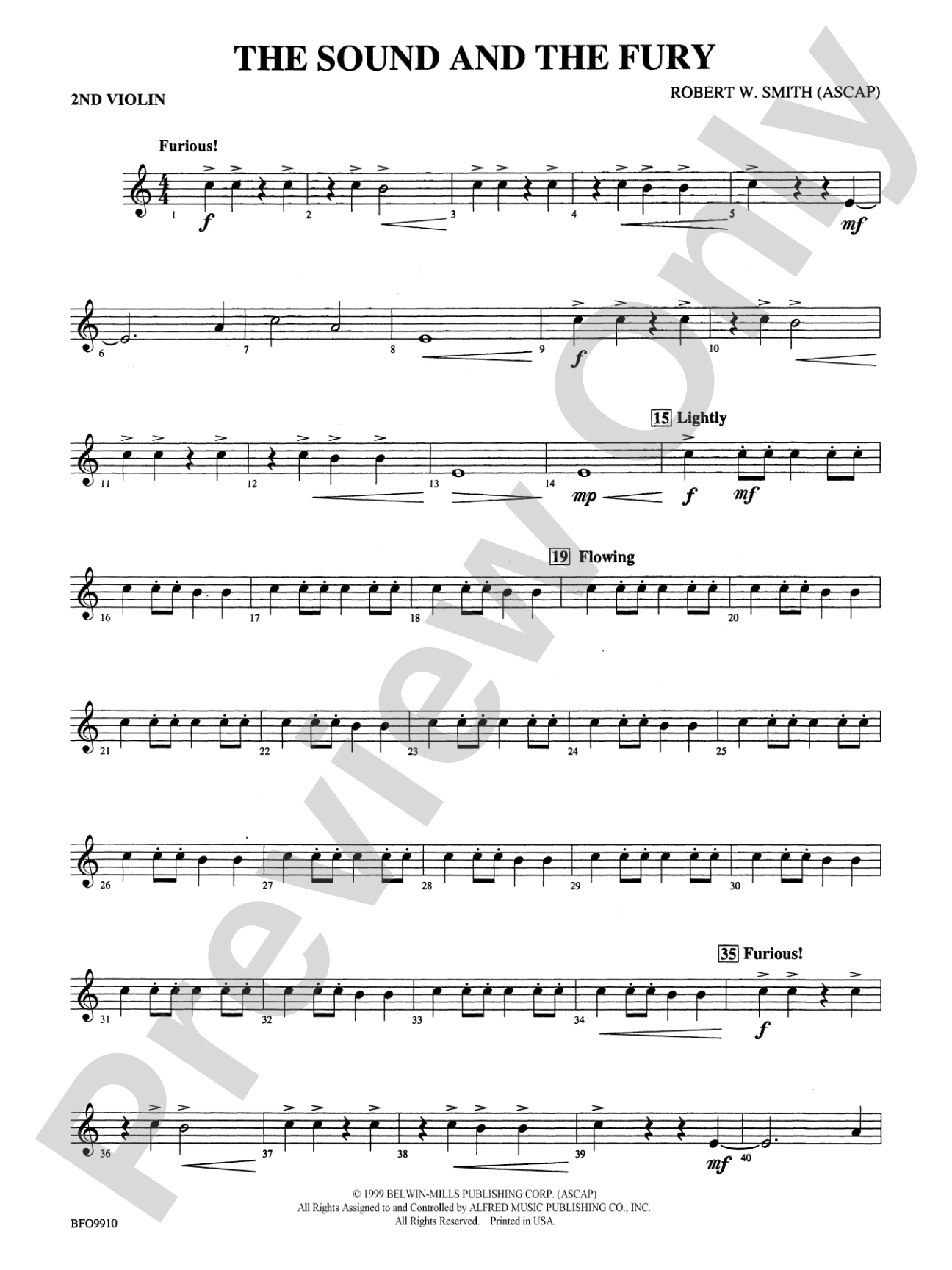

The Sound and the Fury: 2nd Violin
By Robert W. Smith
Grade: 2.5
Item: 00-PC-0015206_VN2
$3.00
Pickup currently not available
Description
The Sound and the Fury was inspired by the literary work of the same name by William Faulkner, known for his epic portrayal of the conflicts between the old and new South. Opening with a vibrant drama of punctuating thrusts in strings, winds, and percussion, the mood only shifts when we move to a lyrical and ambient section of contrasting sounds. Powerful strokes return, moving to a dramatic conclusion. A superior choice for concert or contest with guaranteed stunning audience appeal. Playable by strings or by adding any winds and percussion up to full orchestra. (2:04)


Don't just read it, hear it, play along with it, and watch your students grow with it. In MakeMusic Cloud, The Sound and the Fury: 2nd Violin comes alive with professional accompaniment, adjustable tempo, and built-in practice tools that turn solo practice into real progress.
Open in the Player
Jump straight in and assign it today.
Start Your Free Trial
Open this title and explore the full library in minutes.
Sample Audio
No sample audio found.
Sample Video
No sample videos found.
Additional Details
Series:
Belwin Intermediate String/Full Orchestra
Publisher:
Alfred Music
Page Count:
222
SKU:
00-PC-0015206_VN2
More about this title
About the Composer: Robert W. Smith

Robert W. Smith stands among America's most performed composers of orchestral and concert band music, with over 400 published works distributed primarily through Alfred Music. His education in music education from Troy State University and advanced studies at the University of Miami prepared him to write music that serves both the developing ensemble and the accomplished group. His symphonies, including The Divine Comedy and The Odyssey, have reached audiences across North America, Europe, Australia, and Asia, while works like The Tempest have become foundational repertoire in many programs.
Beyond the concert stage, Smith's compositions have appeared in high-profile broadcasts and events spanning the Macy's Thanksgiving Day Parade, the Olympic Games, and Opening Day at Dodger Stadium. He maintains an active conducting and clinician schedule across the United States, Canada, Japan, Australia, and Europe, bringing his distinctive voice directly to musicians and students worldwide.
Why we love this
Smith anchors this score in visceral orchestral drama, opening with sharp, punctuating attacks that immediately grab attention before pivoting to a lush, atmospheric middle section that lets your musicians breathe. The instrumentation is genuinely flexible: you can program it as a string piece at one rehearsal and expand it to full orchestra weeks later without rewriting or rethinking the balance, making it ideal for ensembles navigating lineup changes or growing instrumentation.
What to expect
The music opens with urgency and theatrical tension, strings and winds trading sharp, rhythmic gestures that feel almost percussive in their precision. A reflective, ambient passage then settles into the texture, creating an extended moment of introspection and atmospheric color before dramatic intensity returns to close the work with conviction.
Who it's for
Orchestras and string orchestras at the Grade 2.5 level, whether fielding a full complement of instruments or working with strings alone. The flexible orchestration makes it accessible to programs transitioning from string-only to mixed instrumentation, as well as groups seeking concert or festival repertoire that carries genuine dramatic weight without excessive technical demands.
How to get the most out of it
- Balance the opening string thrusts with clear articulation; these attacks should feel decisive and unified, not muddy. Spend rehearsal time on just the first phrase until the ensemble locks the rhythmic thrust.
- The lyrical ambient section rewards careful dynamic control from all parts. Even sustained notes in the inner voices shape the overall texture, so insist on attention to hairpins and voice independence.
- Support your wind players when they enter the contrasting section; brass especially can overshadow the strings' foundational work. Rehearse balances section by section before combining.
How to use it
Place this early in a concert to establish energy and engagement with the audience; the opening drama commands attention immediately. It pairs well alongside lyrical pieces, as the contrasting emotional arc within the work itself creates a satisfying dramatic arc without needing extensive programming around it.
Skills your students will build
- Executing sharp, unified articulation in rapid string passages
- Shaping sustained notes and dynamic transitions in ambient textures
- Balancing mixed instrumentation and adjusting blend as orchestration expands
- Responding to dramatic shifts in mood and tempo within a single work
- Reading a full orchestral score and identifying part independence