
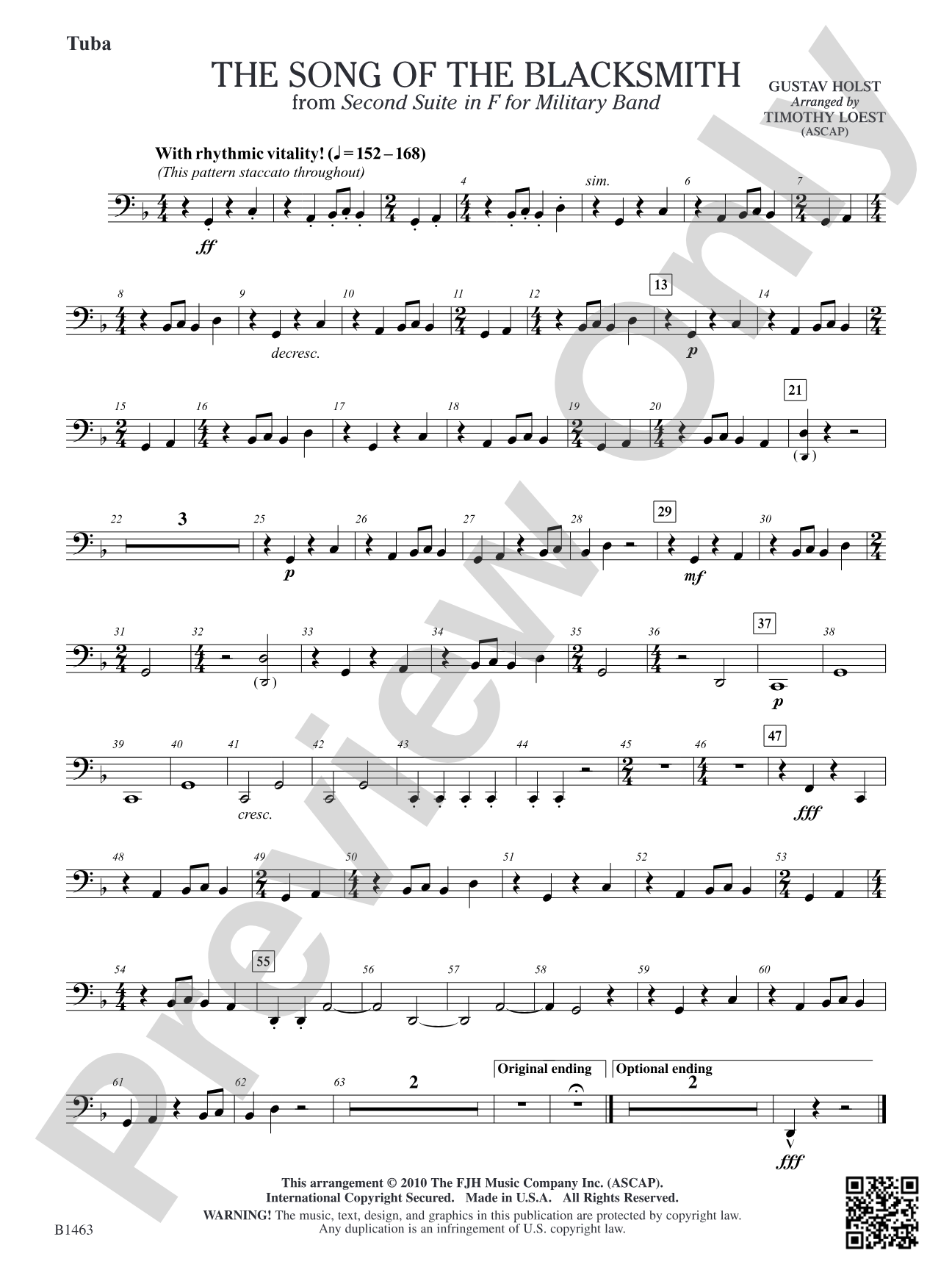

The Song of the Blacksmith: Tuba
Arranged by Timothy Loest
Grade: 2
Item: 98-PC-DB1463_TB1
$7.00
Pickup currently not available
Description
Celebrate the 100th anniversary of Gustav Holst's Second Suite in F with this incredibly authentic yet amazingly approachable arrangement of the third movement. Your students can now experience the rhythmic vitality and novel anvil sound of one of the most significant works ever composed for wind band. Two endings allow directors to either follow the form of the original work or have a slightly more definitive ending if desired. An arrangement of uncompromising quality that lives up to the artistry of the original!


Don't just read it, hear it, play along with it, and watch your students grow with it. In MakeMusic Cloud, The Song of the Blacksmith: Tuba comes alive with professional accompaniment, adjustable tempo, and built-in practice tools that turn solo practice into real progress.
Open in the Player
Jump straight in and assign it today.
Start Your Free Trial
Open this title and explore the full library in minutes.
Sample Audio
1
Audio File
--:--
0:00
0:00
Sample Video
No sample videos found.
Additional Details
Series:
FJH Young Band
Publisher:
The FJH Music Company, Inc.
SKU:
98-PC-DB1463_TB1
More about this title
About the Composer: Timothy Loest

Timothy Loest has spent over three decades teaching instrumental music while building a distinguished composing and arranging career. His works for young band are performed internationally, and his influence extends through pedagogical methods and conducting clinics that shape music education at state and national levels. In 2017, his composition Cloud Gate (Reflections of a City) reached an audience of over 5,000 at Chicago's Millennium Park, and that same year he received the Illinois Grade School Music Association's Cloyd Myers Memorial Award for Excellence in Music Education.
Loest's publishing history spans multiple major houses, including Warner Bros. Publications, C.L. Barnhouse Company, and The FJH Music Company. He founded Fanfare Music Press in 2022 to publish high-caliber band compositions and arrangements. His pedagogical impact extends to best-selling instrumental methods such as Measures of Success®, Warm-ups and Beyond, Rhythms and Beyond, and Chorales and Beyond. His music has appeared on network television programs including The Tonight Show Starring Jimmy Fallon and Good Morning America. Loest holds degrees from Illinois State University and Northwestern University and maintains active membership in ASCAP.
Why we love this
Loest captures the essential character of Holst's original without overwhelming a Grade 2 ensemble. The arrangement respects the work's historical significance while making it genuinely playable for young musicians; students experience authentic wind band writing rather than a stripped-down imitation. The two ending options give directors real programming flexibility, allowing the piece to serve different concert contexts or musical objectives.
What to expect
The piece pulses with the energy of a blacksmith's workshop: rhythmic, purposeful, and intensely alive. Despite its Grade 2 accessibility, it carries the nobility and forward momentum of Holst's original, drawing students into music that feels important and substantial rather than merely educational.
Who it's for
Concert band directors seeking genuine masterwork experience at an accessible level, particularly those working with Grade 2 ensembles or programs celebrating Holst's contributions to wind band literature. This arrangement works equally well for honor bands and festival programs where authentic representation of significant repertoire matters.
How to get the most out of it
- Lock the rhythmic precision between percussion and winds in the opening statement. The anvil (or substitute) should sit at the forefront of the texture without overpowering the melodic line.
- Shape the thematic material with long-line phrasing rather than sectional breathing. Young players often hear marches as block chords; help them hear the continuity and drama.
- Balance the inner voices carefully. Holst's original uses them to drive harmonic interest, and maintaining that detail at Grade 2 level prevents the arrangement from sounding thin.
- Decide your ending choice early in rehearsal so the ensemble can build toward the correct structural goal. Each ending requires slightly different weight and closure.
How to use it
Program this on concerts devoted to masterworks or centennial celebrations of significant wind band composers. It pairs well with other Grade 2-3 literature as an anchor piece that elevates the entire program's artistic scope. Festival and contest seasons benefit from its dual ending options, which allow directors to choose the most effective conclusion for their particular ensemble and venue.
Skills your students will build
- Rhythmic precision in marked figures while maintaining legato phrasing
- Reading and executing authentic wind band textures (not simplified voicings)
- Dynamic control and voice independence within an active harmonic texture
- Understanding period-appropriate phrasing and articulation conventions
- Listening skills for inner voice balance in a historically significant arrangement