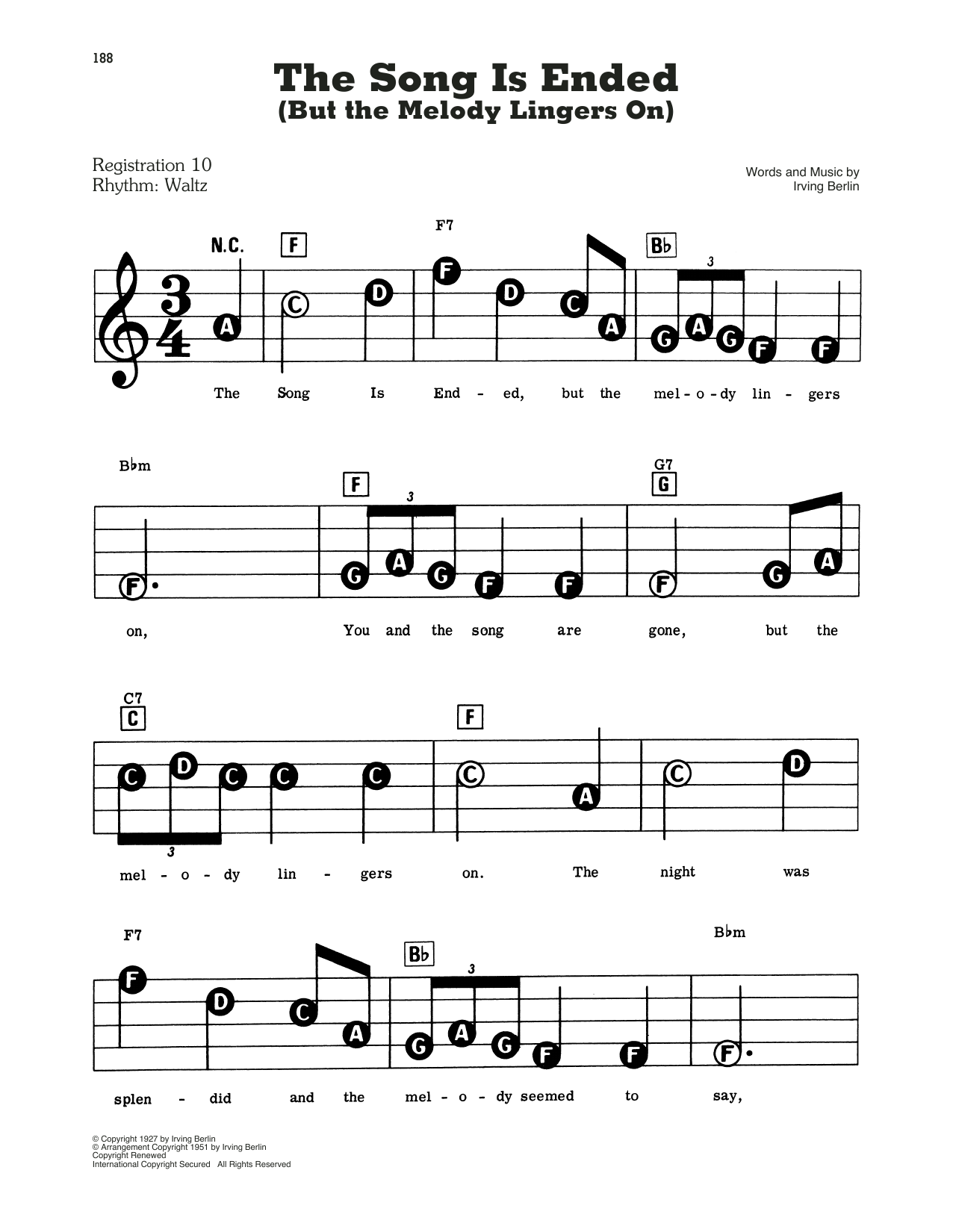
The Song Is Ended (But The Melody Lingers On) Sheet Music Preview

The Song Is Ended (But The Melody Lingers On): E-Z Play Today

Item: 35-DS00455658

Digital Download
$4.99
Description

The Song Is Ended (But The Melody Lingers On): E-Z Play Today isn't in MakeMusic Cloud just yet...but it could be. Let us know you'd like to see it, and you'll help shape what comes next. In the meantime, start a free trial and dive into thousands of interactive titles your students can play along with today.

Sample Audio
No sample audio found.
Sample Video
Additional Details
Publisher: Hal Leonard
Page Count: 2
SKU: 35-DS00455658

More about this title

About the Creator: Irving Berlin

Irving Berlin composed "The Song Is Ended (But The Melody Lingers On)" in 1927, capturing the bittersweet essence of a farewell with music that refuses to let go. Berlin's gift for crafting memorable melodies and emotionally resonant lyrics made him one of Broadway's most celebrated songwriters, and this standard exemplifies his ability to write a hook that stays with listeners long after the final note.

The song became a jazz standard almost immediately, recorded by countless artists across generations. Its reflective quality and singable melody made it a natural fit for performers who wanted to convey warmth and nostalgia, cementing its place in the Great American Songbook.

Why we love this

The E-Z Play format opens this standard to pianists who might otherwise never access it, removing the barrier between appreciation and actual playing. The two-page length makes it manageable for early intermediate players while the jazz and Broadway context gives students immediate exposure to repertoire that shapes American musical identity.

What to expect

A conversation held at dusk. The melody carries warmth and acceptance; even as it acknowledges an ending, there is comfort in the persistence of memory. This is not melancholy but rather a gentle, knowing reflection.

Who it's for

Early intermediate pianists ready to move beyond method book exercises and into genuine jazz standards. This works equally well for students studying American songwriting traditions, performers building a small repertoire of familiar pieces, or anyone wanting to understand why certain melodies endure.

How to get the most out of it

  • Let the melody breathe without rushing; this tune rewards a conversational, almost speech-like delivery that mirrors its lyrical quality.
  • Explore subtle dynamic shaping within phrases rather than sudden changes. The understated approach honors the song's reflective mood.
  • If using the accompaniment track (if available), sit with it first to absorb the harmonic movement before adding your own interpretive choices.

How to use it

Pair this with other Berlin standards or jazz standards from the 1920s to create a mini unit on American songwriting craft. It also serves as an excellent palette cleanser between more demanding repertoire in a student recital, offering the audience a moment of recognition and ease.

Skills your students will build

  • Reading jazz chord symbols and understanding their harmonic function
  • Phrasing in the jazz tradition with attention to lyrical contour
  • Recognizing and playing the characteristic melodic shapes of Tin Pan Alley composition
  • Interpreting music notation within the E-Z Play simplified format

You May Also Like