
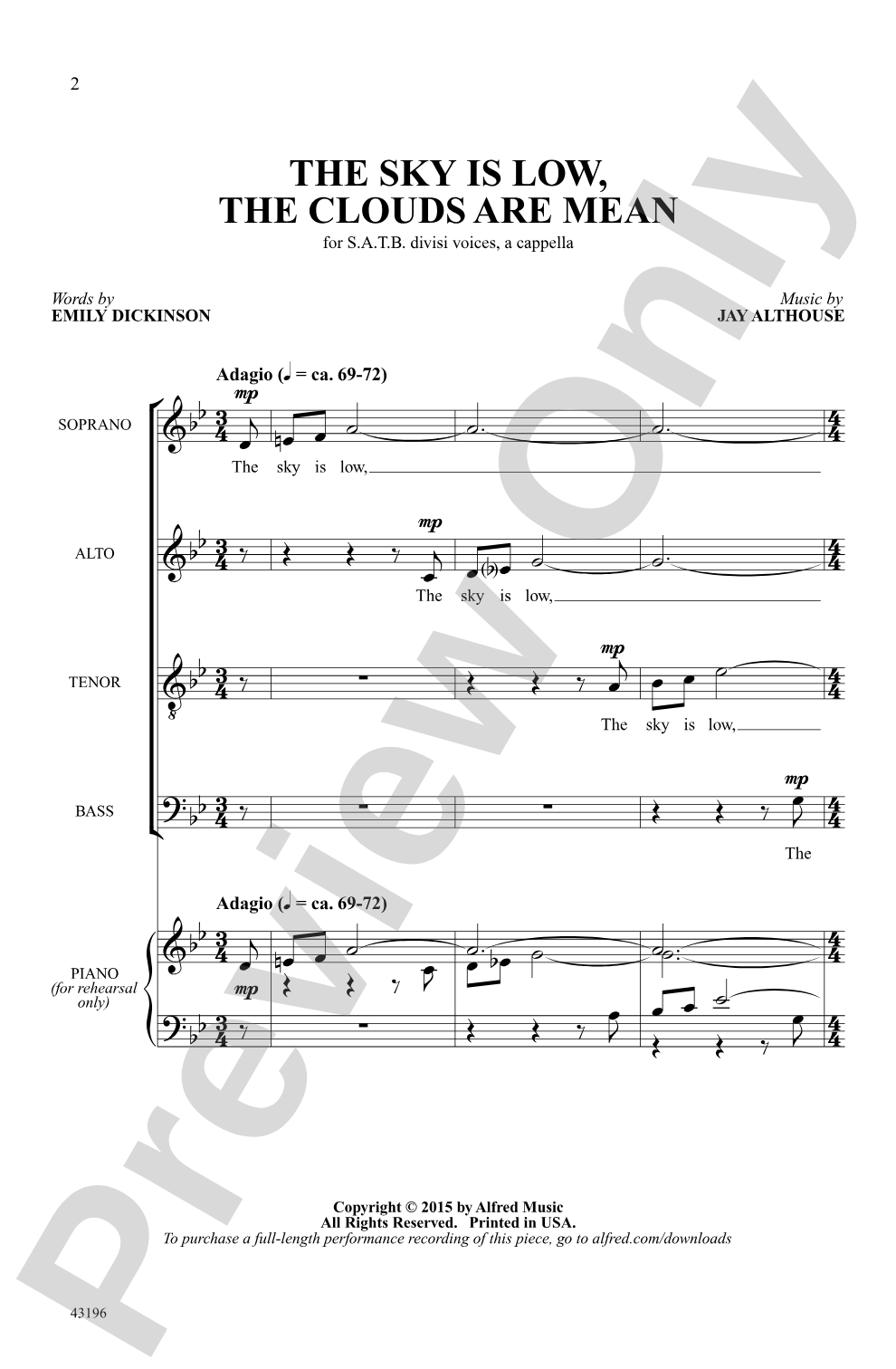
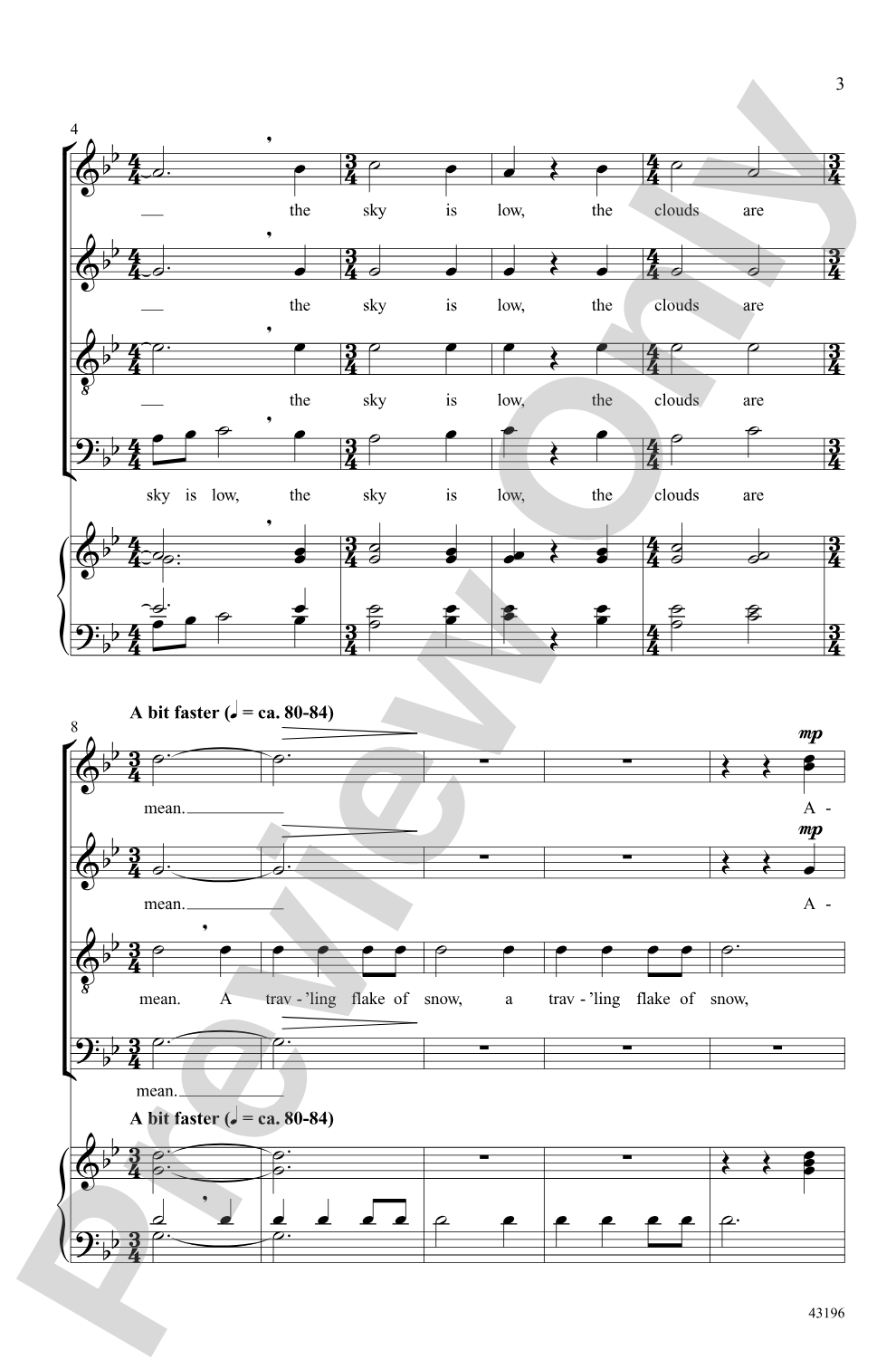

The Sky Is Low, the Clouds Are Mean: SATB a cappella Choral Octavo
Words by Emily Dickinson, music by Jay Althouse
Item: 00-PO-0003196

$1.90
Minimum order quantity: 20 copies
Pickup currently not available
Related Items
The Sky Is Low, the Clouds Are Mean: SATB a cappella Choral Octavo |
$1.90
|
View |
Description
Dickinson's poetic description of a dark and somber day seems to say that like all of us, even nature sometimes has a bad day. The music rises and falls wonderfully with the text in this expressive and dramatic setting.


Don't just read it, hear it, play along with it, and watch your students grow with it. In MakeMusic Cloud, The Sky Is Low, the Clouds Are Mean: SATB a cappella Choral Octavo comes alive with professional accompaniment, adjustable tempo, and built-in practice tools that turn solo practice into real progress.
Open in the Player
Jump straight in and assign it today.
Start Your Free Trial
Open this title and explore the full library in minutes.
Sample Audio
1
Audio File
--:--
0:00
0:00
Sample Video
No sample videos found.
Additional Details
Series:
Lawson-Gould
Publisher:
Alfred Music
Page Count:
8
SKU:
00-PO-0003196
More about this title
About the Composer: Jay Althouse

Jay Althouse holds degrees in Music Education and Music from Indiana University of Pennsylvania, where he was honored as a Distinguished Alumni. Early in his career, he worked as a rights and licenses administrator for a major educational music publisher and served on the Executive Board of the Music Publishers Association of America. His compositional output spans over 800 choral works across all difficulty levels, performed regularly across the English-speaking world.
Althouse is an ASCAP writer member and a consistent recipient of the ASCAP Special Award for his compositions. Beyond his choral work, he has co-written children's musicals with Sally K. Albrecht, compiled vocal solo collections including Folk Songs for Solo Singers, and authored or co-authored several classroom resources: The Complete Choral Warm-up Book, Accent on Composers, Ready to Read Music, Sixty Music Quizzes, and One-Page Composer Bios. He co-wrote I Hear America Singing, performed by the San Francisco Girls and Boys Choirs at President Barack Obama's 2009 Inauguration. Althouse has served on the board of the North Carolina Master Chorale and currently sits on the National Advisory Board of the Folk Art Society of America.
Why we love this
Althouse captures the emotional arc of Dickinson's poem with genuine musical sensitivity, allowing the harmonic movement and phrase shaping to illuminate the text rather than overshadow it. The piece works as both a showcase for expressive singing and a meaningful meditation on human resilience, making it equally valuable in concert programming and classroom discussion about how music interprets literature.
What to expect
The piece mirrors its subject: moody, introspective, and ultimately compassionate. Althouse's harmony darkens and lightens in conversation with the text, creating moments of unexpected brightness that suggest hope breaking through gloom. Singing it feels like giving voice to a private moment of melancholy recognition.
Who it's for
This octavo suits advanced high school choirs, collegiate ensembles, and community choirs with solid harmonic reading skills and expressive maturity. The piece demands careful attention to intonation and blend in close-voiced passages, making it ideal for singers who are ready to explore nuance and interpretive depth.
How to get the most out of it
- Shape each phrase according to Dickinson's syntax rather than imposing regular phrase lengths; let the poetic structure guide your breathing and harmonic emphasis.
- Attend carefully to dynamics marked in the score to create the rise and fall that mirrors the textual emotion; these contours are essential to the piece's expressive intent.
- Balance the vocal lines so that the text remains intelligible throughout; clarity of word stress will strengthen the connection between poem and music.
- Experiment with slight adjustments to vowel color during lower or darker passages to enhance the somber mood without losing blend across the SATB texture.
How to use it
Position this as a centerpiece in a concert exploring poetry and music, pairing it with other settings of American verse or pieces exploring emotional complexity. Its eight-page length and moderate technical demands make it work equally well as a standalone piece or as part of a larger thematic program about nature and human experience.
Skills your students will build
- Expressive interpretation of literary text through harmonic and dynamic choices
- Intonation and blend in close-voiced SATB writing
- Phrase shaping and breath control across longer harmonic passages
- Darkening and brightening of vowel resonance to serve emotional context