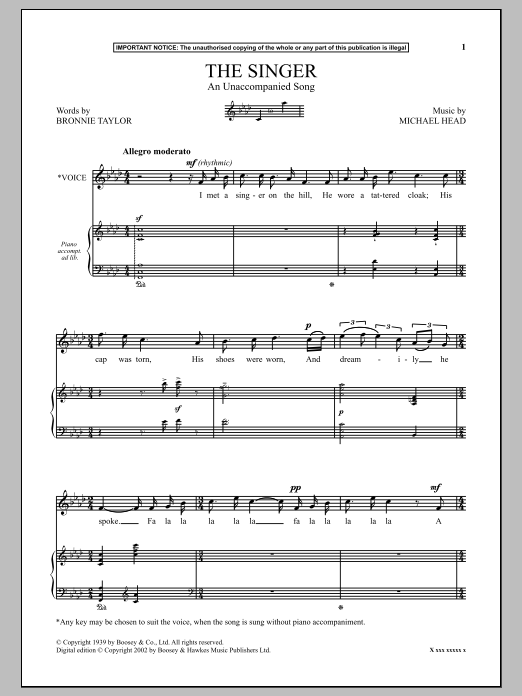
The Singer (An Unaccompanied Song) Sheet Music Preview

The Singer (An Unaccompanied Song): Piano Vocal

As performed by Michael Head

Item: 35-DS00238054

Digital Download
$5.99
Description

The Singer (An Unaccompanied Song): Piano Vocal isn't in MakeMusic Cloud just yet...but it could be. Let us know you'd like to see it, and you'll help shape what comes next. In the meantime, start a free trial and dive into thousands of interactive titles your students can play along with today.

Sample Audio
No sample audio found.
Sample Video
Additional Details
Publisher: Hal Leonard
Page Count: 4
SKU: 35-DS00238054

More about this title

About the Artist: Michael Head

Michael Head (1900–1976) was an English composer, conductor, and baritone whose output spanned art song, choral works, and orchestral compositions. He studied at the Royal Academy of Music and built a reputation as a sensitive songwriter whose vocal works demonstrate sophisticated harmonic language and a gift for text painting. His songs remain staples of the recital repertoire and continue to challenge and reward singers seeking expressive depth.

Why we love this

Head's setting captures intimate lyricism without sentimentality, and the unaccompanied approach demands that singers truly inhabit the text rather than lean on instrumental support. Your students will discover how much musical communication lives in line shaping, breath, and intonation when the piano drops away entirely.

What to expect

Intimate and reflective, with the singer's voice hanging in silence like a solitary conversation with the listener. The unaccompanied texture creates a sense of immediacy and vulnerability that draws the audience into quiet observation.

Who it's for

Intermediate to advanced vocalists preparing recital repertoire or exploring the English art song tradition. This work suits singers comfortable with harmonic independence and ready to develop mature interpretive choices.

How to get the most out of it

  • Shape phrases vocally as if the piano were present, maintaining harmonic consciousness even without accompaniment.
  • Pay particular attention to vowel consistency across the range; unaccompanied singing exposes tonal shifts immediately.
  • Consider the emotional arc across the full piece rather than treating it as discrete moments; continuity is your only structural support.

How to use it

Nest this among other chamber works or art songs in a vocal recital to create a moment of stillness and introspection. It also works beautifully as a closing or transitional piece that shifts the mood before moving into larger accompanied selections.

Skills your students will build

  • Singing without harmonic support from an accompanist
  • Maintaining consistent intonation in longer unaccompanied passages
  • Sustaining vocal line independence while managing phrase shape
  • Interpreting English song text with sensitivity to word and musical meaning

You May Also Like