The Show Must Go On (arr. Mark Brymer) Sheet Music Preview

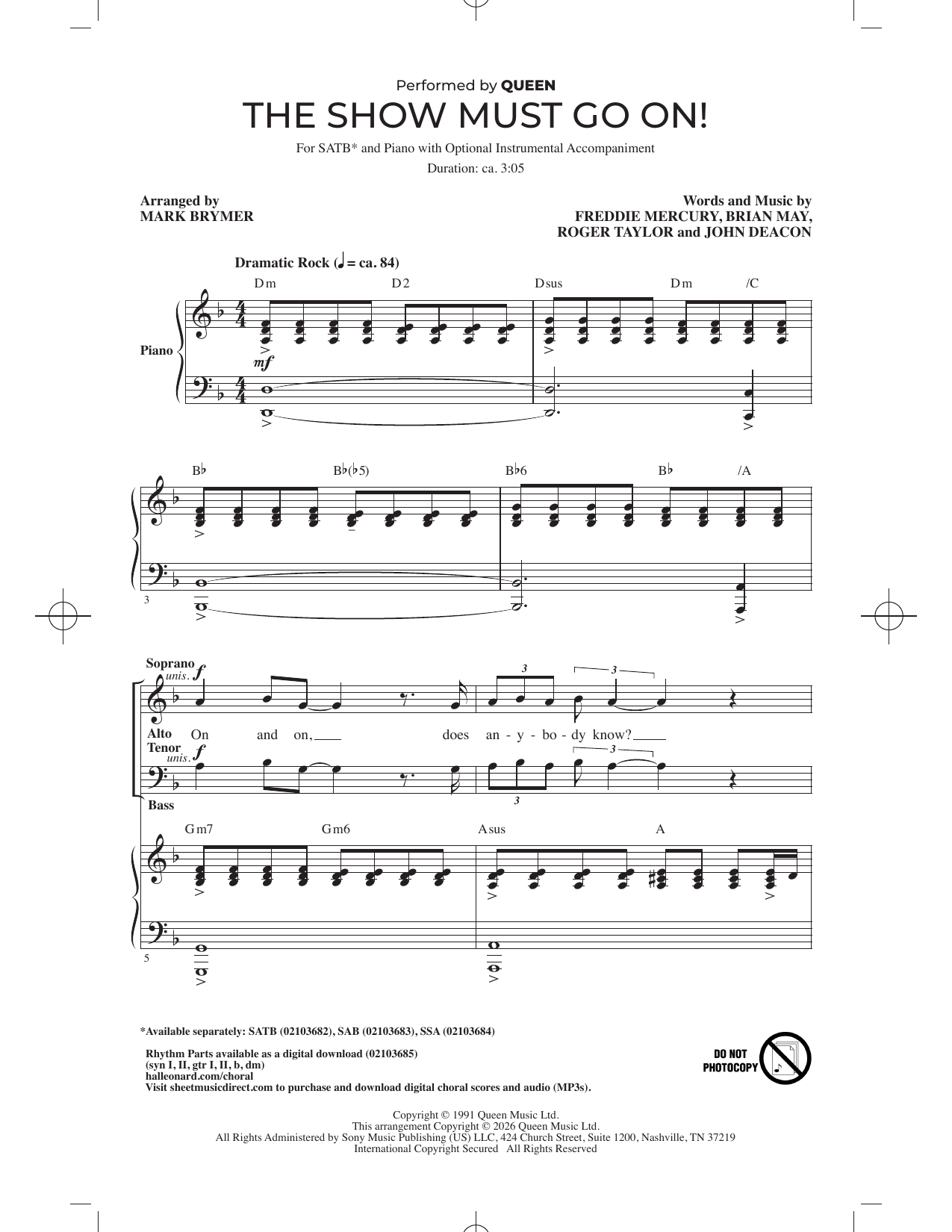
The Show Must Go On (arr. Mark Brymer): SATB Choral Octavo

As performed by Queen / Arranged by Mark Brymer

Item: 35-DS01953842

Digital Download
$2.50

Minimum order quantity: 10 copies

Description

Discover MakeMusic Cloud: thousands of interactive titles your students can play along with today.

Sample Audio
No sample audio found.
Sample Video
Additional Details
Publisher: Hal Leonard
Page Count: 10
SKU: 35-DS01953842

More about this title

About the Artist: Queen

Queen emerged in the 1970s as one of rock's most ambitious and theatrical bands, driven by Freddie Mercury's uncompromising artistry and the instrumental prowess of Brian May, Roger Taylor, and John Deacon. Their catalog spans stadium anthems, operatic experiments, and intimate ballads, all unified by a refusal to accept conventional boundaries between genres. For choral arrangers, Queen's work presents an exceptional challenge and reward: the melodies are singable, the harmonies are rich, and the emotional stakes feel genuinely high.

Freddie Mercury's songwriting combined the directness of pop hooks with the sophistication of classical and music theater influences. This arrangement of "The Show Must Go On" captures that duality, making it accessible to high school and community choirs while honoring the original's dramatic intensity.

Why we love this

Mark Brymer's arrangement transforms this power ballad into a piece that works brilliantly for SATB ensembles without sacrificing its emotional core. The ten-page score gives singers genuine material to sink their teeth into, and the dramatic arc of the original translates naturally to the choral setting, making this a standout choice for programs that want to showcase your choir's range beyond traditional classical repertoire.

What to expect

Singing this piece feels like you're delivering a defiant message to a crowd. There's glamour and theatricality in the writing, paired with an underlying vulnerability that emerges in the quieter sections. The arrangement honors Queen's DNA while creating something that belongs in a choral concert.

Who it's for

This arrangement is ideal for high school show choirs, community theater productions, and any SATB ensemble looking to program accessible pop repertoire with genuine artistic substance. It works equally well as a concert closer or as part of a rock-focused set, and it engages singers who might feel disconnected from traditional classical fare.

How to get the most out of it

  • Balance the melody across voice parts carefully in sections where it passes between sopranos and altos. Mercury's original sits high and urgent, so ensure your soloists or leading voices have the stamina and support to carry those passages cleanly.
  • Attend to the dynamics as written. This piece relies on contrasts between intimate verses and swelling full sections to create its theatrical impact; resisting the urge to sing everything at concert volume will make the climaxes land harder.
  • Lock the rhythmic precision early in rehearsals. Rock and pop arrangements demand tightness that differs from classical choral singing; sloppy entrances or trailing releases will undermine the piece's momentum.
  • Consider staging or movement subtle enough to match the song's defiant grace. This isn't a march, but it does reward a sense of unified purpose and presence from the ensemble.

How to use it

Reserve this for a concert where you can let it breathe as a standalone moment, perhaps as a powerful encore or as the centerpiece of a set exploring rock and pop influences on choral music. It pairs well with other theatrical pop arrangements and can anchor a concert aimed at audiences who don't typically attend classical choral events.

Skills your students will build

  • Sustaining legit singing tone through rock-influenced repertoire
  • Managing dynamic contrast and phrasing across extended musical statements
  • Balancing pop-derived rhythmic precision with choral blend
  • Performing with theatrical presence and conviction in secular popular music
  • Reading and executing the specific harmonic color that results from Brymer's four-part setting

You May Also Like