
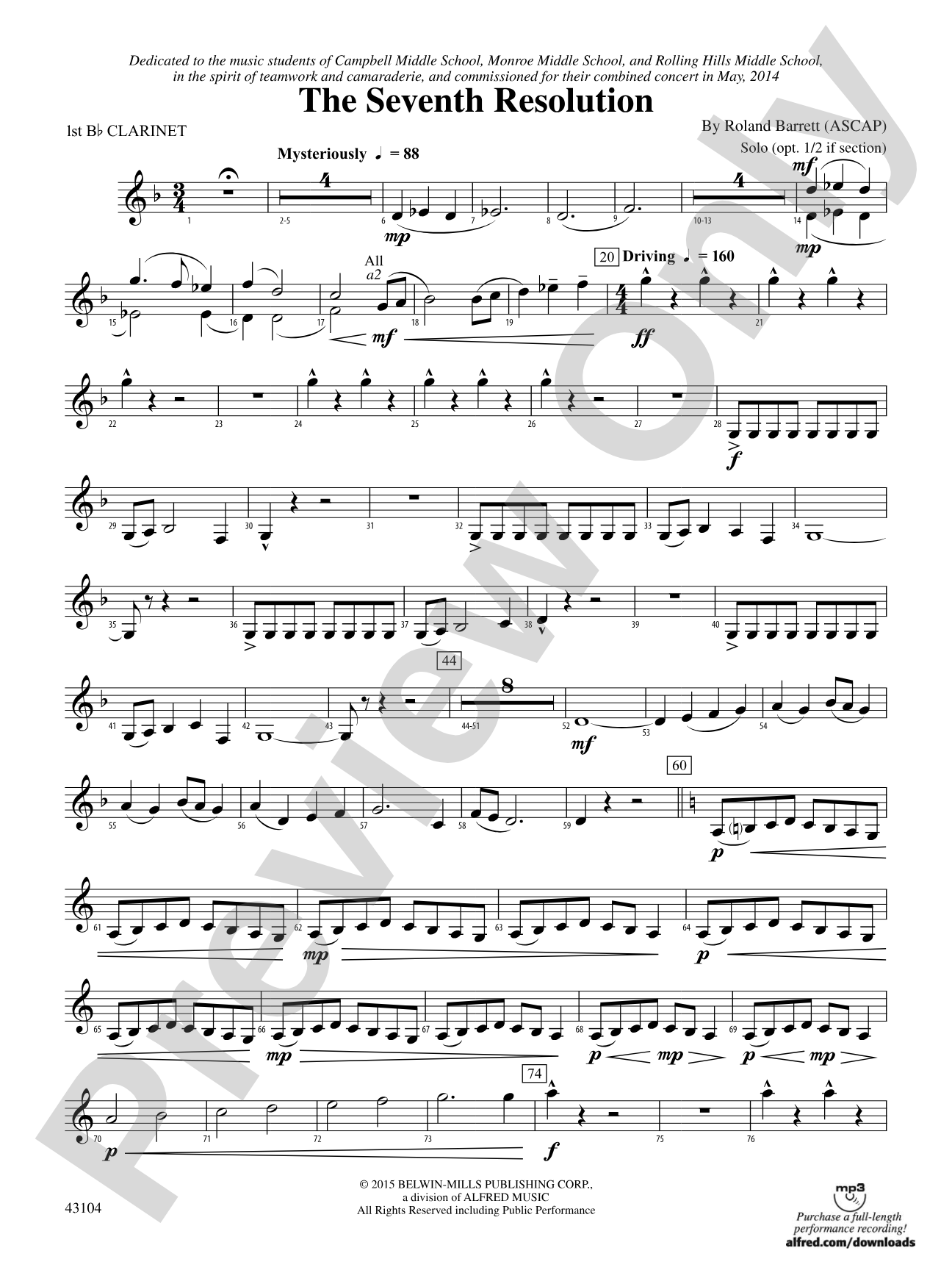

The Seventh Resolution: 1st B-flat Clarinet
By Roland Barrett
Grade: 2.5 (Easy to Medium Easy)
Item: 00-PC-0016755_C1
$3.00
Pickup currently not available
Description
In the final days of November, as the nights grew longer and the vicious North winds began to pound the embattled city, the kingdom was rapidly nearing its darkest hour. As enemy forces threatened from every side, the exhausted council gathered in the great hall for one final desperate meeting. With all hope waning, with all other options exhausted, and with one last chance to save his people, the king summoned all remaining forces and invoked The Seventh Resolution. A contemporary bold work! (4:30)


Don't just read it, hear it, play along with it, and watch your students grow with it. In MakeMusic Cloud, The Seventh Resolution: 1st B-flat Clarinet comes alive with professional accompaniment, adjustable tempo, and built-in practice tools that turn solo practice into real progress.
Open in the Player
Jump straight in and assign it today.
Start Your Free Trial
Open this title and explore the full library in minutes.
Sample Audio
1
Audio File
--:--
0:00
0:00
Sample Video
Additional Details
Series:
Belwin Young Band
Publisher:
Alfred Music
Page Count:
278
SKU:
00-PC-0016755_C1
More about this title
About the Composer: Roland Barrett

Roland Barrett holds a faculty position at the University of Oklahoma, where he teaches music theory and composition with particular emphasis on twentieth-century topics at both undergraduate and graduate levels. He has maintained an active presence in band music for decades, having served fifteen years as Assistant Director of Bands before joining the university faculty in 2001, and continues as the musical arranger for the Pride of Oklahoma marching band.
Barrett's catalog includes over two hundred published works and arrangements spanning symphonic band, chamber ensembles, and marching band. His compositions have earned performances by the Dallas Wind Symphony, numerous All-State and All-Region honor bands, and broadcasts on National Public Radio and USA cable television. He is a multiple ASCAPlus award recipient and has been recognized at major conferences including the Midwest Band & Orchestra Convention and the International Trumpet Guild convention.
Why we love this
Barrett crafts a narrative arc that never feels overwrought despite its dramatic premise. The work deploys contemporary harmonic language and orchestration choices that sound sophisticated without demanding virtuosic technical facility, making it genuinely rewarding for a Grade 2.5 ensemble to perform.
What to expect
The opening establishes an atmosphere of siege and urgency, with harmonic tension building steadily across the score. By the invoking of the Seventh Resolution, the music crystallizes into bold, defiant writing that conveys both desperation and determination without resorting to cheap theatrical effects.
Who it's for
Intermediate concert bands seeking repertoire with genuine dramatic substance and contemporary voice without excessive technical demands. Directors programming for fall or spring concert series who want a meaningful centerpiece that engages both performers and audiences.
How to get the most out of it
- Shape the climactic moments carefully. The council's desperation calls for dynamic contrast, but younger ensembles often rush these sections. Focus on clarity and ensemble precision over volume.
- Balance the programmatic storytelling with musical coherence. The work functions as concert music first; let the narrative enhance rather than dictate your interpretation.
- Mark entrances after key thematic transitions. The contemporary harmonic language can mask sectional entries, so ensure brass and woodwind cues are well-prepared in rehearsal.
How to use it
Anchor a concert around themes of challenge and resilience, or program it as a dramatic contrast to lighter or more lyrical works. At 4 minutes 30 seconds, it functions effectively as a substantial centerpiece that demonstrates what young musicians can accomplish with contemporary concert repertoire.
Skills your students will build
- Reading contemporary harmonic language and dissonance
- Shaping long dynamic arcs across multiple sections
- Coordinating sectional transitions in non-traditional harmonic contexts
- Performing with rhythmic precision during complex orchestrations
- Responding to programmatic intent through musical expression