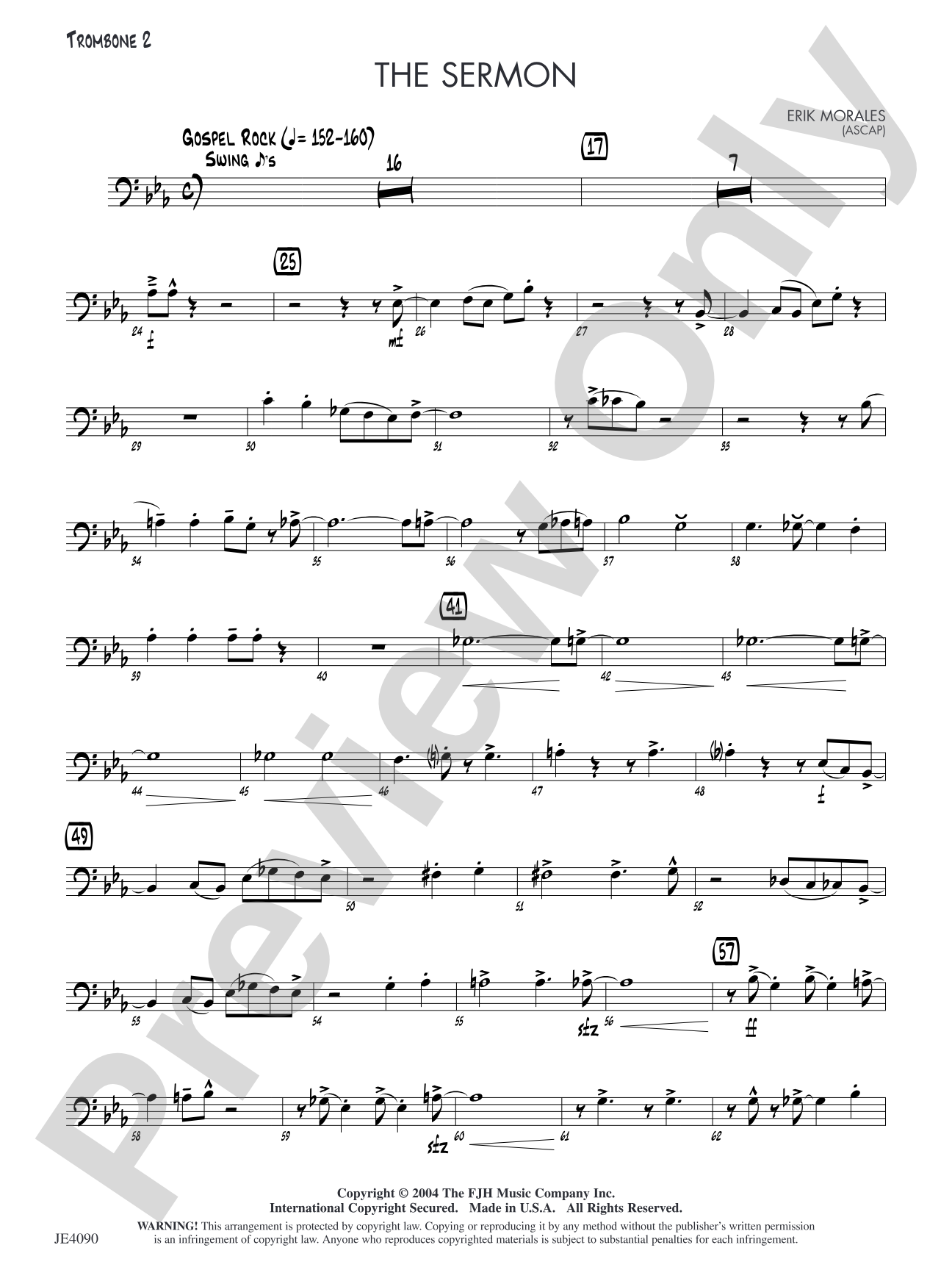
The Sermon: Trombone 2 Sheet Music Preview

The Sermon: Trombone 2

By Erik Morales

Grade: 3

Item: 98-PC-DJE4090_TN2

Digital Download
$7.00
Description
What a great chart! The Sermon seemlessly integrates gospel, rock, jazz, and Dixieland. The sax section is featured prominently throughout, and the rest of the ensemble gets plenty of exciting material as well. The melody is a strong hook and is naturally developed throughout the chart, including a short Dixieland section that includes an optional clarinet for a really authentic sound.

The Sermon: Trombone 2 isn't in MakeMusic Cloud just yet...but it could be. Let us know you'd like to see it, and you'll help shape what comes next. In the meantime, start a free trial and dive into thousands of interactive titles your students can play along with today.

Sample Audio
0:00
0:00
Sample Video
Additional Details
Series: FJH Intermediate Jazz Ensemble
Publisher: The FJH Music Company, Inc.
SKU: 98-PC-DJE4090_TN2

More about this title

About the Composer: Erik Morales

Erik Morales

Erik Morales has built a prolific career bridging the worlds of concert music and jazz since his high school arranging days in south Florida. A trumpeter by training, he studied composition at Florida International University and earned his degree from the University of Louisiana, Lafayette in 1989, launching a composing trajectory that now includes over 150 published works across classical, jazz, wind, orchestral, and chamber settings.

Morales has earned recognition for balancing artistic integrity with pedagogical sound judgment. His trumpet works have earned first place performances at the 2006 and 2008 National Trumpet Competitions, and his Concerto for Two Trumpets premiered at the 2013 International Trumpet Guild conference. In 2016, he was inducted into the Louisiana Association for Jazz Education's Hall of Fame, a distinction reflecting decades of contributions to the jazz education community.

Why we love this

The Sermon succeeds because it genuinely swings while remaining accessible to high school players. Morales gives the saxophone section the spotlight they crave, then distributes engaging rhythmic and melodic material throughout the rest of the ensemble so nobody sits idle. The built-in authenticity of the Dixieland section, complete with optional clarinet, gives players a tangible taste of jazz history without requiring them to be sight-readers.

What to expect

The Sermon sounds like four great American musical traditions having a conversation: gospel warmth, rock drive, jazz sophistication, and New Orleans joy. The melody is instantly memorable, and the arrangement respects each style enough that players feel they're learning something real about the music, not just playing notes.

Who it's for

Grade 3 jazz ensembles with solid section blend and willingness to explore multiple musical vernaculars in one sitting. The part writing assumes players can handle contemporary jazz rhythms and can navigate the style switches without losing ensemble cohesion.

How to get the most out of it

  • Lock the sax section's articulation early in rehearsal; the tight ensemble phrasing on the main hook is what makes this chart stick with audiences.
  • Let the gospel and rock influences coexist rather than blend them into one style. The genre shifts are intentional and should read clearly.
  • Bring out the walking bass and ride cymbal during the Dixieland section so the form change lands as a real arrival, not just a texture swap.
  • Record a rough playthrough once parts are solid; hearing how the gospel groove underpins the jazz vocabulary helps students understand the whole thing as one coherent piece.

How to use it

This works beautifully on a spring concert that celebrates jazz beyond bebop standards, or as the centerpiece of a program exploring American roots music. Its length and accessibility make it an ideal opener or closer, and the clear sectional drama gives new ensemble members a satisfying performance experience early in their jazz education.

Skills your students will build

  • Gospel and rock rhythmic phrasing in a jazz context
  • Dixieland style articulation and phrasing conventions
  • Managing style shifts within a single piece
  • Prominent section work (saxophone ensemble voicing and blend)
  • Call-and-response interaction between sections
  • Straight-eighths and swung-eighths interpretation

You May Also Like