
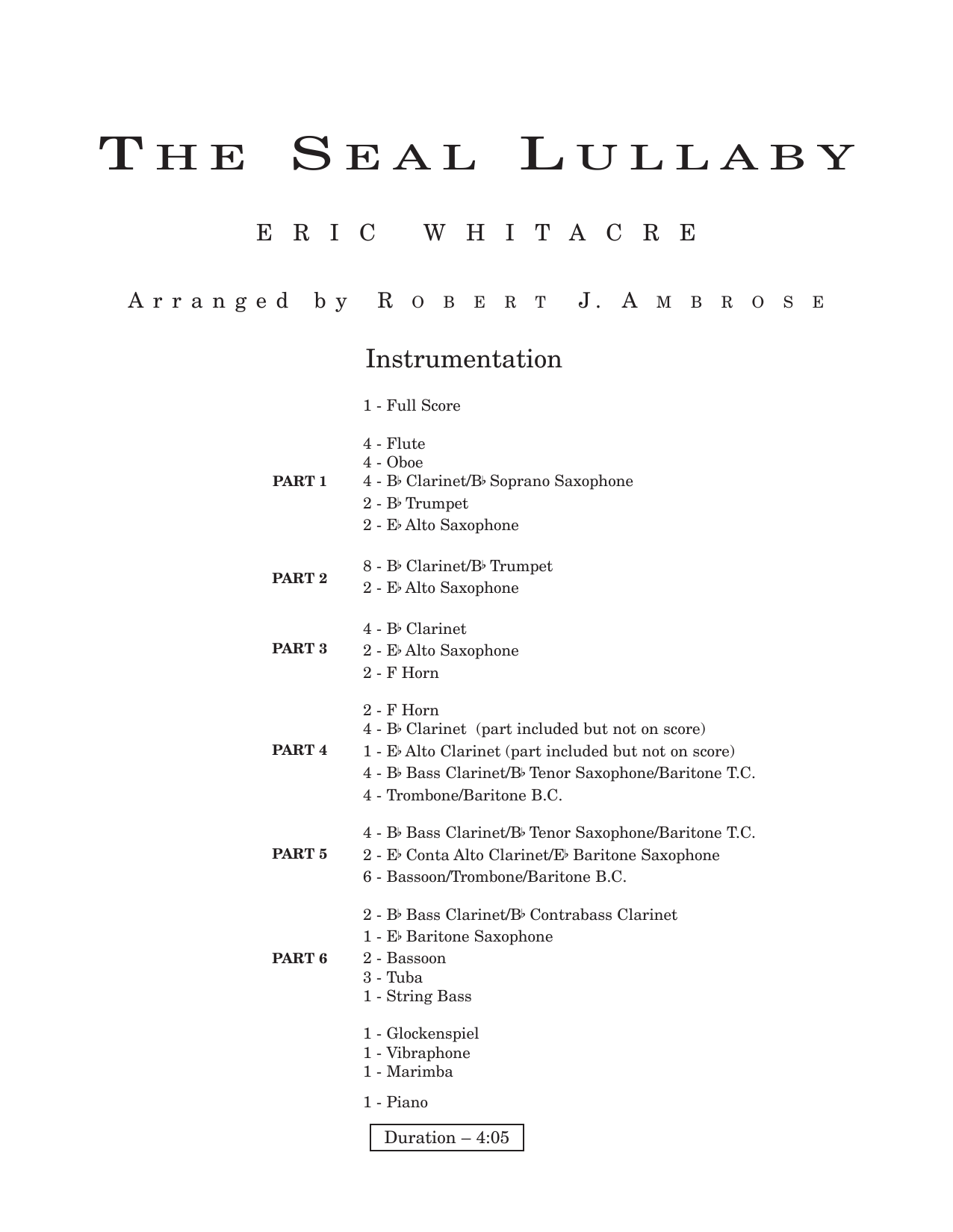

The Seal Lullaby (for Flexible Wind Band) (arr. Robert J. Ambrose): Concert Band Conductor Score & Parts
By Eric Whitacre / Arranged by Robert J. Ambrose
Item: 35-PK01106633
$75.00
Pickup currently not available
Buy Extra Parts (Digital PDF Download)
Parts Added to Cart!
Description
A new arrangement of the Whitacre classic created during the COVID-19 pandemic as part of The Creative Repertoire Initiative. Arranged with maximum flexibility in mind, the work can be performed by any of the following ensembles: concert band (with as few as six wind players), brass ensemble, clarinet choir, saxophone choir, woodwind choir.


The Seal Lullaby (for Flexible Wind Band) (arr. Robert J. Ambrose): Concert Band Conductor Score & Parts isn't in MakeMusic Cloud just yet...but it could be. Let us know you'd like to see it, and you'll help shape what comes next. In the meantime, start a free trial and dive into thousands of interactive titles your students can play along with today.
Request This Title
Tell us you want it.
Start Your Free Trial
Explore everything that's ready to play right now.
Sample Audio
No sample audio found.
Sample Video
No sample videos found.
Additional Details
Publisher:
Hal Leonard
SKU:
35-PK01106633
More about this title
About the Composer: Eric Whitacre
Eric Whitacre stands among the most performed living composers, known for choral works that have fundamentally shaped contemporary wind band and vocal repertoire. His compositional voice emphasizes accessibility without sacrificing artistic depth; his pieces consistently connect with student musicians while maintaining the expressive demands that engage advanced performers.
Whitacre's focus on flexibility and inclusion in his writing reflects his broader philosophy about music education. He understands that ensembles come in all shapes and sizes, and has dedicated significant creative energy to arrangements that serve schools and community groups with varied instrumentation.
Why we love this
Robert J. Ambrose has engineered genuine flexibility here without the usual compromise of dumbed-down voicing or hollow orchestration. The arrangement honors Whitacre's harmonic language while making smart use of divisi and optional doublings, meaning your group sounds complete whether you have eight players or thirty. It's the rare flexible arrangement that doesn't feel like you're settling.
What to expect
Hushed and introspective, like listening to someone sing a familiar song in a half-remembered way. The harmonic palette is modern yet warm, with moments of gentle luminosity that emerge through careful orchestration. The lullaby rises and falls with the gentle insistence of a bedtime ritual, never demanding but always present.
Who it's for
Any band director working with a small ensemble, a mixed instrumentation group, or a program that shifts roster size throughout the year. This also serves teachers building clarinet or saxophone choirs who want repertoire beyond standard transcriptions. The flexibility is genuine enough that single-director teachers and large programs alike find authentic use.
How to get the most out of it
- Balance the sustained sonorities carefully in the opening statements; these transparent textures expose any tonal inconsistency, so ensemble tuning and vowel shape demand your full attention.
- Let the natural phrasing breathe. Whitacre's harmony wants space to settle, so resist the urge to push through sustained sections with constant forward momentum.
- Mark your parts clearly regarding which lines are essential and which are doublings for your specific instrumentation. Rehearsal time saved on interpretation means more time spent on the musical details that matter.
- The lullaby character lives in restraint. Coach your soloists and section leaders to sing rather than play, even in the passages with movement.
How to use it
Pair this with other works by Whitacre or colleagues writing in similar harmonic language to build a concert segment exploring contemporary choral sensibilities in wind writing. It also functions beautifully as a concert opener or closer, setting a reflective tone that frames heavier repertoire effectively. Consider programming it early in the season when instrumentation might still be settling.
Skills your students will build
- Sustaining warm, blended tone across changing instrumentation
- Responsive ensemble listening in sparse, exposed textures
- Reading flexible instrumentation cues and doubling assignments
- Shaping long-line phrasing in music without obvious harmonic rhythm
- Balancing individual color with collective blend in heterogeneous ensembles