
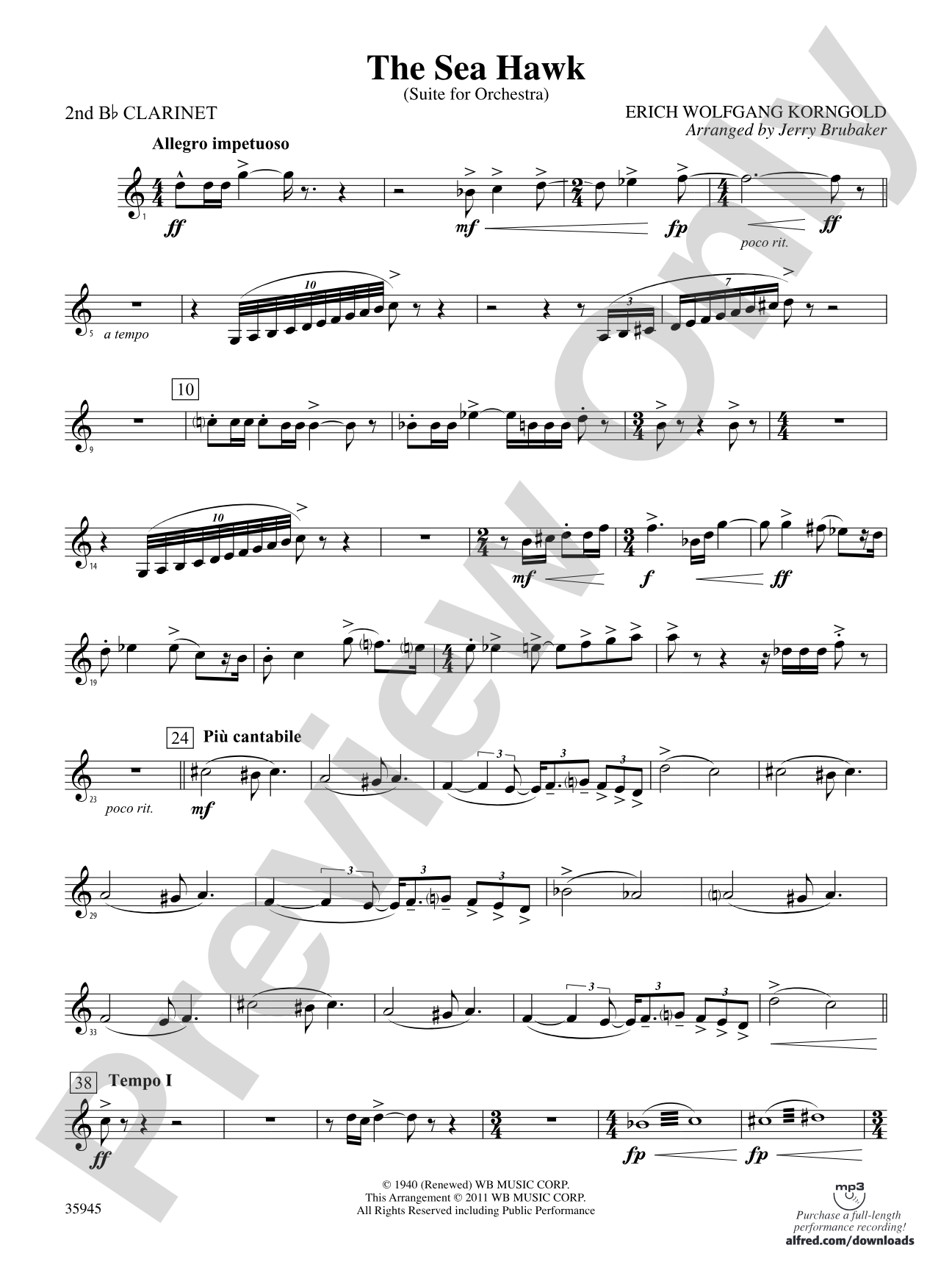

The Sea Hawk: 2nd B-flat Clarinet
Suite for Orchestra
By Erich Wolfgang Korngold / arr. Jerry Brubaker
Grade: 4
Item: 00-PC-0015023_C2
$3.00
Pickup currently not available
Description
Written in 1940, this movie music plays more like a symphony than a soundtrack. Several of the majestic themes from this marvelous score are featured in this truly classic arrangement. Perfect for advanced student groups or community orchestras.
"Performers will enjoy bringing this marvelous work to an audience."
-The Instrumentalist


"Performers will enjoy bringing this marvelous work to an audience."
-The Instrumentalist
Don't just read it, hear it, play along with it, and watch your students grow with it. In MakeMusic Cloud, The Sea Hawk: 2nd B-flat Clarinet comes alive with professional accompaniment, adjustable tempo, and built-in practice tools that turn solo practice into real progress.
Open in the Player
Jump straight in and assign it today.
Start Your Free Trial
Open this title and explore the full library in minutes.
Sample Audio
1
Audio File
--:--
0:00
0:00
Sample Video
No sample videos found.
Additional Details
Series:
Pop Concert Full Orchestra
Publisher:
Alfred Music
Page Count:
226
SKU:
00-PC-0015023_C2
Instrumentation:
full (vibraphone, timp, snare, bass, crashcym/triangle/tamb, suscym/tamtam, harp)
More about this title
About the Composer: Erich Wolfgang Korngold
Erich Wolfgang Korngold (1897-1957) was an Austrian-American composer whose film scores redefined what orchestral music could accomplish on screen. A child prodigy who studied with respected masters, Korngold brought symphonic ambition and harmonic sophistication to Hollywood, composing for films like The Adventures of Robin Hood and The Sea Hawk. His film music transcended the soundtrack genre, earning him Academy Awards and establishing a legacy that influences film composers today.
For educators, Korngold's work offers students a bridge between concert music and popular entertainment. His scores demonstrate how traditional orchestral forms and advanced harmonic language thrive in narrative contexts, proving that accessibility and musical substance are not opposing forces.
Why we love this
This arrangement captures the symphonic grandeur of Korngold's original without overwhelming advanced groups. The themes are instantly recognizable and rewarding to perform; your orchestra will feel the heroic sweep that made this 1940 score endure. Programming a work rooted in Hollywood's golden age opens conversations about how orchestral language travels between concert hall and cinema.
What to expect
Korngold's Sea Hawk unfolds with the pageantry and romance of a grand adventure. Soaring themes rise above rich harmonic support, creating moments of genuine uplift alongside more introspective passages. The orchestration shimmers with detail—harp, vibraphone, and carefully placed percussion create atmosphere without sacrificing the clarity of melodic line.
Who it's for
This score suits advanced student orchestras and community ensembles with strong section leadership and secure reading skills. The Grade 4 rating reflects both the musical language (chromatic harmony, occasional key area shifts) and the performance demands (sustained ensemble playing, careful balancing). Conductors working with orchestras ready to tackle concert repertoire beyond basic pedagogy will find a satisfying, audience-friendly choice here.
How to get the most out of it
- Shape the majestic themes with long, singing phrases across sections. Korngold's melodies demand sustained line and careful dynamic contour, not rushed articulation.
- Balance the harp and percussion parts carefully in rehearsal. These voices support the texture throughout; if they recede into the background, the orchestration loses its shimmer.
- Prepare the brass to sustain without wavering. Korngold's harmonic language relies on clean ensemble blend in tutti passages; balance matters as much as volume.
- Lock the pulse with the timpani and bass section early. Many themes sit atop a steady rhythmic foundation; clarity there lets the melody float above.
How to use it
Open a concert with this work to establish an evening focused on orchestral color and accessible sophistication, then follow with chamber works or lighter contemporary pieces. It pairs naturally with other film music or with late Romantic orchestral repertoire from European composers. Consider programming it when you want to highlight your ensemble's growth in ensemble balance and lyrical playing.
Skills your students will build
- Sustaining long melodic lines with consistent dynamic shape
- Balancing melody and harmonic support across sections
- Reading and executing chromatic harmony and key area shifts
- Coordinating rhythmic precision with expressive phrasing
- Understanding orchestration through study of harp, percussion, and brass color