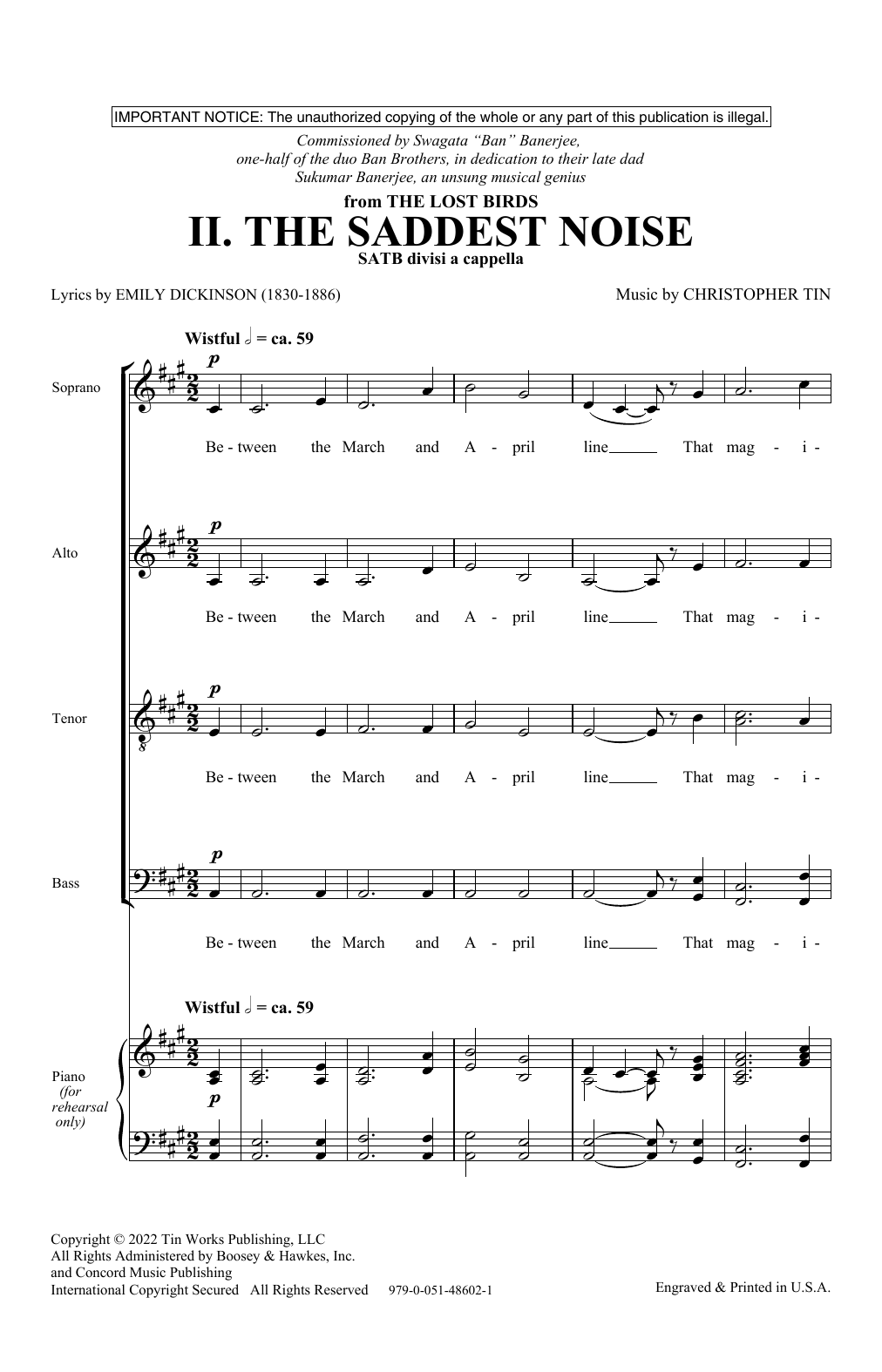
The Saddest Noise (Movement II from The Lost Birds) Sheet Music Preview

The Saddest Noise (Movement II from The Lost Birds): SATB Divisi Choral Octavo

By Christopher Tin / By Emily Dickinson

Item: 35-DS01114877

Digital Download
$2.99
Description

The Saddest Noise (Movement II from The Lost Birds): SATB Divisi Choral Octavo isn't in MakeMusic Cloud just yet...but it could be. Let us know you'd like to see it, and you'll help shape what comes next. In the meantime, start a free trial and dive into thousands of interactive titles your students can play along with today.

Sample Audio
No sample audio found.
Sample Video
Additional Details
Publisher: Hal Leonard
Page Count: 14
SKU: 35-DS01114877

More about this title

About the Composer: Christopher Tin

Christopher Tin

Christopher Tin's compositional voice draws from a richly layered background: born in California to Chinese immigrants, educated at Stanford and Oxford, then trained at London's Royal College of Music under some of Britain's most rigorous standards. His Grammy-winning work across film, television, video games, and concert music reveals an artist fluent in melody and orchestration, equally at home with large ensemble writing and intimate chamber textures. His music has reached audiences from the Hollywood Bowl to amateur choirs worldwide, always marked by dramatic clarity and melodic generosity.

Tin's training in composition, conducting, and English literature converged in his breakthrough album Calling All Dawns, which earned two Grammy Awards including Best Classical Crossover Album. He holds a Fulbright Scholarship and an MMus with Distinction from the Royal College of Music, graduating top of his class and winning the Horovitz Composition Prize. Beyond concert works, his scoring for major films, video games like Civilization IV, and international advertising campaigns has established him as one of contemporary music's most versatile voices.

Why we love this

Tin sets a Dickinson poem to music with remarkable restraint, letting the text breathe while creating harmonic movement that feels inevitable rather than imposed. The divisi writing unlocks textural possibilities without becoming cumbersome, giving singers chances to experience four-part counterpoint naturally. Programming this movement from The Lost Birds gives your concert a moment of genuine emotional weight without requiring soloists or orchestration.

What to expect

Melancholic without sentimentality; the harmonies move with quiet inevitability, creating moments of unexpected consonance that feel like relief. Dickinson's spare, devastating language meets music that mirrors her compression of thought, building intimacy rather than grandeur. The a cappella texture places every vertical sonority under a magnifying glass, making each chord change a small emotional event.

Who it's for

Choirs with solid part-singing skills and singers who can handle sustained, introspective material. The 14-page score and divisi writing suit ensembles large enough to split comfortably into eight parts, though doubling is possible with smaller groups. This works equally well for collegiate chamber choirs, advanced high school programs, and semi-professional singing groups.

How to get the most out of it

  • Balance the divided voices by listening inward rather than pushing outward; this piece's power comes from acoustic blending, not volume projection.
  • Anchor the harmonic motion with clear diction on Dickinson's most resonant words; the poem carries the structural logic alongside Tin's voice leading.
  • Allow rubato in places where the text creates natural pauses, but maintain underlying pulse integrity when multiple voice parts move simultaneously.

How to use it

Pair this as a concert closer or pre-intermission piece where its reflective mood can settle into the room; it also works effectively as part of a Dickinson-centered program with spoken interludes. The movement's length and emotional arc make it an ideal companion to other contemporary a cappella works, or as contrast within a program that moves between periods and styles. Consider programming it after more energetic repertoire to reset audience attention toward listening.

Skills your students will build

  • Sustaining harmonic independence within divisi SATB texture
  • Vocal expression of sparse, modernist poetry through precise diction
  • Maintaining ensemble blend across divided voice parts in a cappella setting
  • Reading and executing composer-notated divisi scoring
  • Controlling dynamic nuance across sustained vocal lines without vibrato excess

You May Also Like