

The Sacred Spheres: Bass Clarinet
By Tyler S. Grant
Grade: 5
Item: 98-PC-TGB026_BBC
$12.00
Pickup currently not available
Description
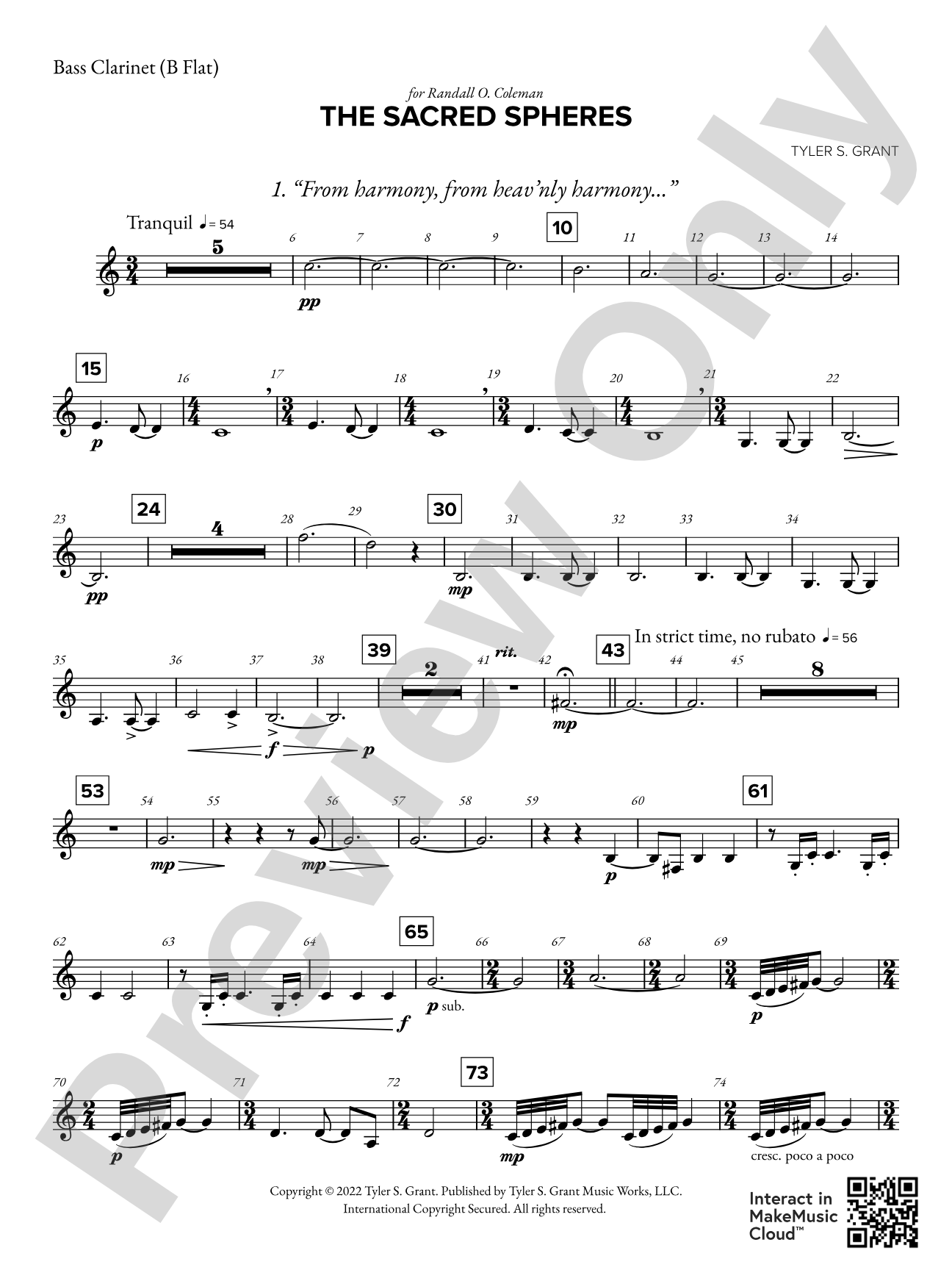
The Sacred Spheres by Tyler S. Grant is written in two contrasting movements. The title of the first movement, "From Harmony, from heav'nly harmony...," comes directly from the first line of John Dryden's poem, "A Song for St. Cecilia's Day." The first few notes musically depict the beginning of the "universal framework" described in the text through delicate textures and orchestrations that develop as the movement progresses. The second stanza of the poem highlights the capacity for musical elements to inspire passion, which is represented at the climax of the first movement.
The second movement, "Cries, hark the foe comes," picks up the poem from the third stanza, highlighting the spectrum of emotions that can be summoned by various instruments. The beginning of the movement highlights the "trumpet's loud clangor" along with drums that inspire war and conflict. The movement transitions to a section of mourning through the sound of a "warbling" flute. The ending of the movement combines the final stanzas along with the Grand Chorus to recapitulate earlier material and create a celebratory and impactful finale.
Commissioned by a consortium of bands in honor of Randall O. Coleman; Recorded by the Kennesaw State University Wind Ensemble.


The second movement, "Cries, hark the foe comes," picks up the poem from the third stanza, highlighting the spectrum of emotions that can be summoned by various instruments. The beginning of the movement highlights the "trumpet's loud clangor" along with drums that inspire war and conflict. The movement transitions to a section of mourning through the sound of a "warbling" flute. The ending of the movement combines the final stanzas along with the Grand Chorus to recapitulate earlier material and create a celebratory and impactful finale.
Commissioned by a consortium of bands in honor of Randall O. Coleman; Recorded by the Kennesaw State University Wind Ensemble.
The Sacred Spheres: Bass Clarinet isn't in MakeMusic Cloud just yet...but it could be. Let us know you'd like to see it, and you'll help shape what comes next. In the meantime, start a free trial and dive into thousands of interactive titles your students can play along with today.
Request This Title
Tell us you want it.
Start Your Free Trial
Explore everything that's ready to play right now.
Sample Audio
1
Audio File
--:--
0:00
0:00
Sample Video
No sample videos found.
Additional Details
Series:
Tyler S. Grant Music Works
Publisher:
Tyler S. Grant Music Works, LLC.
SKU:
98-PC-TGB026_BBC
More about this title
About the Composer: Tyler S. Grant

Tyler S. Grant has built a reputation as a composer and arranger whose works appear regularly on honor ensemble programs and annual repertoire lists across North America and internationally. His commissions and publications have expanded steadily since 2010, with performances at prestigious venues including Carnegie Hall, The Midwest Clinic, and the Meyerson Symphony Center. He studied instrumental music education and conducting at the University of Alabama under Randall Coleman, whose mentorship proved formative to his development as a composer.
Beyond composition, Grant maintains an active conducting and clinician schedule, having worked with over 100 school programs across more than 15 states. His compositions for bands and orchestras span all ability levels, and his work Panoramic Fanfare won the Dallas Wind Symphony's 2014 Call for Fanfares Competition. He has also contributed educational content to Alfred Music's Sound Innovations series and shared insights through podcasts and publications including School Band & Orchestra Magazine and The Instrumentalist.
Why we love this
Grant's gift for narrative orchestration shines here: he lets Dryden's poem drive the musical architecture, creating two distinct movements that reward careful listening without sacrificing engagement. The programmatic approach gives conductors a natural interpretive lens, and the contrast between movements (ethereal textures to war-inspired fanfares to mourning to celebration) holds an audience's attention while remaining musically substantial at Grade 5.
What to expect
The opening unfolds like watching cosmic order emerge from silence, delicate and deliberate. Then the second movement jolts you awake with trumpet calls and percussion, shifts into genuine sorrow, and builds toward a triumphant, earned resolution that feels both celebratory and reflective.
Who it's for
Concert bands at the Grade 5 level seeking programmatic repertoire with substance. This works especially well for groups ready to tackle literary connections and contrasting musical characters, and for programs featuring festival or contest performance.
How to get the most out of it
- Shape the opening movement's delicate textures carefully; the initial 'universal framework' needs clarity and restraint before it builds, so avoid pushing dynamics too soon.
- Balance the trumpet's 'loud clangor' in the second movement against surrounding voices so the fanfare cuts through without overwhelming the ensemble's ability to respond dynamically later.
- Mark the transition to the mourning section distinctly in rehearsal; the shift from percussive conflict to the warbling flute requires a genuine change in ensemble character and articulation.
- Bring out the recapitulation and Grand Chorus finale with full commitment; this material rewards clear conducting and a unified ensemble sound to land the celebratory impact.
How to use it
Program this as a contest or festival centerpiece, or use it as the anchor of a concert that explores connections between poetry and instrumental music. The two-movement structure and thematic breadth make it a compelling program closer that demonstrates ensemble growth and sophistication without requiring extreme technical demands.
Skills your students will build
- Balance and blend across contrasting orchestrations (delicate textures to bold brass passages)
- Dynamic and stylistic contrast between connected movements
- Ensemble response to programmatic context and poetic imagery
- Intonation and tone control at soft dynamics and in transparent textures
- Articulation variation to depict specific instruments mentioned in the text (trumpet, flute, drums)