
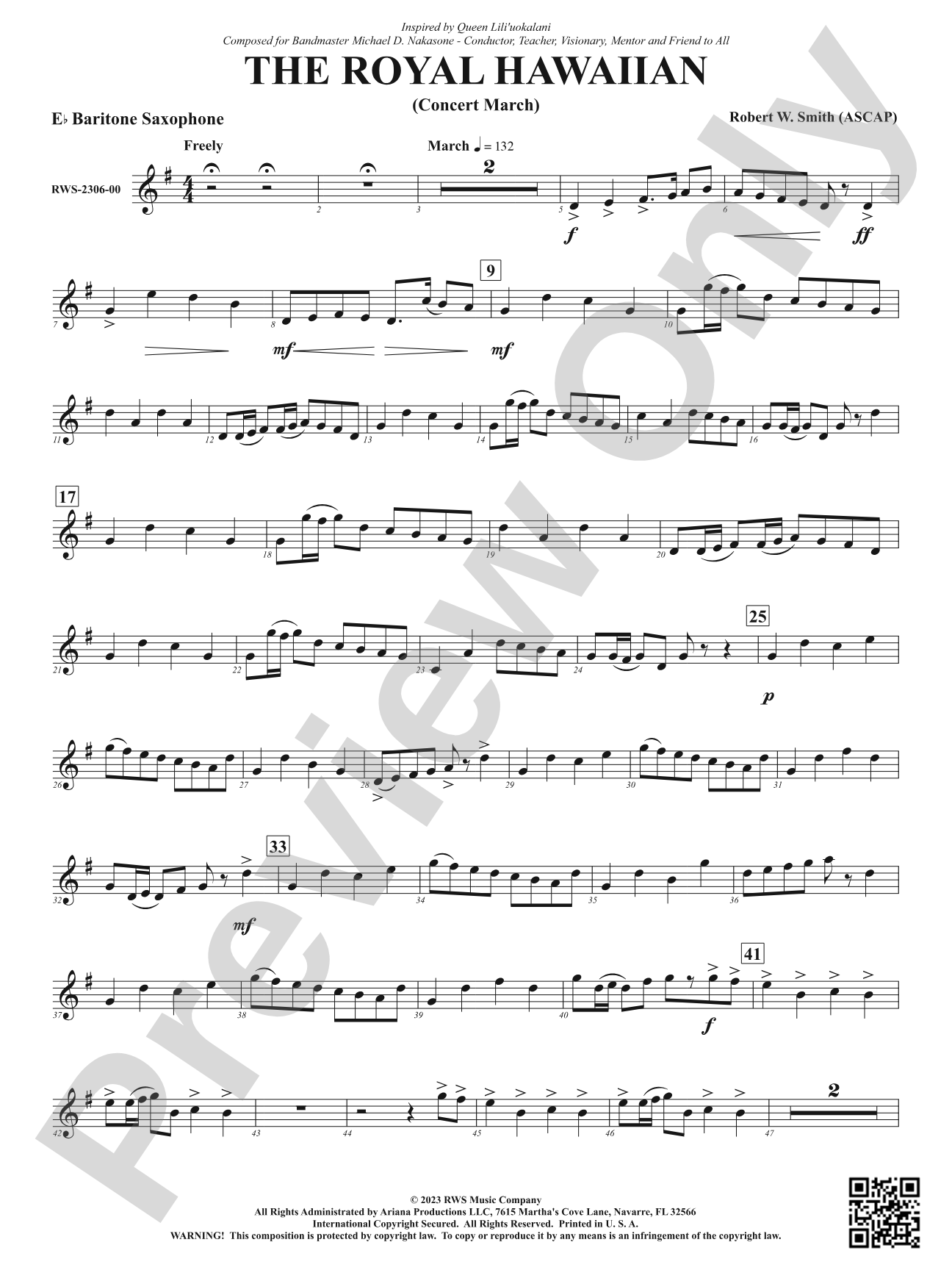

The Royal Hawaiian - Concert March: E-flat Baritone Saxophone
Concert March
By Robert W. Smith
Grade: 4
Item: 98-PC-RWS2306_BTX
$3.99
Pickup currently not available
Description
A march composed in a classic American style, The Royal Hawaiian is based on the famous "Aloha Oe" composed by Queen Lili'uokalani in 1878. Featuring American military percussion as well as traditional Hawaiian instruments including optional conch shell, the blend of musical textures creates an unusual yet familiar march setting. If Sousa had surfed, we believe this is what he would have heard!
Original Item#: RWS-2306-00


Original Item#: RWS-2306-00
The Royal Hawaiian - Concert March: E-flat Baritone Saxophone isn't in MakeMusic Cloud just yet...but it could be. Let us know you'd like to see it, and you'll help shape what comes next. In the meantime, start a free trial and dive into thousands of interactive titles your students can play along with today.
Request This Title
Tell us you want it.
Start Your Free Trial
Explore everything that's ready to play right now.
Sample Audio
1
Audio File
--:--
0:00
0:00
Sample Video
No sample videos found.
Additional Details
Series:
RWS - Symphony Band
Publisher:
RWS Music Company
SKU:
98-PC-RWS2306_BTX
More about this title
About the Composer: Robert W. Smith

Robert W. Smith has established himself as a defining voice in American concert band and orchestral composition. With more than 400 published works to his credit, he has created an extensive catalog that serves ensembles at all levels, from developing groups to professional orchestras. His education at Troy State University and the University of Miami provided the foundation for a compositional voice that balances accessibility with artistic depth.
Smith's works have traveled far beyond the rehearsal hall. His symphonies, including The Divine Comedy and The Odyssey, have resonated with musicians and audiences across North America, Europe, Australia, and Asia. His concert band scores have become standard repertoire in schools worldwide, while his arrangements and compositions have graced television broadcasts, state ceremonies, the Olympic Games, and the Macy's Thanksgiving Day Parade. As both composer and clinician, he continues to shape the landscape of American band music through his relentless output and his work with ensembles across the United States, Canada, and internationally.
Why we love this
Smith channels the architectural confidence of classic American march writing while honoring Queen Lili'uokalani's melodic gift. The integration of military percussion alongside conch shell and traditional Hawaiian sounds creates a sonic palette that feels both unexpected and emotionally coherent, giving your band a piece that entertains and intrigues audiences in equal measure. At Grade 4, the writing demands precision and blend without overwhelming developing sections.
What to expect
The Royal Hawaiian moves with the measured confidence of a Sousa march, yet its heart belongs to the islands. Hawaiian melody surfaces above driving percussion, creating an almost cinematic quality, as though a traditional military pageant has discovered the ocean and found something worth celebrating.
Who it's for
Conductors leading Grade 4 concert bands who want a piece that bridges American band tradition with world music awareness. This work appeals to ensembles ready for solid technical demands and audiences who respond to repertoire with genuine cultural substance and a touch of novelty.
How to get the most out of it
- Balance the march's steady rhythmic foundation with the flowing Hawaiian melody line; the percussion texture should anchor rather than overwhelm the upper voices.
- If you include the optional conch shell part, rehearse the timing separately first so players understand when their moment arrives within the fuller march texture.
- Shape the piece with the understanding that it celebrates two distinct musical traditions; let the transitions between march character and Hawaiian song-like passages breathe naturally.
- Pay attention to articulation consistency in the woodwind section, especially in unison passages, to maintain the crisp military march aesthetic alongside the legit Hawaiian elements.
How to use it
Program this as a concert opener that immediately signals your band's range and sophistication, or use it to anchor a concert theme exploring American musical geography and cultural intersections. The piece works equally well in a patriotic context, a spring concert, or any program where you want to demonstrate ensemble maturity while offering audiences something genuinely memorable.
Skills your students will build
- Precise articulation and rhythmic control in march idioms
- Balance between rhythmic foundation and lyrical melody
- Ensemble blend when combining contrasting musical textures
- Sectional independence and awareness of orchestration color
- Expressive phrasing across both military and Hawaiian musical styles