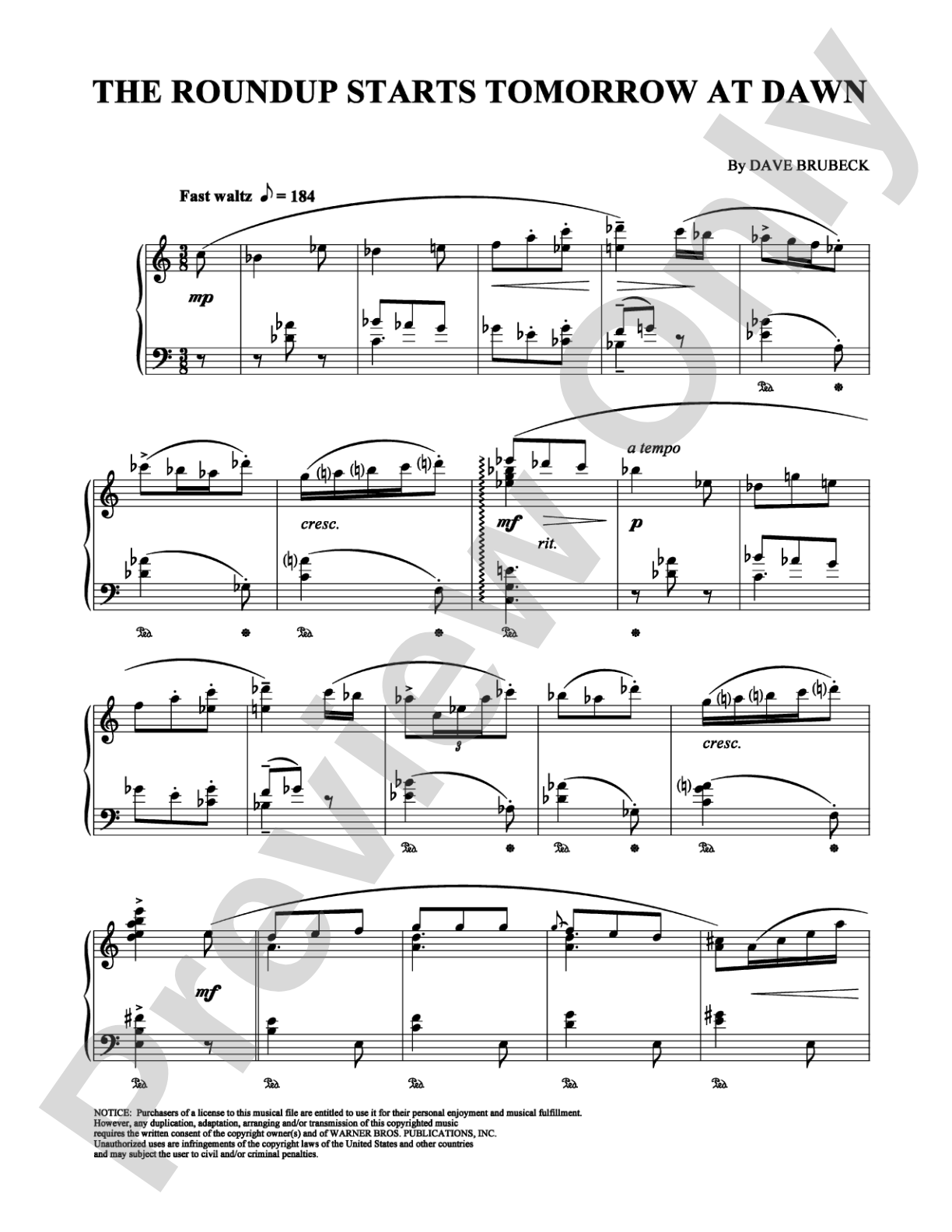
The Roundup Starts Tomorrow at Dawn: Piano Digital Sheet Music

The Roundup Starts Tomorrow at Dawn: Piano Digital Sheet Music

Dave Brubeck

Item: 00-PS-0003223

Digital Download
$3.99
Description

The Roundup Starts Tomorrow at Dawn: Piano Digital Sheet Music isn't in MakeMusic Cloud just yet...but it could be. Let us know you'd like to see it, and you'll help shape what comes next. In the meantime, start a free trial and dive into thousands of interactive titles your students can play along with today.

Sample Audio
No sample audio found.
Sample Video
Additional Details
SKU: 00-PS-0003223

More about this title

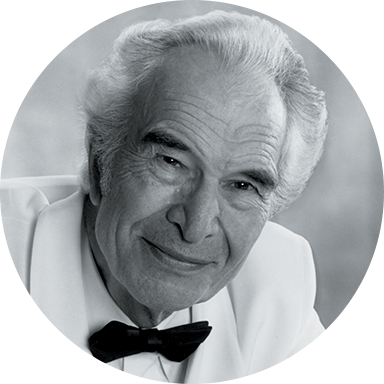
About the Artist: Dave Brubeck

Dave Brubeck

Dave Brubeck was a pianist and composer who moved fluidly between jazz improvisation and fully notated classical forms. His output spanned choral works, hymns, orchestral pieces, chamber music, ballet suites, and large-scale works for chorus and orchestra, alongside his iconic jazz recordings. He studied with Darius Milhaud after World War II, and Milhaud's encouragement to synthesize jazz language with classical technique became central to Brubeck's artistic identity.

Brubeck's cultural impact extended far beyond music. He helped break racial barriers in mid-century America and received the Presidential Medal of the Arts from President Clinton, a Grammy Lifetime Achievement Award, and election to the American Classical Music Hall of Fame in 2003. His album Time Out became the first jazz album to sell over a million copies, and works like To Hope! and Pange Lingua Variations have been performed and recorded by major orchestras and choirs worldwide.

Why we love this

Brubeck's jazz compositions reward pianists who understand both swing language and harmonic sophistication. This piece captures his gift for writing melodies that sing naturally while sitting on chords that demand real touch and voicing control. It's the kind of tune that feels accessible on first read but reveals new layers with each rehearsal.

What to expect

Warm and unhurried, with the landscape imagery of its title unfolding across gentle harmonies. The tune has a reflective quality that invites the player into a conversational kind of playing, where precision serves the song rather than dominating it.

Who it's for

Jazz pianists developing their harmonic vocabulary and improvisational confidence. This piece works for intermediate to advanced students who grasp swing rhythm and want to explore how Brubeck blends accessible melodies with substantial harmonic content. It also suits recital pianists looking to expand beyond classical repertoire.

How to get the most out of it

  • Listen closely to recordings of Brubeck's own interpretations to understand how he voices chords and phrases across the keyboard. His touch shapes the melody as much as the harmony.
  • Pay attention to rhythmic placement within the swing feel. Brubeck rarely plays metronomically. Let the melody breathe slightly ahead of or behind the beat for natural phrasing.
  • Build the left hand independently before combining hands. The accompaniment pattern needs to groove with certainty so the right hand can float over it.

How to use it

Feature this in a jazz-focused concert or recital where you're mixing classical and jazz traditions. It pairs well alongside other Brubeck compositions or in a program exploring American songwriting and improvisation. The piece also works as a stylistic bridge piece, showing audiences how jazz vocabulary coexists with compositional craft.

Skills your students will build

  • Swing rhythm and relaxed phrasing in jazz context
  • Voicing clusters and extensions in the left hand
  • Balancing melody and accompaniment independence
  • Reading and interpreting jazz articulation and dynamics

You May Also Like