
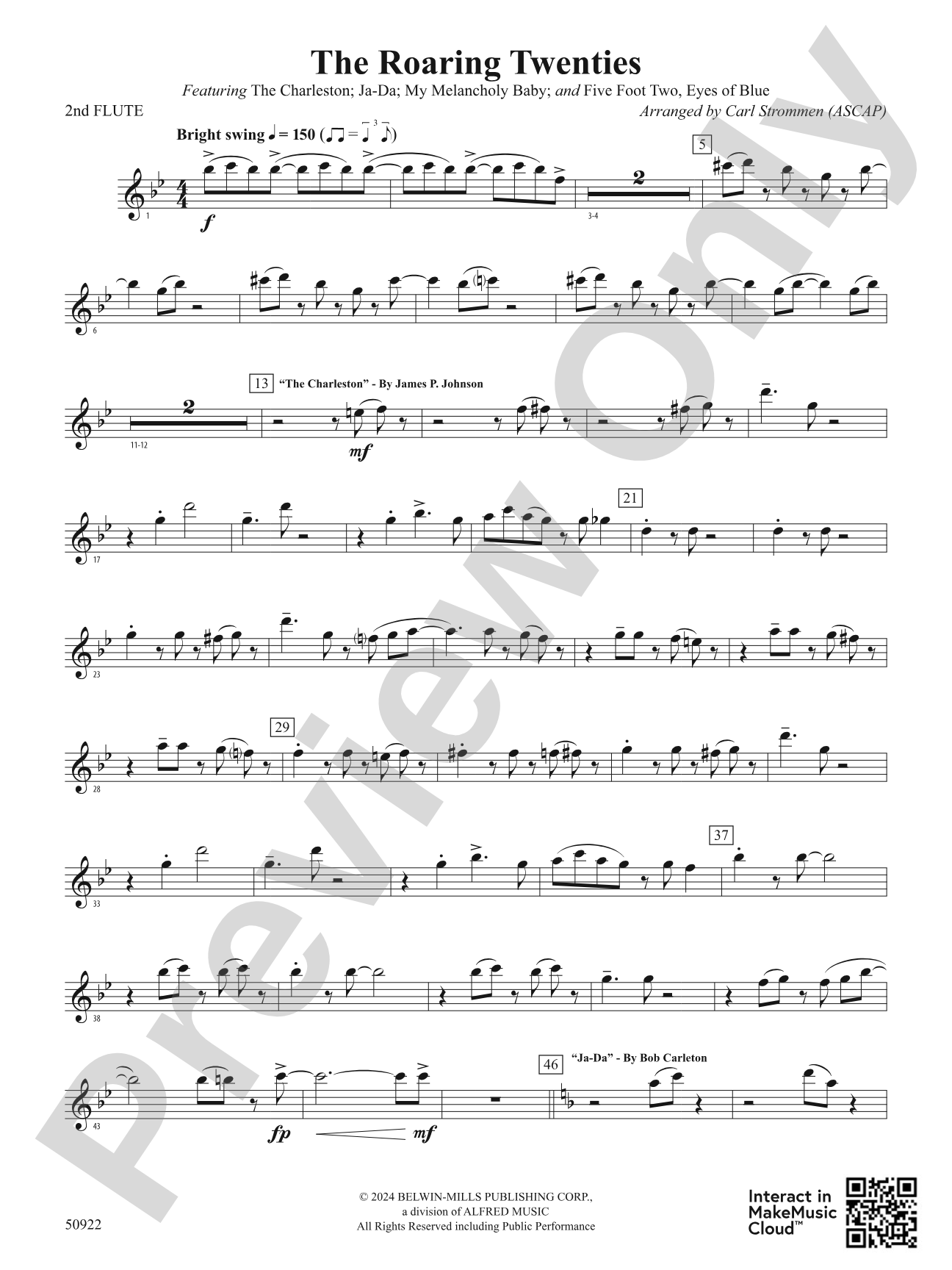

The Roaring Twenties: 2nd Flute
Featuring: The Charleston / Ja-Da / My Melancholy Baby / Five Foot Two
Arranged by Carl Strommen
Grade: 3.5
Item: 00-PC-0019316_F2
$3.00
Pickup currently not available
Description
The Roaring Twenties by veteran arranger Carl Strommen features popular songs of the 1920s. The spirit of optimism is exemplified by upbeat tunes like "The Charleston," "Ja-Da," and "Five Foot Two, Eyes of Blue," while the soulful ballad "My Melancholy Baby" provides a beautiful contrast. Your students will love learning about the music of this era and performing this swinging chart! (5:15)


Don't just read it, hear it, play along with it, and watch your students grow with it. In MakeMusic Cloud, The Roaring Twenties: 2nd Flute comes alive with professional accompaniment, adjustable tempo, and built-in practice tools that turn solo practice into real progress.
Open in the Player
Jump straight in and assign it today.
Start Your Free Trial
Open this title and explore the full library in minutes.
Sample Audio
1
Audio File
--:--
0:00
0:00
Sample Video
Additional Details
Series:
Belwin Concert Band
Publisher:
Alfred Music
SKU:
00-PC-0019316_F2
More about this title
About the Composer: Carl Strommen

Carl Strommen stands among the most frequently performed composer-arrangers working across concert band, orchestra, jazz ensemble, and vocal contexts today. His music regularly reaches audiences through concert halls, television broadcasts, and film scores, and he maintains an active schedule as both a clinician and commissioned composer. Strommen's consistent output has earned him the annual ASCAP Standard Writers Award throughout his career.
A graduate of City College of New York, Strommen has remained connected to academic music through an adjunct teaching position in orchestration and composition at the C.W. Post Campus of Long Island University in Brookville, New York. He divides his time between Long Island and Colorado with his family.
Why we love this
Strommen's arrangement captures the authentic swing and energy of 1920s popular music without oversimplifying the parts for a 3.5-level band. The pairing of familiar upbeat numbers with a genuine ballad creates programming momentum and gives your ensemble real interpretive territory to explore. Students at this level rarely encounter period-specific jazz language executed with this much musical integrity.
What to expect
The optimism and forward motion of the 1920s permeates this work. Upbeat tunes sparkle with syncopation and period-specific jazz idioms, creating an irresistible energy, while 'My Melancholy Baby' slows the pace to reveal the emotional depth beneath the era's surface exuberance. The contrasts between numbers give the piece shape and narrative.
Who it's for
Bands at the Grade 3.5 level who are ready to engage with jazz language and jazz-inflected concert literature. This works especially well for groups strong enough to handle light swing feels and small-ensemble textures within a full band setting, and for ensembles whose directors want to teach musical history through active performance.
How to get the most out of it
- Balance the ensemble so the melody soloists in 'The Charleston' and 'Ja-Da' cut through without the band overwhelming them; this is small combo spirit, not a march.
- Approach 'My Melancholy Baby' with genuine rubato and phrase shaping rather than metronomic precision; let the sections breathe and respond to the lyrical intent.
- Lock the clarinet and saxophone sections together on the syncopated rhythms throughout; these lines need the precision of a jazz section, not concert band detachment.
- Treat the 1920s idiom as a legitimate musical vocabulary rather than novelty material; the style demands clean articulation and jazz inflection from every player.
How to use it
This arrangement sits perfectly in a concert celebrating American musical styles or the Great American Songbook, especially if you pair it with either earlier American dances or later jazz standards. The 5:15 duration and engaging subject matter make it an ideal opener or closer for a family concert or informal performance. It also works well as a bridge piece in a program that spans multiple decades of American music.
Skills your students will build
- Jazz articulation and phrasing (tonguing, swing inflection, note shaping)
- Small ensemble balance and sectional independence within a full band context
- Syncopated rhythm reading specific to 1920s jazz idioms
- Stylistic flexibility (contrast between swinging uptempo passages and lyrical ballad playing)
- Rubato and expressive phrasing in ballad sections