
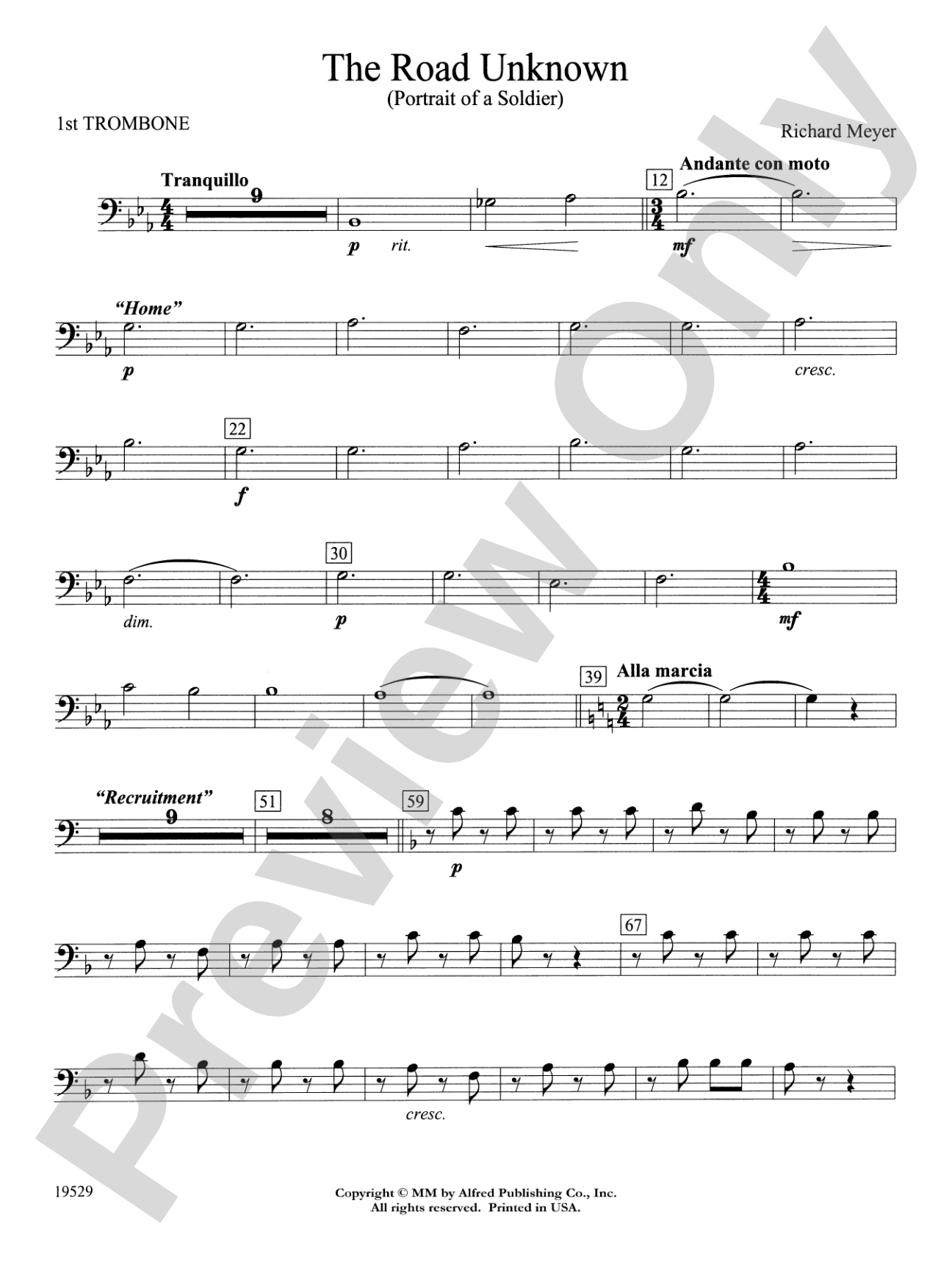

The Road Unknown: 1st Trombone
By Richard Meyer
Grade: 2 (Medium Easy)
Item: 00-PC-0000328_TN1
$3.00
Pickup currently not available
Description
Deriving its subtitle from a Civil War poem by Walt Whitman, this original tone poem by Richard Meyer is full of emotion and energy. The work is divided into four sections entitled "Home," "Recruitment," "Departure," and "Into Battle." It begins with a recurring theme introduced by solo trumpet that represents a young man. This segues into the next theme, which features George Roots's stirring "Battle Cry of Freedom." Flutes and drums are widely used to convey a strong feeling of patriotism. The Road Unknown is a thoughtful, well-written work that is sure to stand out at your next concert!


Don't just read it, hear it, play along with it, and watch your students grow with it. In MakeMusic Cloud, The Road Unknown: 1st Trombone comes alive with professional accompaniment, adjustable tempo, and built-in practice tools that turn solo practice into real progress.
Open in the Player
Jump straight in and assign it today.
Start Your Free Trial
Open this title and explore the full library in minutes.
Sample Audio
1
Audio File
--:--
0:00
0:00
Sample Video
No sample videos found.
Additional Details
Series:
Young Symphonic
Publisher:
Alfred Music
Page Count:
258
SKU:
00-PC-0000328_TN1
More about this title
About the Composer: Richard Meyer

Richard Meyer brings three decades of string education expertise into his work as a composer and conductor. He spent 22 years building the orchestra program at Oak Avenue Intermediate School in Temple City, California, expanding it from 29 students to 200, and directed the Pasadena Youth Symphony Orchestra for 16 years, leading ensembles on international tours to Vienna, Australia, and Canada. Beyond the podium, Meyer created the "Giving Bach" program, which uses interactive concerts to reach special needs and underserved students across Southern California.
As a composer, Meyer has established himself as a nationally recognized voice with over 190 published compositions and arrangements. He served 16 years as string editor for Alfred Publishing Company and co-authored the String Explorer Series and Sight-read It for Strings. Meyer remains active as a guest conductor and clinician, sharing his pedagogical philosophy at the A.S.T.A. National Conference, state orchestra director associations, and university workshops.
Why we love this
Meyer writes with the voice of someone who has spent decades in the rehearsal room and understands exactly what concert bands at this level can accomplish. The emotional architecture of this piece works because it's built on authentic thematic material (including the Civil War-era "Battle Cry of Freedom") and clear sectional storytelling, giving students something substantial to invest in musically without overwhelming them technically. The Grade 2 scoring is genuinely accessible while the narrative arc ensures an audience stays engaged from the opening trumpet solo through the final battle sequences.
What to expect
The Road Unknown unfolds like a young man's journey, beginning with quiet hope and homesickness before building into the urgent patriotic fervor of recruitment and departure. Whitman's influence runs through the emotional undercurrents; this isn't flag-waving spectacle but rather a thoughtful meditation on conflict, loss, and courage. By the time you reach the final section, the accumulated emotional resonance of the earlier themes creates genuine power.
Who it's for
This work sits squarely in the sweet spot for bands that have moved past fundamentals but aren't yet ready for advanced Grade 3 repertoire. Directors programming Grade 2 festival or contest seasons will find a piece that carries genuine musical substance without excessive technical demands, giving students room to focus on interpretation and ensemble blend. It's equally effective for summer concerts or patriotic programming where you need something meaningful rather than purely entertaining.
How to get the most out of it
- Shape the solo trumpet theme in the opening section with long, singing phrases; this melody carries the emotional weight of the entire work and sets the tone for everything that follows.
- Balance the incorporation of "Battle Cry of Freedom" so the familiar melody stands out clearly while surrounding voices provide supportive harmony without drowning it out.
- Use the drum writing to anchor transitions between sections; the percussion patterns are integral to the pacing and help actors tell the story through rhythm and color.
- Attend to dynamic contrast between "Home" and "Into Battle" so the later sections feel like genuine escalation rather than repetition of earlier material.
How to use it
Program this as a centerpiece for a summer pops concert celebrating American repertoire and history, or anchor a patriotic program around it. It works beautifully on festival dates where you're running competitive events and need a showcase piece that demonstrates musicianship and interpretation without requiring advanced technical facility. The four-movement structure also makes it a natural fit for educational concerts where you can highlight each section and discuss the compositional storytelling with the audience.
Skills your students will build
- Sustaining long phrases and managing phrasing across sectional transitions
- Balancing multi-textural writing with clear harmonic support underneath featured melodies
- Responding to dramatic dynamic shifts and tempo changes within a narrative framework
- Ensemble cohesion in patriotic and emotionally expressive contexts
- Stylistic accuracy with period material (Civil War-era thematic references)